Social Epidemiology Research Group, Health Service and Population Research Department, Institute of Psychiatry, Psychology & Neuroscience, King's College London, London, UK.
MRC Social, Genetic & Developmental Psychiatry Centre, Institute of Psychiatry, Psychology & Neuroscience, King's College London, London, UK.
Schizophr Bull. 2020 Jul 8;46(4):814-822. doi: 10.1093/schbul/sbaa005.
Stressful life events have been implicated in the onset of psychotic disorders, but there are few robust studies. We sought to examine the nature and magnitude of associations between adult life events and difficulties and first-episode psychoses, particularly focusing on contextual characteristics, including threat, intrusiveness, and independence.
This study forms part of the Childhood Adversity and Psychosis Study (CAPsy), an epidemiological case-control study in London, United Kingdom. Data on life events and difficulties (problems lasting 4 wk or more) during 1 year prior to onset (cases) or interview (controls) were assessed using the semi-structured Life Events and Difficulties Schedule (LEDS). Data were available on 253 individuals with a first episode of psychosis and 301 population-based controls.
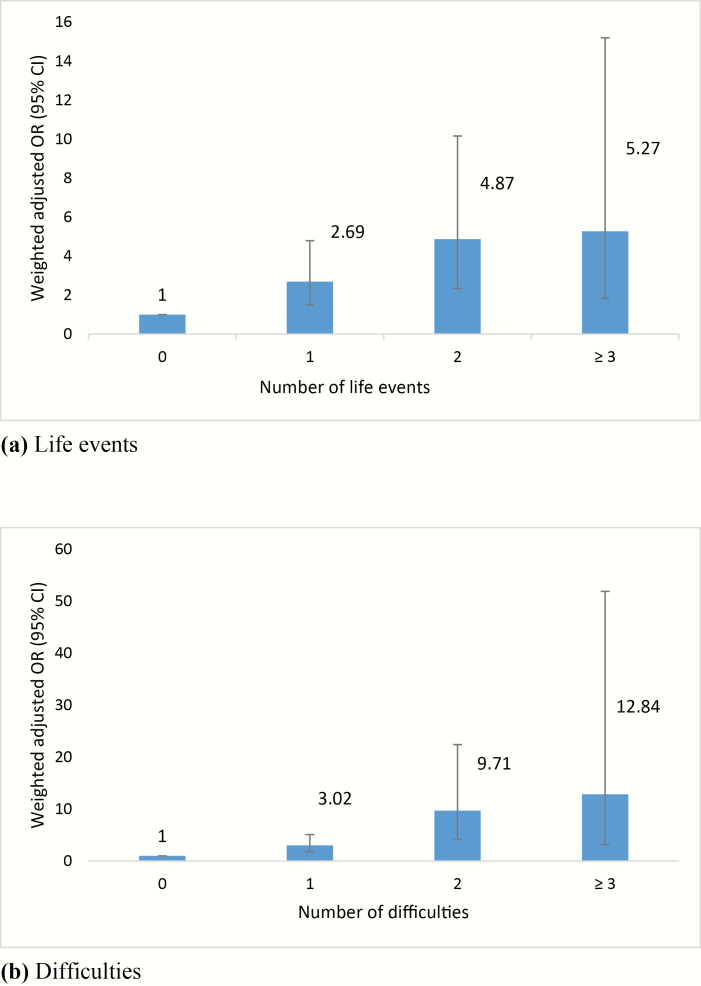
We found strong evidence that odds of exposure to threatening and intrusive events in the 1 year prior to onset were substantially higher among cases compared with controls, independent of age, gender, ethnicity, and social class (ORs > 3). This was consistent across diagnostic categories. We found further evidence that the effect of threatening events and difficulties was cumulative (1 event odds ratio [OR] 2.69 [95% confidence interval (CI) 1.51-4.79]; 2 events OR 4.87 [95% CI 2.34-10.16]; ≥3 events OR 5.27 [95% CI 1.83-15.19]; 1 difficulty OR 3.02 [95% CI 1.79-5.09]; 2 difficulties OR 9.71 [95% CI 4.20-22.40]; ≥3 difficulties OR 12.84 [95% CI 3.18-51.85]).
Threatening and intrusive life events and difficulties are common in the year pre-onset among individuals with a first episode of psychosis. Such experiences may contribute to the development of psychotic disorders.
有研究表明,生活应激事件与精神分裂症的发病有关,但目前仍缺乏强有力的研究证据。本研究旨在探讨成人生活事件和困难与首发精神病之间的性质和关联程度,尤其关注包括威胁性、侵入性和独立性在内的情境特征。
本研究是英国伦敦儿童逆境与精神病研究(CAPsy)的一部分,该研究是一项在首发精神病患者和普通人群中开展的病例对照研究。采用半结构式生活事件和困难量表(LEDS)评估发病前 1 年(病例组)或访谈时(对照组)的生活事件和困难(持续 4 周或以上的问题)数据。共纳入 253 例首发精神病患者和 301 名普通人群对照。
我们发现,与对照组相比,发病前 1 年经历过威胁性和侵入性事件的病例组,其暴露风险显著更高,这一结果独立于年龄、性别、种族和社会阶层(比值比>3)。在不同的诊断类别中,这一结果具有一致性。我们进一步发现,威胁性事件和困难的影响具有累积性(1 次事件比值比[OR]2.69[95%置信区间[CI]1.51-4.79];2 次事件 OR 4.87[95% CI 2.34-10.16];≥3 次事件 OR 5.27[95% CI 1.83-15.19];1 次困难 OR 3.02[95% CI 1.79-5.09];2 次困难 OR 9.71[95% CI 4.20-22.40];≥3 次困难 OR 12.84[95% CI 3.18-51.85])。
在首发精神病患者发病前 1 年中,经历过威胁性和侵入性的生活事件和困难较为常见。这些经历可能与精神病的发生有关。