Soetisna Tri Wisesa, Sukmawan Renan, Setianto Budhi, Mansyur Muchtaruddin, Murni Tri Wahyu, Listiyaningsih Erlin, Santoso Anwar
Department of Cardiothoracic and Vascular Surgery, National Cardiovascular Center Harapan Kita, Jakarta, Indonesia.
Department of Surgery, Faculty of Medicine, Universitas Indonesia, Jakarta, Indonesia.
J Card Surg. 2020 Apr;35(4):740-746. doi: 10.1111/jocs.14454. Epub 2020 Feb 12.
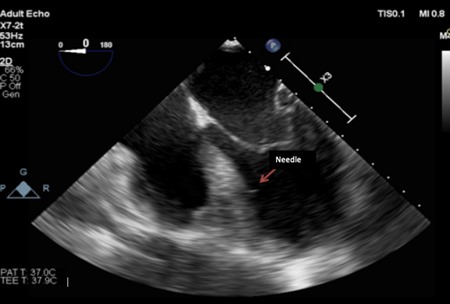
Autologous CD133+ bone marrow stem cells may improve cardiac function. This randomized, single-blind clinical trial inquired whether a combined transepicardial and transseptal implantation of CD133+ stem cells during coronary artery bypass grafting (CABG) improve cardiac function with ejection fraction (EF) changes as a primary endpoint in patients with low EF.
Thirty patients with coronary heart disease and EF <35% were randomized to undergo CABG alone or CABG with transseptal and transepicardial implantation of CD133+. Cardiac function was evaluated using cardiac magnetic resonance imaging (MRI) before and 6 months after CABG.
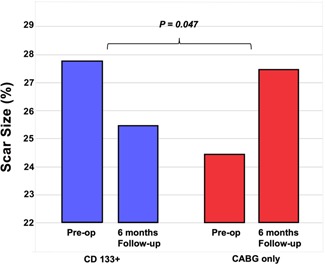
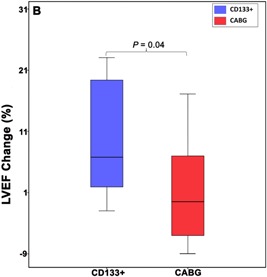
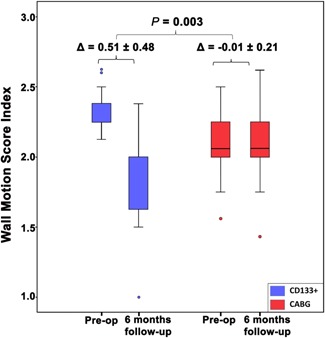
Preoperative EF was lower in the intervention group (25.88% ± 5.66%) than in the control group (30.18% ± 3.85%; P = .04). The adverse event incidence was similar between both groups. At 6 months, EF changes were significantly higher (8.69% ± 9.49; P = .04) in the CD133+ group than in the CABG-only group. Compared to the control group, significant improvements were seen in the wall motion score index (P = .003) and scar size proportion (P = .047) in the CD133+ group. The quality of life (QOL), assessed by a 6-minute walking test, showed considerable improvement in the CD133+ group compared to that in the control group (P = .03). The Minnesota Living with Heart Failure Questionnaire (MLHFQ) scale did not show improvement in the intervention group (P = .09, vs control).
Combined transepicardial and transseptal autologous CD133+ BMC implantation during bypass grafting improved cardiac function in low EF coronary artery disease patients.
自体CD133+骨髓干细胞可能改善心脏功能。这项随机、单盲临床试验探讨了在冠状动脉旁路移植术(CABG)期间经心外膜和经中隔联合植入CD133+干细胞是否能改善心脏功能,以射血分数(EF)变化作为低EF患者的主要终点。
30例冠心病且EF<35%的患者被随机分为单纯接受CABG或接受CABG并经中隔和心外膜植入CD133+。在CABG术前及术后6个月使用心脏磁共振成像(MRI)评估心脏功能。
干预组术前EF(25.88%±5.66%)低于对照组(30.18%±3.85%;P=0.04)。两组不良事件发生率相似。6个月时,CD133+组的EF变化(8.69%±9.49;P=0.04)显著高于单纯CABG组。与对照组相比,CD133+组的室壁运动评分指数(P=0.003)和瘢痕大小比例(P=0.047)有显著改善。通过6分钟步行试验评估的生活质量(QOL)显示,CD133+组与对照组相比有显著改善(P=0.03)。明尼苏达心力衰竭生活问卷(MLHFQ)量表在干预组未显示改善(P=0.09,与对照组相比)。
在旁路移植术中经心外膜和经中隔联合植入自体CD133+骨髓细胞可改善低EF冠心病患者的心脏功能。