Universidade de São Paulo, Faculdade de Odontologia de Ribeirão Preto, Departamento de Odontologia Restauradora, Ribeirão Preto, São Paulo, Brasil.
University of Leuven, Faculty of Medicine, Departament of Imaging and Pathology, OMFS IMPATH Research Group, Leuven, Belgium.
J Appl Oral Sci. 2020 Feb 7;28:e20190393. doi: 10.1590/1678-7757-2019-0393. eCollection 2020.
This study assessed the incidence and variability features of root canals system (RCS) and their ramifications according to Pucci & Reig (PR) (1944) and the American Association of Endodontists (AAE) (2017) by micro-computed tomography (μCT).
500 representative extracted human teeth of each tooth group (n=50) (maxillary/mandibular central and lateral incisors, canines, first and second premolars and molars) were scanned by μCT with a resolution of 26.70 μm. The reconstructed cross-sections images and the visualization of the continuous slices in the transversal axis were performed using DataViewer software. RCS were classified according to Pucci & Reig (main canal, collateral canal, lateral canal, secondary canal, accessory canal, intercanal, recurrent canal) and AAE (main canal, accessory canal, lateral canal). The apical deltas were assessed for both classifications. The prevalence of apical deltas was evaluated using the Chi-squared test (p<0.05).
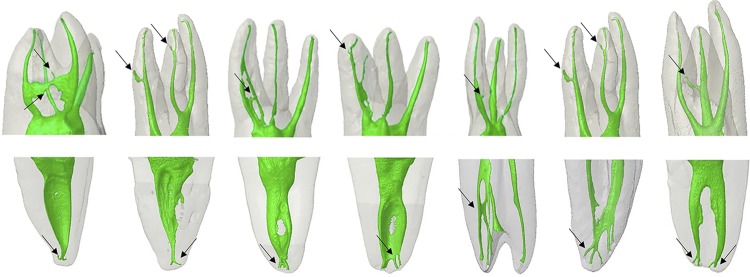
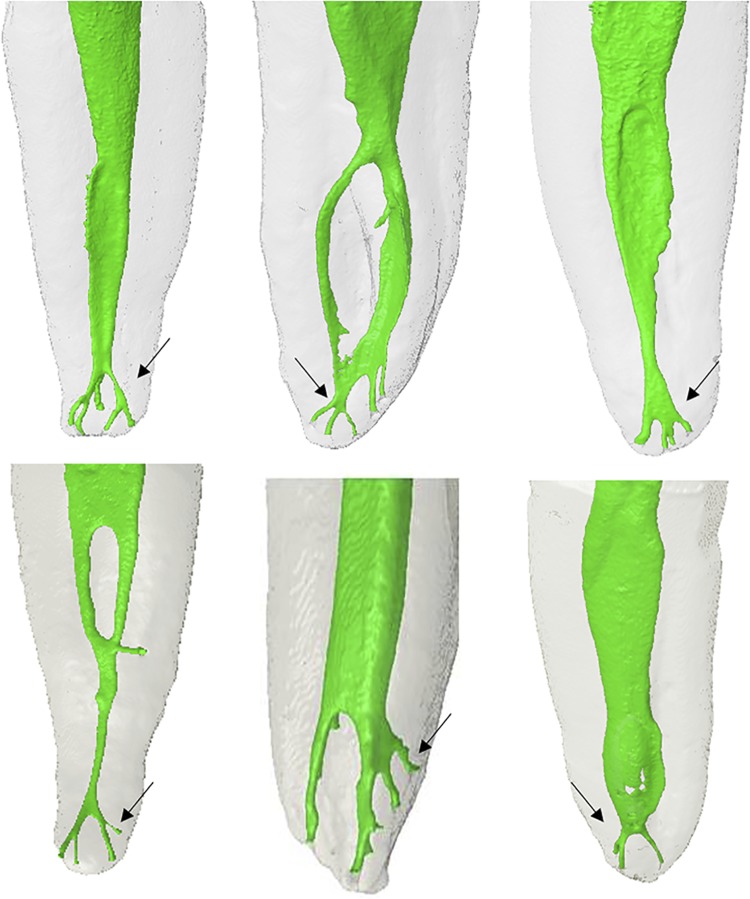
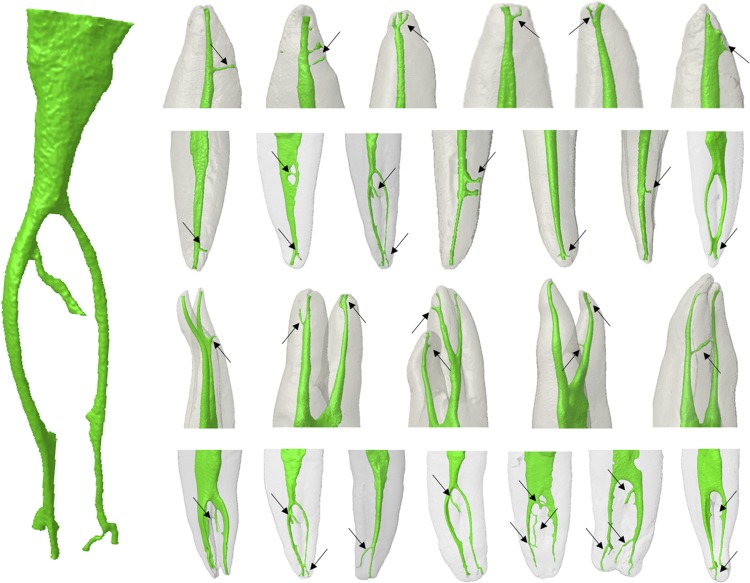
According to PR, a higher incidence of lateral canals was observed in maxillary canines (10%), central incisors (8%) and first premolars (6%). Using AAE, the highest incidence of lateral canals was observed in the mandibular first premolars (85%), first and second molars (84%), lateral incisors (67%), canines (59%), and in maxillary first premolars (52%). Regarding accessory canals, the PR showed a frequency in 2% of the maxillary lateral incisors and maxillary and mandibular first premolars and 3% of mandibular first and second molars. On the other hand, the AAE showed the highest incidence of accessory canals in 86% of the maxillary first premolars, 71% in mandibular lateral incisors, 69% in mandibular first premolars, 65% in mandibular canines, and 56% in maxillary canines. The PR showed the lowest incidence of apical deltas for all dental groups when compared with AAE (p=0.004). Interestingly, distal canals in maxillary molars showed a significant discrepancy between classifications (p=0.027).
μCT enabled accurately describing the RC system and related ramifications, adding to the PR and AAE classifications, with some discrepancies reported for maxillary molars. Clinical Relevance This μCT study enabled a thorough description of the variability among root canals and their ramifications, including clinically relevant details on the presence and location of lateral canals and accessories in all human tooth groups, beyond the currently existing classification systems.
本研究通过微计算机断层扫描(μCT)评估 Pucci & Reig(PR)(1944 年)和美国牙髓病学会(AAE)(2017 年)根管系统(RCS)及其分支的发生率和变异性特征。
每组(上颌/下颌中切牙、侧切牙、尖牙、第一和第二前磨牙、磨牙)各随机抽取 50 颗有代表性的人离体牙(n=50),使用分辨率为 26.70 μm 的 μCT 进行扫描。使用 DataViewer 软件对重建的横截面图像和横轴上的连续切片进行可视化处理。根据 Pucci & Reig(主根管、侧副根管、侧根管、次根管、副根管、根管间、再通根管)和 AAE(主根管、副根管、侧根管)对 RCS 进行分类。评估两种分类的根尖差异。使用卡方检验(p<0.05)评估根尖差异的发生率。
根据 PR,上颌尖牙(10%)、中切牙(8%)和第一前磨牙(6%)的侧根管发生率较高。根据 AAE,下颌第一前磨牙(85%)、第一和第二磨牙(84%)、侧切牙(67%)、尖牙(59%)和上颌第一前磨牙(52%)的侧根管发生率最高。关于副根管,PR 在 2%的上颌侧切牙和上颌及下颌第一前磨牙以及 3%的下颌第一和第二磨牙中显示出频率。另一方面,AAE 显示上颌第一前磨牙的副根管发生率最高(86%),下颌侧切牙(71%)、下颌第一前磨牙(69%)、下颌尖牙(65%)和上颌尖牙(56%)。与 AAE 相比,PR 显示所有牙组的根尖差异发生率最低(p=0.004)。有趣的是,上颌磨牙的远中根管在两种分类之间存在显著差异(p=0.027)。
μCT 能够准确描述根管系统及其分支,与 PR 和 AAE 分类相比,增加了一些上颌磨牙的差异。
本 μCT 研究对根管及其分支的变异性进行了全面描述,包括在所有人类牙组中有关侧根管和副根管的临床相关细节,包括其存在和位置,超出了目前现有的分类系统。