Wen Lihong, Zhang Song, Wan Kunzhen, Zhang Hong, Zhang Xiaoyun
Hospital of Chengdu University of Traditional Chinese Medicine,Chengdu, Sichuan Province, P.R. China.
Medicine (Baltimore). 2020 Feb;99(7):e18995. doi: 10.1097/MD.0000000000018995.
To determine the risk factors related to hemorrhagic transformation in Chinese patients with acute ischemic stroke treated with intravenous thrombolysis.
Studies published in different languages were retrieved by systematically searching PubMed, EMBASE, Vip, CNKI, and WanFang Data from the establishment of the library to December 31, 2018, as well as manually examining the references of the original articles. The outcome measures of efficacy covered risk factors. Safety evaluation was measured by relative ratio of complications.
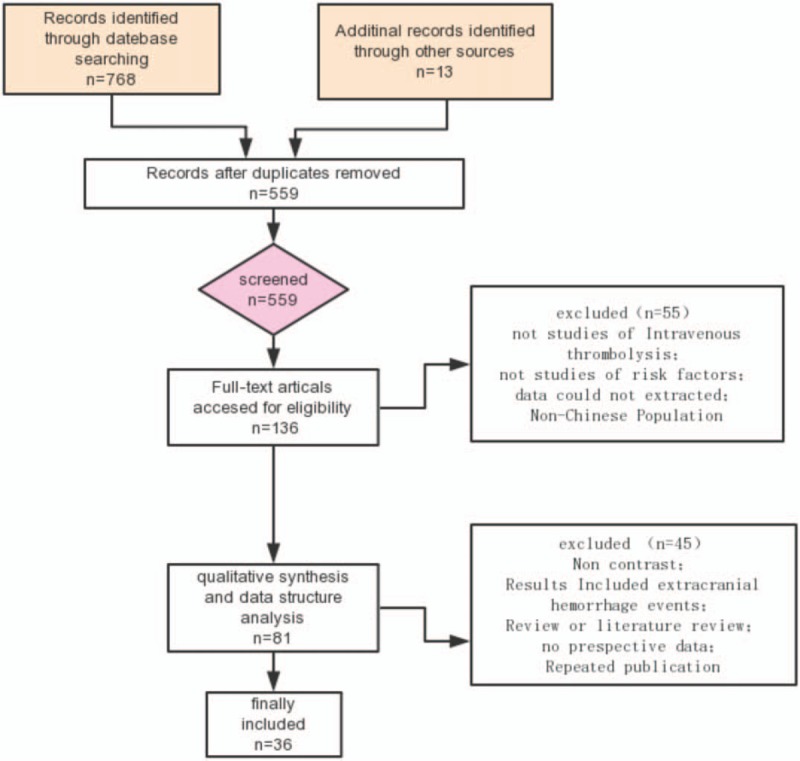
A total of 36 studies involving 5597 participants were covered in this meta-analysis. The results indicated that age [WMD = 2.44, 95% CI (1.39,3.48)], male [OR = 1.21, 95% CI (1.02, 1.44)], diabetes [OR = 2.05, 95%CI (1.72,2.44)], atrial fibrillation [OR = 2.85, 95%CI (2.40, 3.39)], previous stroke [OR = 1.8, 95%CI (1.33, 2.44)], onset to treatment time (OTT) [WMD = 3.74, 95%CI (2.91, 4.58)], National Institute of Health stroke scale scores (NIHSS) [WMD = 4.17, 95% CI (3.37, 4.97)], infarct size [WMD = 4.11, 95% CI (3.15, 5.37)], ischemic signs of computed tomography (CT) [OR = 3.49, 95%CI (2.47, 4.93)] were associated with increased risk of hemorrhagic transformation after intravenous thrombolysis.
The systematic review showed that male, age, diabetes, NIHSS, OTT, atrial fibrillation, post stroke, infarct size, and ischemic signs of CT were significantly correlated with hemorrhagic transformation (HT).
CRD42019127499.
确定接受静脉溶栓治疗的中国急性缺血性脑卒中患者发生出血性转化的相关危险因素。
通过系统检索PubMed、EMBASE、维普、中国知网和万方数据(从建库至2018年12月31日)以及人工查阅原始文章的参考文献,检索不同语言发表的研究。疗效的结局指标涵盖危险因素。安全性评估通过并发症的相对比值来衡量。
本荟萃分析共纳入36项研究,涉及5597名参与者。结果表明,年龄[加权均数差(WMD)=2.44,95%置信区间(CI)(1.39,3.48)]、男性[比值比(OR)=1.21,95%CI(1.02,1.44)]、糖尿病[OR=2.05,95%CI(1.72,2.44)]、心房颤动[OR=2.85,95%CI(2.40,3.39)]、既往卒中[OR=1.8,95%CI(1.33,2.44)]、发病至治疗时间(OTT)[WMD=3.74,95%CI(2.91,4.58)]、美国国立卫生研究院卒中量表评分(NIHSS)[WMD=4.17,95%CI(3.37,4.97)]、梗死灶大小[WMD=4.11,95%CI(3.15,5.37)]、计算机断层扫描(CT)的缺血征象[OR=3.49,95%CI(2.47,4.93)]与静脉溶栓后出血性转化风险增加相关。
系统评价表明,男性、年龄、糖尿病、NIHSS、OTT、心房颤动、卒中后、梗死灶大小和CT的缺血征象与出血性转化(HT)显著相关。
CRD42019127499。