Institute Reproductive Health, Tongji Medical College, Huazhong University of Science and Technology, Wuhan, Hubei 430030, China.
Key Laboratory of Male Reproductive Health, National Health Commission of the People's Republic of China, Beijing 100081, China.
Cells. 2020 Feb 10;9(2):399. doi: 10.3390/cells9020399.
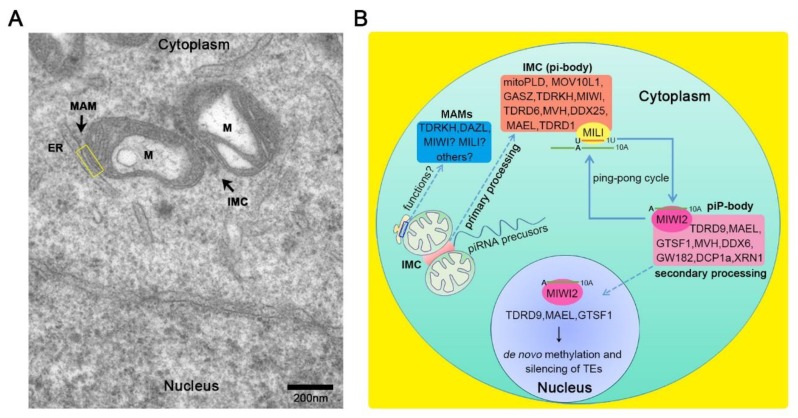
Multiple specific granular structures are present in the cytoplasm of germ cells, termed nuage, which are electron-dense, non-membranous, close to mitochondria and/or nuclei, variant size yielding to different compartments harboring different components, including intermitochondrial cement (IMC), piP-body, and chromatoid body (CB). Since mitochondria exhibit different morphology and topographical arrangements to accommodate specific needs during spermatogenesis, the distribution of mitochondria-associated nuage is also dynamic. The most relevant nuage structure with mitochondria is IMC, also called pi-body, present in prospermatogonia, spermatogonia, and spermatocytes. IMC is primarily enriched with various Piwi-interacting RNA (piRNA) proteins and mainly functions as piRNA biogenesis, transposon silencing, mRNA translation, and mitochondria fusion. Importantly, our previous work reported that mitochondria-associated ER membranes (MAMs) are abundant in spermatogenic cells and contain many crucial proteins associated with the piRNA pathway. Provocatively, IMC functionally communicates with other nuage structures, such as piP-body, to perform its complex functions in spermatogenesis. Although little is known about the formation of both IMC and MAMs, its distinctive characters have attracted considerable attention. Here, we review the insights gained from studying the structural components of mitochondria-associated germinal structures, including IMC, CB, and MAMs, which are pivotal structures to ensure genome integrity and male fertility. We discuss the roles of the structural components in spermatogenesis and piRNA biogenesis, which provide new insights into mitochondria-associated germinal structures in germ cell development and male reproduction.
细胞质中的生殖细胞存在多种特定的颗粒结构,称为 nuage,其电子密度高、无膜、靠近线粒体和/或核,大小不同,形成不同的隔室,包含不同的成分,包括线粒体间黏合(IMC)、piP 体和染色质体(CB)。由于线粒体在精子发生过程中表现出不同的形态和拓扑排列,以适应特定的需求,因此与线粒体相关的 nuage 分布也是动态的。与线粒体最相关的 nuage 结构是 IMC,也称为 pi-body,存在于前精原细胞、精原细胞和精母细胞中。IMC 主要富含各种 Piwi 相互作用 RNA(piRNA)蛋白,主要功能是 piRNA 的生物发生、转座子沉默、mRNA 翻译和线粒体融合。重要的是,我们之前的工作报道称,与线粒体相关的内质网(ER)膜(MAMs)在精子发生细胞中丰富,并包含许多与 piRNA 途径相关的关键蛋白。有趣的是,IMC 与其他 nuage 结构(如 piP 体)在功能上相互沟通,以在精子发生中发挥其复杂功能。尽管对 IMC 和 MAMs 的形成知之甚少,但它们的独特特征引起了相当大的关注。在这里,我们综述了研究与线粒体相关的生殖结构的结构成分(包括 IMC、CB 和 MAMs)所获得的见解,这些结构是确保基因组完整性和男性生育能力的关键结构。我们讨论了这些结构成分在精子发生和 piRNA 生物发生中的作用,这为生殖细胞发育和男性生殖过程中与线粒体相关的生殖结构提供了新的见解。