Department of Neuroscience, Imaging and Clinical Sciences,"G. d'Annunzio" University of Chieti-Pescara, Chieti-Pescara, Italy.
Institute for Advanced Biomedical Technologies, "G. d'Annunzio" University of Chieti-Pescara, Chieti-Pescara, Italy.
Sci Rep. 2020 Feb 12;10(1):2469. doi: 10.1038/s41598-020-58787-w.
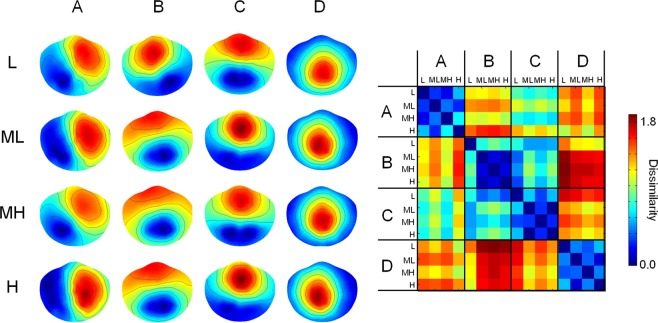
Variation of the magnitude of posterior alpha rhythm (8-12 Hz) has functional and behavioural effects in sensory processing and cognitive performances. Electrical brain activity, as revealed by electroencephalography (EEG), can be represented by a sequence of microstates of about 40-120 ms duration, in which distributed neural pools are synchronously active and generate stable spatial potential topographies on the scalp. Microstate dynamics may reflect transitions between global states characterized by selective inhibition of specific intra-cortical regions, mediated by alpha activity. We investigated the intra-subject and inter-subject relationship between microstate features and alpha band. High-density EEG signals were acquired in 29 healthy subjects during ten minutes of eyes closed rest. Individual EEG signal epochs were classified into four groups depending on the amount of occipital alpha power, and microstate metrics (duration, coverage and frequency of occurrence) were calculated and compared across groups. Correlations between alpha power and microstate metrics between individuals were also performed. To assess if microstate parameter variations are specific for the alpha band, the same analysis was also performed for theta and beta bands, as well as for global field power. We observed an increase in the metrics of microstate, previously associated to the visual system, with the level of intra-subject amplitude alpha oscillations, together with lower coverage of microstate associated with executive attention network and a higher frequency of microstate associated with task negative network. Other modulation effects of broad-band EEG power level on microstate metrics were observed. These effects are not specific for the alpha band, since they can equally be attributed to fluctuations in other frequency bands. We can interpret our results as a regulation mechanism mediated by posterior alpha level, dynamically interacting with other frequency bands, responsible for the switching between active areas.
后 alpha 节律(8-12Hz)幅度的变化对感觉处理和认知表现有功能和行为影响。脑电图(EEG)揭示的脑电活动可以用大约 40-120ms 持续时间的微状态序列来表示,在微状态中,分布式神经池同步活跃,并在头皮上产生稳定的空间电势拓扑。微状态动力学可能反映了由 alpha 活动介导的特定皮质内区域选择性抑制的全局状态之间的转换。我们研究了微状态特征与 alpha 频带之间的个体内和个体间关系。在 29 名健康受试者闭眼休息十分钟期间采集了高密度 EEG 信号。根据枕部 alpha 功率的量,将个体 EEG 信号时段分类为四组,并在组间计算和比较微状态指标(持续时间、覆盖度和出现频率)。还对个体之间 alpha 功率和微状态指标之间的相关性进行了分析。为了评估微状态参数变化是否特定于 alpha 频带,还对 theta 和 beta 频带以及全局场功率进行了相同的分析。我们观察到,与视觉系统相关的微状态指标随着个体内幅度 alpha 振荡水平的增加而增加,与执行注意网络相关的微状态覆盖度降低,与任务负网络相关的微状态频率升高。还观察到其他宽频带 EEG 功率水平对微状态指标的调制效应。这些效应不是特定于 alpha 频带的,因为它们同样可以归因于其他频带的波动。我们可以将我们的结果解释为一种由后 alpha 水平介导的调节机制,该机制与其他频率带动态相互作用,负责在活跃区域之间切换。