Glerum Pieter J, Maliepaard Marc, de Valk Vincent, Scholl Joep H G, van Hunsel Florence P A M, van Puijenbroek Eugène P, Burger David M, Neef Kees
Medicines Evaluation Board, Utrecht, The Netherlands.
Department of Clinical Pharmacy and Toxicology, Maastricht University Medical Centre, Maastricht, The Netherlands.
Clin Transl Sci. 2020 May;13(3):599-607. doi: 10.1111/cts.12746. Epub 2020 Feb 12.
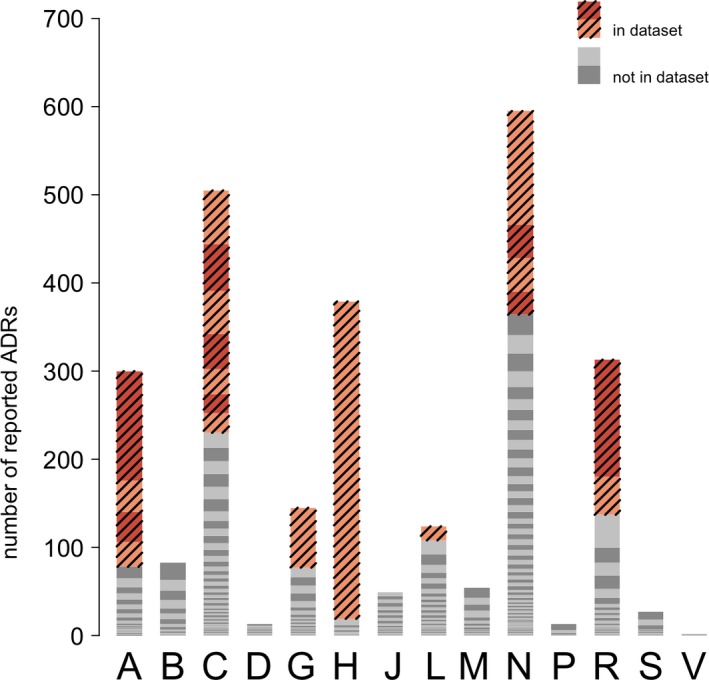
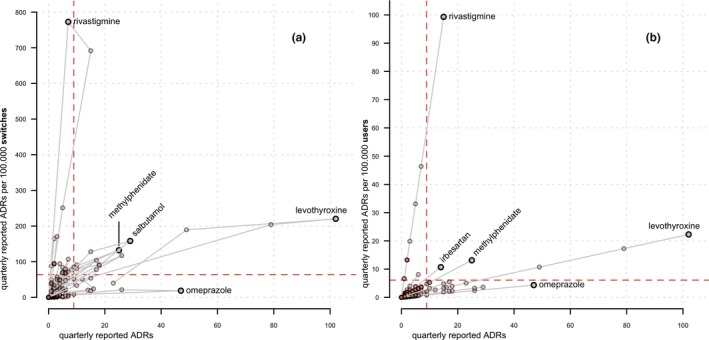
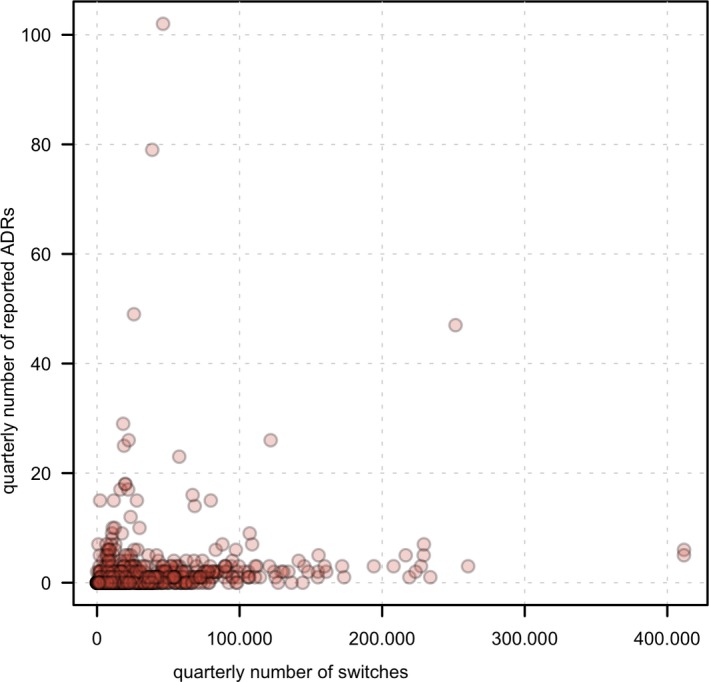
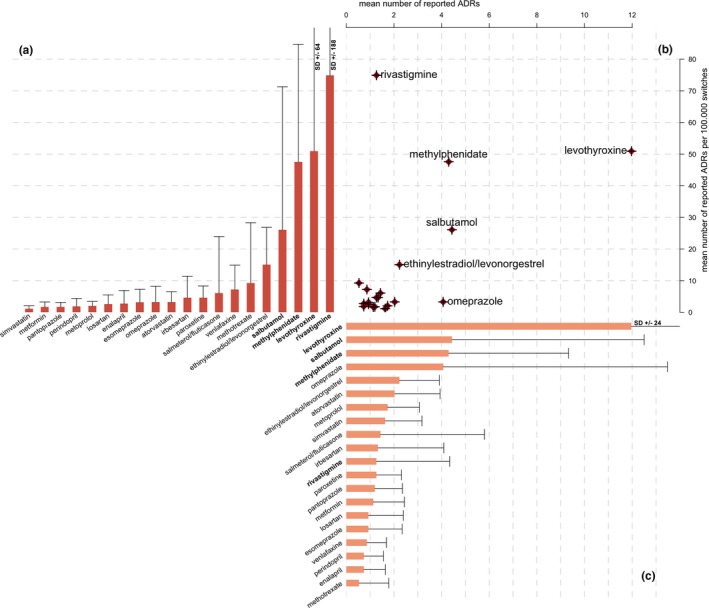
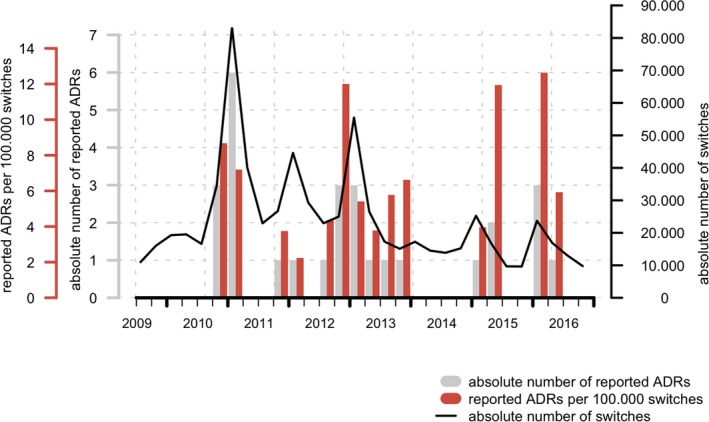
We performed a retrospective cohort study in the Dutch patient population to identify active substances with a relatively high number of adverse drug reactions (ADRs) potentially related to drug switching. For this, we analyzed drug switches and reported ADRs related to switching between June 1, 2009, and December 31, 2016, for a selection of 20 active substances. We also compared pharmacovigilance analyses based on the absolute, switch-corrected, and user-corrected numbers of ADRs. In total, 1,348 reported ADRs and over 23.8 million drug switches were obtained from the National Health Care Institute in The Netherlands and from Lareb, which is The Netherlands Pharmacovigilance Centre. There was no correlation between the number of ADRs and the number of switches, but, on average, we found 5.7 reported ADRs per 100,000 switches. The number was relatively high for rivastigmine, levothyroxine, methylphenidate, and salbutamol, with 74.9, 50.9, 47.6, and 26.1 ADRs per 100,000 switches, respectively. When comparing analyses using the absolute number and the switch-corrected number of ADRs, we demonstrate that different active substances would be identified as having a relatively high number of ADRs, and different time periods of increased numbers of ADRs would be observed. We also demonstrate similar results when using the user-corrected number of ADRs instead of the switch-corrected number of ADRs, allowing for a more feasible approach in pharmacovigilance practice. This study demonstrates that pharmacovigilance analyses of switch-related ADRs leads to different results when the number of reported ADRs is corrected for the actual number of drug switches.
我们在荷兰患者群体中开展了一项回顾性队列研究,以确定可能与换药相关、具有相对较多药物不良反应(ADR)的活性物质。为此,我们分析了20种活性物质在2009年6月1日至2016年12月31日期间的换药情况以及报告的与换药相关的ADR。我们还比较了基于ADR的绝对数、换药校正数和使用者校正数的药物警戒分析。总共从荷兰国家医疗保健研究所和荷兰药物警戒中心Lareb获取了1348例报告的ADR以及超过2380万次换药信息。ADR数量与换药次数之间无相关性,但平均而言,我们发现每10万次换药中有5.7例报告的ADR。对于卡巴拉汀、左甲状腺素、哌甲酯和沙丁胺醇,该数字相对较高,每10万次换药分别有74.9、50.9、47.6和26.1例ADR。在比较使用ADR绝对数和换药校正数的分析时,我们发现不同的活性物质会被确定为具有相对较多的ADR,并且会观察到ADR数量增加的不同时间段。当使用使用者校正的ADR数量而非换药校正的ADR数量时,我们也得到了类似的结果,这为药物警戒实践提供了一种更可行的方法。这项研究表明,当根据实际换药次数对报告的ADR数量进行校正时,与换药相关的ADR的药物警戒分析会得出不同的结果。