Francis I Proctor Foundation, University of California, San Francisco, California, USA.
Faculty of Health and Medical Sciences, University of Surrey, Guildford, United Kingdom.
J Infect Dis. 2020 Jun 11;221(Suppl 5):S519-S524. doi: 10.1093/infdis/jiz691.
As the World Health Organization seeks to eliminate trachoma by 2020, countries are beginning to control the transmission of trachomatous inflammation-follicular (TF) and discontinue mass drug administration (MDA) with oral azithromycin. We evaluated the effect of MDA discontinuation on TF1-9 prevalence at the district level.
We extracted from the available data districts with an impact survey at the end of their program cycle that initiated discontinuation of MDA (TF1-9 prevalence <5%), followed by a surveillance survey conducted to determine whether TF1-9 prevalence remained below the 5% threshold, warranting discontinuation of MDA. Two independent analyses were performed, 1 regression based and 1 simulation based, that assessed the change in TF1-9 from the impact survey to the surveillance survey.
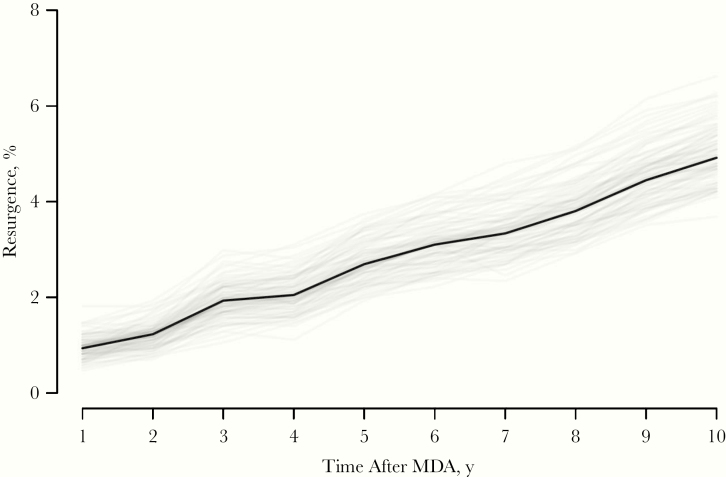
Of the 220 districts included, TF1-9 prevalence increased to >5% from impact to surveillance survey in 9% of districts. Regression analysis indicated that impact survey TF1-9 prevalence was a significant predictor of surveillance survey TF1-9 prevalence. The proportion of simulations with >5% TF1-9 prevalence in the surveillance survey was 2%, assuming the survey was conducted 4 years after MDA.
An increase in TF1-9 prevalence may represent disease resurgence but could also be due to measurement error. Improved diagnostic tests are crucial to elimination of TF1-9 as a public health problem.
世界卫生组织(WHO)力求在 2020 年消除沙眼,各国开始控制沙眼滤泡性炎症(TF)的传播,并停止用口服阿奇霉素进行大规模药物治疗(MDA)。我们评估了停止 MDA 对地区一级 TF1-9 流行率的影响。
我们从现有数据中提取了在项目周期结束时进行影响调查的地区的数据,这些地区已经开始停止 MDA(TF1-9 流行率<5%),随后进行了监测调查,以确定 TF1-9 流行率是否仍低于 5%的阈值,是否需要停止 MDA。我们进行了两次独立的分析,一次是基于回归的分析,另一次是基于模拟的分析,以评估从影响调查到监测调查 TF1-9 的变化。
在纳入的 220 个地区中,9%的地区从影响调查到监测调查,TF1-9 流行率增加到>5%。回归分析表明,影响调查的 TF1-9 流行率是监测调查 TF1-9 流行率的一个重要预测因素。假设监测调查在 MDA 后 4 年进行,模拟中监测调查 TF1-9 流行率>5%的比例为 2%。
TF1-9 流行率的增加可能代表疾病的再次出现,但也可能是由于测量误差。改进诊断检测对于消除 TF1-9 作为公共卫生问题至关重要。