Kim Yu-Mi, Jeon Ji-Young, Moon Seol Ju, Jung Jina, Son Hankil, Kim Min-Gul
Center for Clinical Pharmacology and Biomedical Research Institute, Chonbuk National University Hospital, Jeonju 54907, Republic of Korea.
Department of Pharmacology, School of Medicine, Chonbuk National University, Jeonju 54907, Republic of Korea.
Transl Clin Pharmacol. 2018 Jun;26(2):73-78. doi: 10.12793/tcp.2018.26.2.73. Epub 2018 Jun 18.
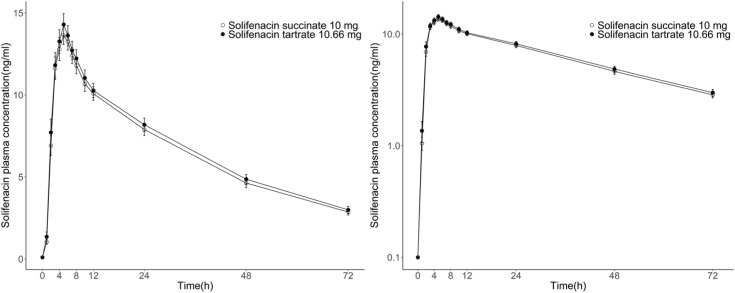
Solifenacin is a muscarinic antagonist indicated for the treatment of overactive bladder with symptoms. Solifenacin tartrate is a newly developed salt formulation of solifenacin. This study compared the pharmacokinetic and safety properties after single-dose administration of solifenacin tartrate (test formulation) and solifenacin succinate (reference formulation) in healthy male volunteers. A total of 36 subjects were enrolled in this randomized, open-label, single-dose, two-way crossover study. During each treatment period, subjects received the test formulation or reference formulation. Plasma samples were collected at pre-dose and at 1, 2, 3, 4, 5, 6, 7, 8, 10, 12, 24, 48 and 72 hours post-dose. Safety was assessed by adverse events, physical examinations, laboratory assessments, 12-lead electrocardiograms, and vital signs. Thirty-three subjects completed the study and were included in the pharmacokinetic analysis. The mean (standard deviation) values of AUC for the test and reference formulations were 486.98 (138.47) and 469.07 (128.29) h·ng/mL, respectively. The mean (standard deviation) values of C for the test and reference formulations were 14.66 (3.85) and 14.10 (3.37) ng/mL, respectively. The 90% confidence intervals for AUC and C were 0.9702 to 1.1097 and 0.9779 to 1.0993, respectively. All adverse events were mild or moderate, and there were no serious adverse events. The pharmacokinetic properties of solifenacin tartrate were similar to those of solifenacin succinate and met the acceptance criteria for bioequivalence. Both formulations were safe, and no significant difference was observed in the safety assessments of the formulations.
索利那新是一种毒蕈碱拮抗剂,适用于治疗伴有症状的膀胱过度活动症。酒石酸索利那新是索利那新新开发的盐制剂。本研究比较了健康男性志愿者单剂量给予酒石酸索利那新(试验制剂)和琥珀酸索利那新(参比制剂)后的药代动力学和安全性特征。共有36名受试者参与了这项随机、开放标签、单剂量、双向交叉研究。在每个治疗期,受试者接受试验制剂或参比制剂。在给药前以及给药后1、2、3、4、5、6、7、8、10、12、24、48和72小时采集血浆样本。通过不良事件、体格检查、实验室评估、12导联心电图和生命体征评估安全性。33名受试者完成了研究并纳入药代动力学分析。试验制剂和参比制剂的AUC均值(标准差)分别为486.98(138.47)和469.07(128.29)h·ng/mL。试验制剂和参比制剂的C均值(标准差)分别为14.66(3.85)和14.10(3.37)ng/mL。AUC和C的90%置信区间分别为0.9702至1.1097和0.9779至1.0993。所有不良事件均为轻度或中度,无严重不良事件。酒石酸索利那新的药代动力学特征与琥珀酸索利那新相似,符合生物等效性的接受标准。两种制剂均安全,在制剂的安全性评估中未观察到显著差异。