Jeong Hyeon-Cheol, Kim Tae-Eun, Shin Kwang-Hee
College of Pharmacy, Research Institute of Pharmaceutical Sciences, Kyungpook National University, Daegu 41566, Korea.
Department of Clinical Pharmacology, Konkuk University Medical Center, Seoul 05030, Republic of Korea.
Transl Clin Pharmacol. 2019 Mar;27(1):33-41. doi: 10.12793/tcp.2019.27.1.33. Epub 2019 Mar 27.
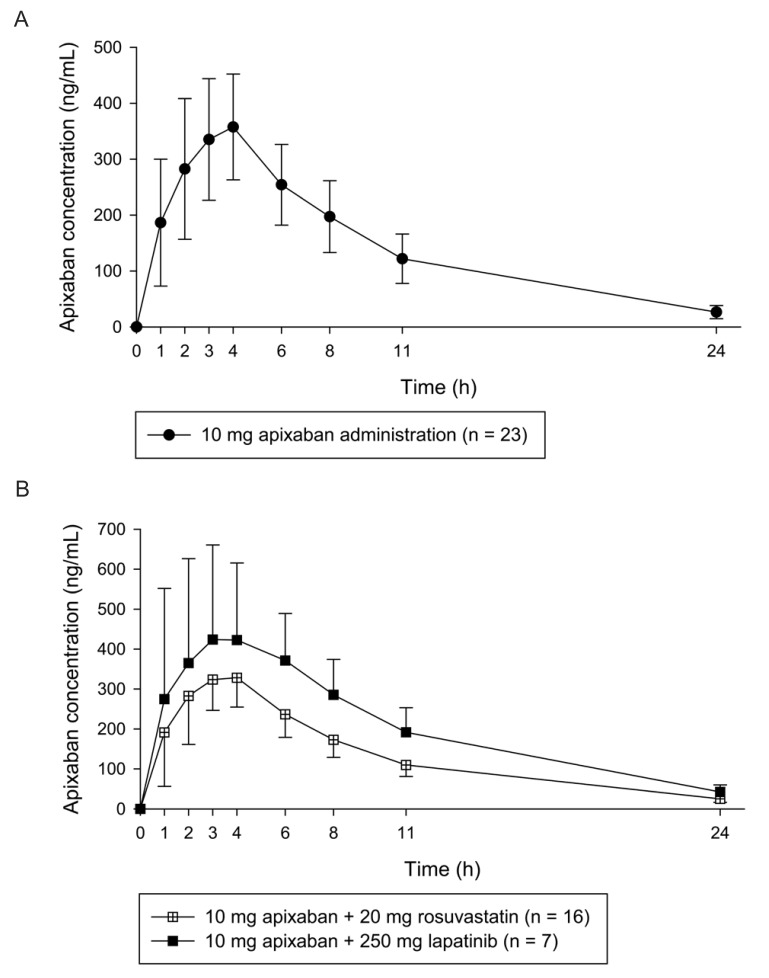
Apixaban, an inhibitor of direct factor Xa, is used for the treatment of venous thromboembolic events or prevention of stroke. Unlike many other anticoagulant agents, it does not need periodic monitoring. However, monitoring is still required to determine the risk of bleeding due to overdose or surgery. Usually, apixaban concentrations are indirectly quantified using an anti-factor Xa assay. However, this method has a relatively narrow analytical concentration range, poor selectivity, and requires an external calibrator. Therefore, the goal of current study was to establish an analytical method for determining plasma levels of apixaban using ultra performance liquid chromatography-tandem mass spectrometry (UPLC-MS/MS). To this end, apixaban was separated using 2.5 mM ammonium formate (pH 3.0) (A) and 100% methanol containing 0.1% formic acid (B) using the gradient method with a Thermo hypersil GOLD column. The mass detector condition was optimized using the electrospray ionization (ESI) positive mode for apixaban quantification. The developed method showed sufficient linearity (coefficient of determination [r ≥ 0.997]) at calibration curve ranges. The percentage (%) changes in accuracy, precision, and all stability tests were within 15% of the nominal concentration. Apixaban concentration in plasma from healthy volunteers was quantified using the developed method. The mean maximum plasma concentration (C) was 371.57 ng/mL, and the median time to achieve the C (T) was 4 h after administration of 10 mg apixaban alone. Although the results showed low extraction efficiency (~16%), the reproducibility (% change was within 15% of nominal concentration) was reliable. Therefore, the developed method could be used for clinical pharmacokinetic studies.
阿哌沙班是一种直接Xa因子抑制剂,用于治疗静脉血栓栓塞事件或预防中风。与许多其他抗凝剂不同,它不需要定期监测。然而,仍需要进行监测以确定因过量用药或手术导致出血的风险。通常,阿哌沙班浓度通过抗Xa因子测定间接定量。然而,该方法的分析浓度范围相对较窄,选择性较差,并且需要外部校准物。因此,本研究的目的是建立一种使用超高效液相色谱-串联质谱法(UPLC-MS/MS)测定血浆中阿哌沙班水平的分析方法。为此,使用2.5 mM甲酸铵(pH 3.0)(A)和含0.1%甲酸的100%甲醇(B),采用梯度洗脱法,在Thermo hypersil GOLD柱上分离阿哌沙班。采用电喷雾电离(ESI)正模式对阿哌沙班进行定量,优化了质量检测器条件。所建立的方法在校准曲线范围内显示出足够的线性(决定系数[r≥0.997])。准确度、精密度和所有稳定性试验的百分比(%)变化在标称浓度的15%以内。使用所建立的方法对健康志愿者血浆中的阿哌沙班浓度进行了定量。单独给予10 mg阿哌沙班后,平均最大血浆浓度(C)为371.57 ng/mL,达到C的中位时间(T)为4小时。尽管结果显示提取效率较低(约16%),但重现性(%变化在标称浓度的15%以内)是可靠的。因此,所建立的方法可用于临床药代动力学研究。