Hara Takahito, Kimura Akiko, Miyazaki Tohru, Tanaka Hiroshi, Morimoto Megumi, Nakai Katsuhiko, Soeda Junpei
Innovation Promotion, Shonan Research Central Office, Research, Takeda Pharmaceutical Company Limited, 2-26-1 Muraoka-Higashi, Fujisawa-shi, Kanagawa, 251-8555, Japan.
Oncology Therapeutic Area Unit for Japan & Asia, Takeda Pharmaceutical Company Limited, 4-1-1 Dosho-machi Chuo-ku Osaka-shi, Osaka, 540-8645, Japan.
Biochem Biophys Rep. 2020 Jan 17;21:100726. doi: 10.1016/j.bbrep.2020.100726. eCollection 2020 Mar.
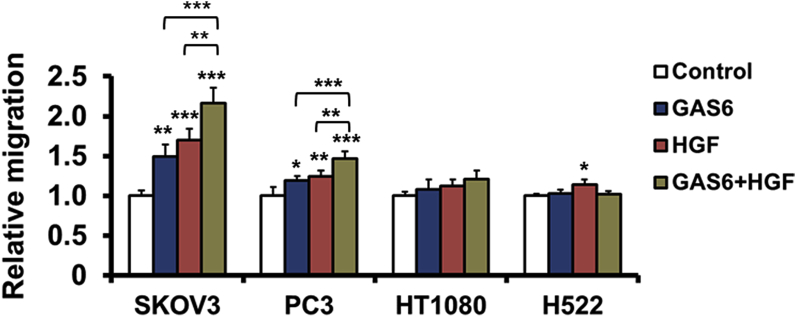
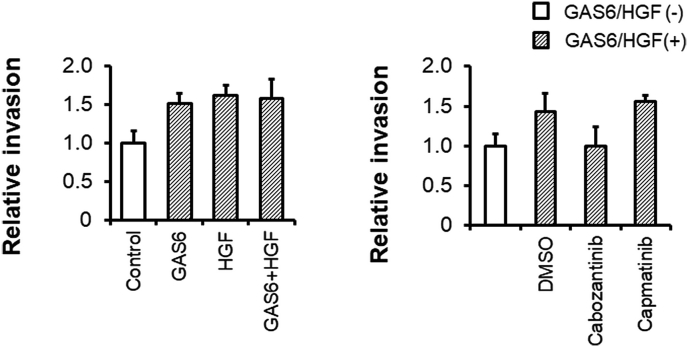
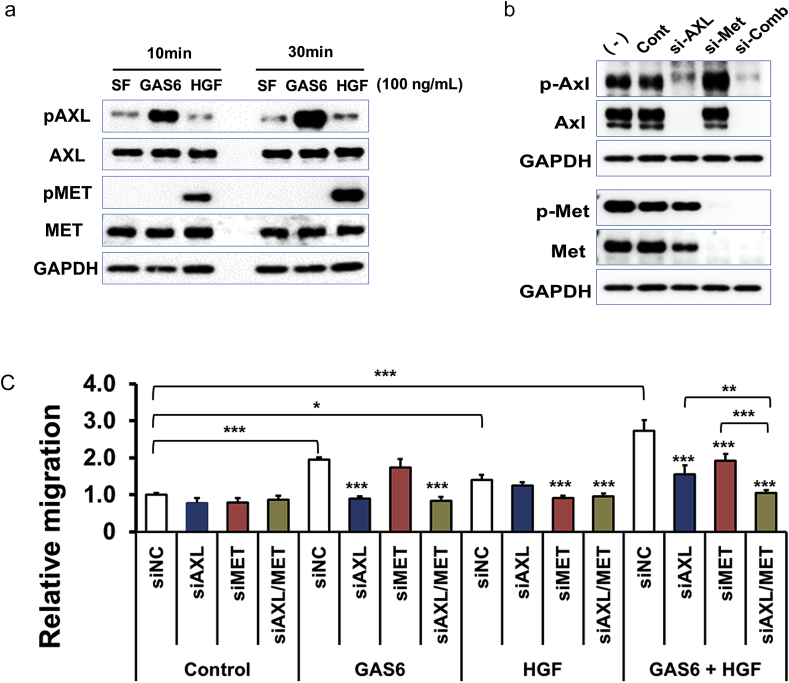
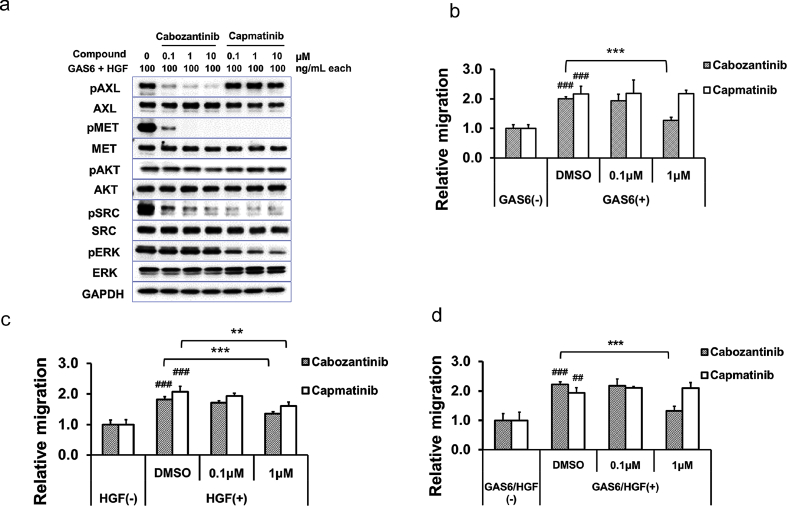
Cabozantinib is known as an inhibitor of receptor tyrosine kinases mainly targeting AXL receptor tyrosine kinase (AXL), proto-oncogene-encoded receptor tyrosine kinase (MET), and vascular endothelial growth factor receptor 2. Growth arrest-specific 6 (GAS6) and hepatocyte growth factor (HGF), the natural ligands of AXL and MET, respectively, are associated with the induction of cancer cell proliferation or metastasis. Currently, it is still unclear how cabozantinib regulates cancer cell migration and invasion by inhibiting AXL and MET. This study was conducted to investigate the mechanism underlying the anti-cancer effects of cabozantinib through regulation of AXL and MET signaling. The results of Boyden chamber assays showed that cancer cell migration was induced by GAS6 and HGF in SKOV3 cells in serum-free medium. Combinatorial treatment with GAS6 and HGF exerted an additive effect on cell migration. Furthermore, we examined the role of AXL and MET signaling in cell migration. Short interfering RNA targeting AXL and MET inhibited GAS6- and HGF-induced migration, respectively. Double knockdown of AXL and MET completely suppressed cell migration induced by combination treatment with GAS6 and HGF compared to AXL or MET inhibition alone. Finally, we investigated the effects of cabozantinib on cell migration and invasion. Cabozantinib inhibited AXL and MET phosphorylation and downregulated the downstream mediators, phosphorylated SRC in the presence of both GAS6 and HGF in SKOV3 cells. The cell migration and invasion induced by combined GAS6 and HGF treatment were suppressed by cabozantinib, but not by capmatinib, a selective MET inhibitor. Our data indicate that the GAS6-AXL and HGF-MET signal pathways markedly contribute to cancer cell migration and invasion in an independent manner, suggesting that simultaneous inhibition of these two pathways contributes to the anti-cancer effects of cabozantinib.
卡博替尼是一种受体酪氨酸激酶抑制剂,主要作用靶点为AXL受体酪氨酸激酶(AXL)、原癌基因编码的受体酪氨酸激酶(MET)和血管内皮生长因子受体2。AXL和MET的天然配体生长停滞特异性蛋白6(GAS6)和肝细胞生长因子(HGF)分别与癌细胞增殖或转移的诱导有关。目前,尚不清楚卡博替尼如何通过抑制AXL和MET来调节癌细胞的迁移和侵袭。本研究旨在通过调节AXL和MET信号通路来探究卡博替尼抗癌作用的机制。博伊登小室试验结果表明,在无血清培养基中,GAS6和HGF可诱导SKOV3细胞发生癌细胞迁移。GAS6和HGF联合处理对细胞迁移具有累加效应。此外,我们研究了AXL和MET信号通路在细胞迁移中的作用。靶向AXL和MET的短发夹RNA分别抑制了GAS6和HGF诱导的迁移。与单独抑制AXL或MET相比,同时敲低AXL和MET可完全抑制GAS6和HGF联合处理诱导的细胞迁移。最后,我们研究了卡博替尼对细胞迁移和侵袭的影响。在SKOV3细胞中,同时存在GAS6和HGF时,卡博替尼抑制AXL和MET磷酸化,并下调下游介质磷酸化SRC。卡博替尼可抑制GAS6和HGF联合处理诱导的细胞迁移和侵袭,但选择性MET抑制剂卡马替尼则无此作用。我们的数据表明,GAS6-AXL和HGF-MET信号通路以独立的方式显著促进癌细胞的迁移和侵袭,这表明同时抑制这两条通路有助于卡博替尼的抗癌作用。