Horio Tomohiro, Morishita Eriko, Mizuno Shohei, Uchino Kaori, Hanamura Ichiro, Espinoza J Luis, Morishima Yasuo, Kodera Yoshihisa, Onizuka Makoto, Kashiwase Koichi, Fukuda Takahiro, Doki Noriko, Miyamura Koichi, Mori Takehiko, Nakao Shinji, Takami Akiyoshi
Division of Hematology, Department of Internal Medicine, Aichi Medical University School of Medicine, Nagakute 480-1195, Japan.
Hematopoietic Cell Transplantation Center, Aichi Medical University Hospital, Nagakute 480-1195, Japan.
Cancers (Basel). 2020 Feb 12;12(2):424. doi: 10.3390/cancers12020424.
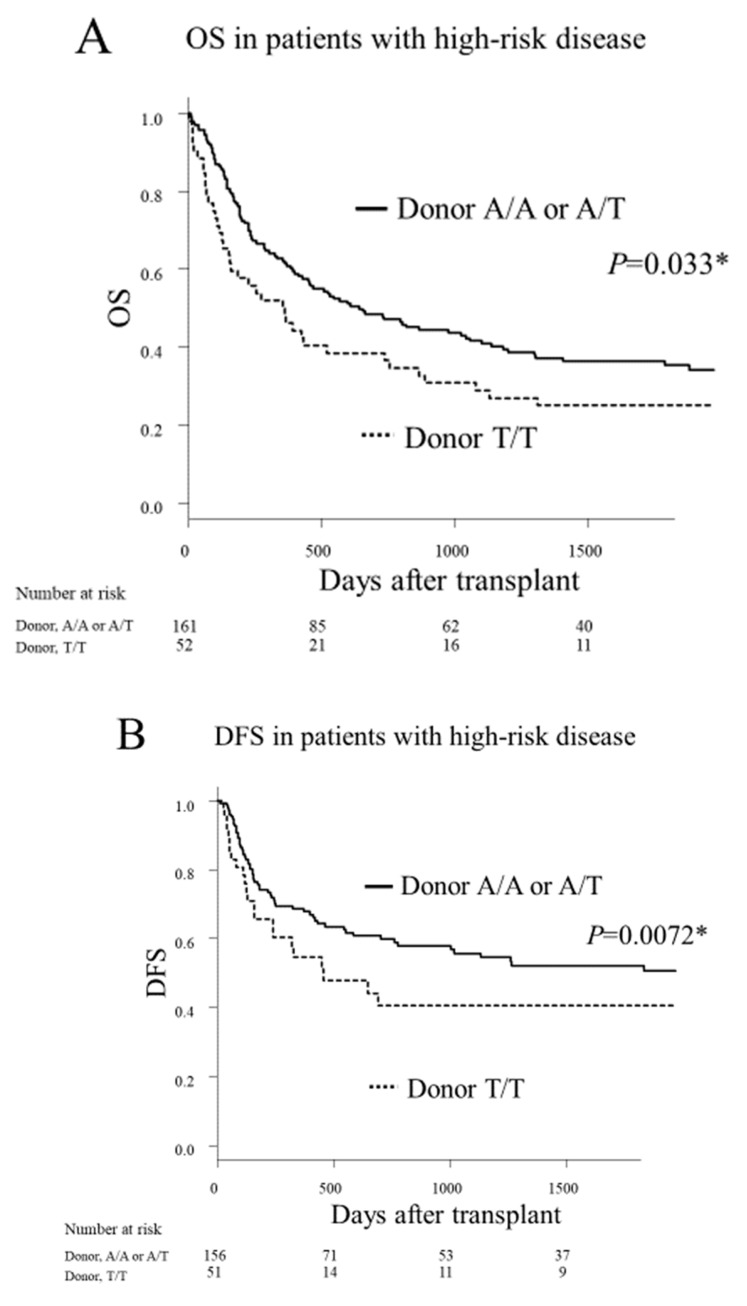
Heme oxygenase-1 (HO-1), an intracellular enzyme that catalyzes the degradation of heme into biliverdin, free iron, and carbon monoxide, exerts anti-inflammatory and cytoprotective effects against endothelial cell injury. The promoter gene has one important single-nucleotide polymorphism (SNP) rs2071746 (-413A>T) that is functional, and the A allele has been reported to be associated with higher expression levels than the T allele. We investigated the influence of the rs2071746 SNP on the transplant outcomes in 593 patients with hematological malignancies undergoing unrelated, human leukocyte antigen (HLA)-matched, T-cell-replete bone marrow transplantation (BMT) through the Japan Donor Marrow Program. In patients with high-risk diseases, the donor A/A or A/T genotype was associated with better 5 year overall survival (35% vs 25%; = 0.03) and 5 year disease-free survival (35% vs. 22%; = 0.0072), compared to the donor T/T genotype. These effects were not observed in patients with low-risk diseases. The current findings therefore indicate that rs2071746 genotyping could be useful for selecting donors and tailoring transplant strategies for patients with high-risk hematologic malignancies.
血红素加氧酶-1(HO-1)是一种细胞内酶,可催化血红素降解为胆绿素、游离铁和一氧化碳,对内皮细胞损伤具有抗炎和细胞保护作用。其启动子基因有一个重要的单核苷酸多态性(SNP)rs2071746(-413A>T)具有功能,据报道A等位基因比T等位基因与更高的表达水平相关。我们通过日本供体骨髓项目,研究了rs2071746 SNP对593例接受无关、人类白细胞抗原(HLA)匹配、T细胞充足的骨髓移植(BMT)的血液系统恶性肿瘤患者移植结局的影响。在高危疾病患者中,与供体T/T基因型相比,供体A/A或A/T基因型与更好的5年总生存率(35%对25%;P=0.03)和5年无病生存率(35%对22%;P=0.0072)相关。在低危疾病患者中未观察到这些效应。因此,目前的研究结果表明,rs2071746基因分型可能有助于为高危血液系统恶性肿瘤患者选择供体和制定移植策略。