Sage Bionetworks, Seattle, WA, USA.
Myeloma Center, University of Arkansas for Medical Sciences, Little Rock, AR, USA.
Leukemia. 2020 Jul;34(7):1866-1874. doi: 10.1038/s41375-020-0742-z. Epub 2020 Feb 14.
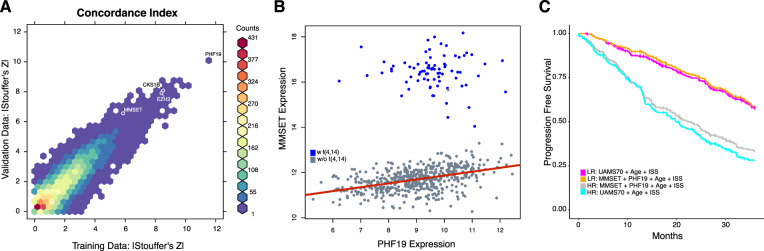
While the past decade has seen meaningful improvements in clinical outcomes for multiple myeloma patients, a subset of patients does not benefit from current therapeutics for unclear reasons. Many gene expression-based models of risk have been developed, but each model uses a different combination of genes and often involves assaying many genes making them difficult to implement. We organized the Multiple Myeloma DREAM Challenge, a crowdsourced effort to develop models of rapid progression in newly diagnosed myeloma patients and to benchmark these against previously published models. This effort lead to more robust predictors and found that incorporating specific demographic and clinical features improved gene expression-based models of high risk. Furthermore, post-challenge analysis identified a novel expression-based risk marker, PHF19, which has recently been found to have an important biological role in multiple myeloma. Lastly, we show that a simple four feature predictor composed of age, ISS, and expression of PHF19 and MMSET performs similarly to more complex models with many more gene expression features included.
虽然过去十年多发性骨髓瘤患者的临床疗效有了显著改善,但由于某些原因,一部分患者无法从当前的治疗方法中获益。已经开发出许多基于基因表达的风险模型,但每个模型都使用不同的基因组合,并且通常涉及检测许多基因,这使得它们难以实施。我们组织了多发性骨髓瘤 DREAM 挑战赛,这是一项众包工作,旨在为新诊断的多发性骨髓瘤患者开发快速进展模型,并将这些模型与之前发表的模型进行基准测试。这项工作产生了更强大的预测因子,并发现纳入特定的人口统计学和临床特征可以改善基于基因表达的高危模型。此外,挑战赛结束后的分析确定了一种新的基于表达的风险标志物 PHF19,最近发现它在多发性骨髓瘤中具有重要的生物学作用。最后,我们表明,由年龄、ISS 和 PHF19 和 MMSET 的表达组成的简单四个特征预测因子的性能与包含更多基因表达特征的更复杂模型相似。