Department of Pediatrics, Gastroenterology Unit, King Saud University, Riyadh11461, Saudi Arabia.
Specialty Pediatrics Division, Pediatric Gastroenterology, Johns Hopkins Aramco Healthcare, Dhahran 31311, Saudi Arabia.
World J Gastroenterol. 2020 Jan 28;26(4):416-423. doi: 10.3748/wjg.v26.i4.416.
Incidence and severity variations of inflammatory bowel disease (IBD) have been reported from Western populations between continents and regions of the same countries. However, no data were available from other countries.
To investigate the regional differences in the IBD profiles of pediatric patients from the Kingdom of Saudi Arabia.
Data from a national multicenter IBD study were used. The incidence, time trend, and clinical presentation of Crohn's disease (CD) and ulcerative colitis (UC) in the Central region (CR), Western region (WR), and Eastern region (ER) were analyzed and compared. Statistical analysis included Poisson regression analysis for incidence variation and Chi-square test for demographic and clinical parameters. A < 0.05 was considered significant.
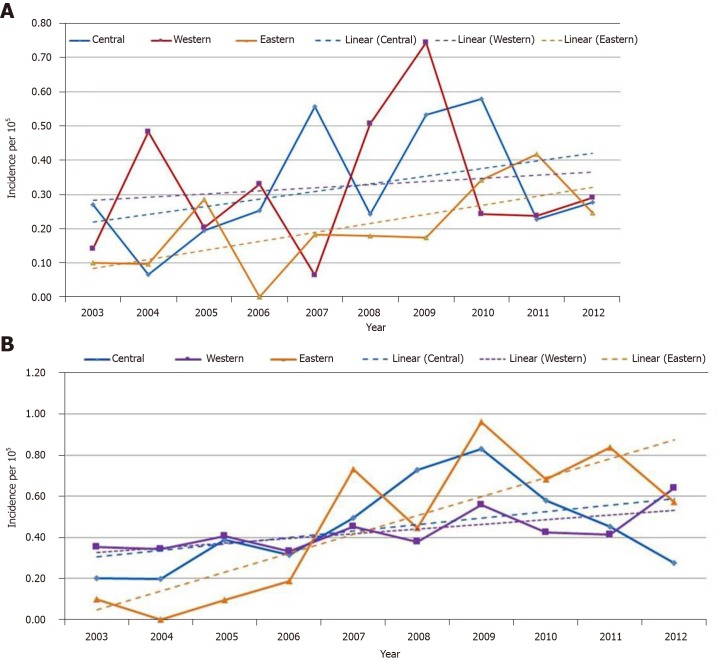
The prevalence of positive family history was lower in children with CD from the ER than the CR or the WR. Consanguinity rate was higher in children with CD and UC from the CR and the ER, respectively. The incidences and time trends of CD and UC were not significantly different between regions. In the ER, a significantly higher percentage of children with CD presented with abdominal pain ( < 0.001), blood in stools ( = 0.048), stricturing or penetrating disease ( = 0.029), higher erythrocyte sedimentation rate ( < 0.001), higher C-reactive protein ( < 0.001), higher anemia ( = 0.017), and lower albumin level ( = 0.014). For children with UC from the ER, a significantly higher percentage presented with anemia ( = 0.006) and a lower percentage with pancolitis ( < 0.001).
The most important finding is the identification of significantly more severe presentation of CD in the ER of the Kingdom of Saudi Arabia. Prospective studies are needed to explain such variations.
炎症性肠病(IBD)的发病率和严重程度在不同大洲和同一国家不同地区的西方人群中已有报道。然而,其他国家没有相关数据。
调查沙特阿拉伯王国儿科患者中 IBD 特征的地区差异。
使用全国多中心 IBD 研究的数据。分析并比较中央区(CR)、西部区(WR)和东部区(ER)的儿童克罗恩病(CD)和溃疡性结肠炎(UC)的发病率、时间趋势和临床表现。统计分析包括发病率变化的泊松回归分析和人口统计学和临床参数的卡方检验。P 值<0.05 被认为具有统计学意义。
与 CR 或 WR 的 CD 患儿相比,ER 的 CD 患儿阳性家族史的比例较低。CR 和 ER 的 CD 和 UC 患儿的近亲结婚率较高。各地区 CD 和 UC 的发病率和时间趋势无显著差异。在 ER,CD 患儿腹痛(<0.001)、粪便带血(=0.048)、狭窄或穿透性疾病(=0.029)、红细胞沉降率(<0.001)、C 反应蛋白(<0.001)、贫血(=0.017)和白蛋白水平(=0.014)的比例明显更高。对于 ER 的 UC 患儿,贫血(=0.006)的比例明显更高,全结肠炎的比例明显更低(<0.001)。
最重要的发现是确定沙特阿拉伯王国 ER 中 CD 的表现更为严重。需要进行前瞻性研究来解释这些差异。