Ramirez Butavand D, Hirsch I, Tomaiuolo M, Moncada D, Viola H, Ballarini F
Laboratorio de Neurociencia Traslacional, Instituto de Biología Celular y Neurociencias "Dr. Eduardo De Robertis" (IBCN), CONICET - Universidad de Buenos Aires, Buenos Aires, Argentina.
Facultad de Medicina, Universidad de Buenos Aires, Buenos Aires, Argentina.
Front Psychol. 2020 Jan 29;11:48. doi: 10.3389/fpsyg.2020.00048. eCollection 2020.
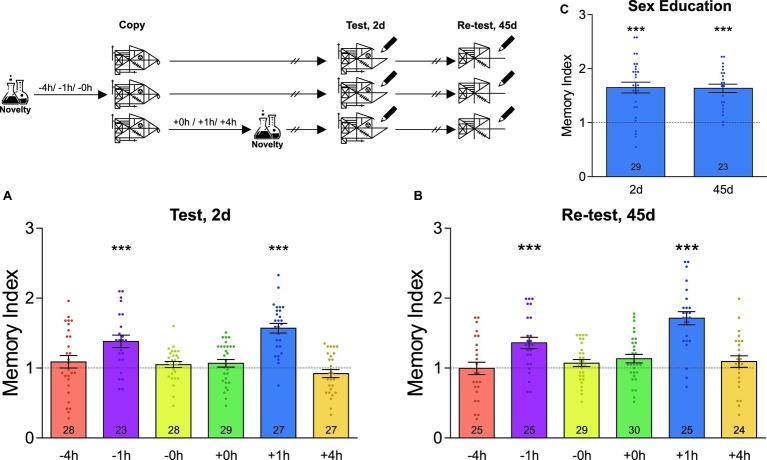
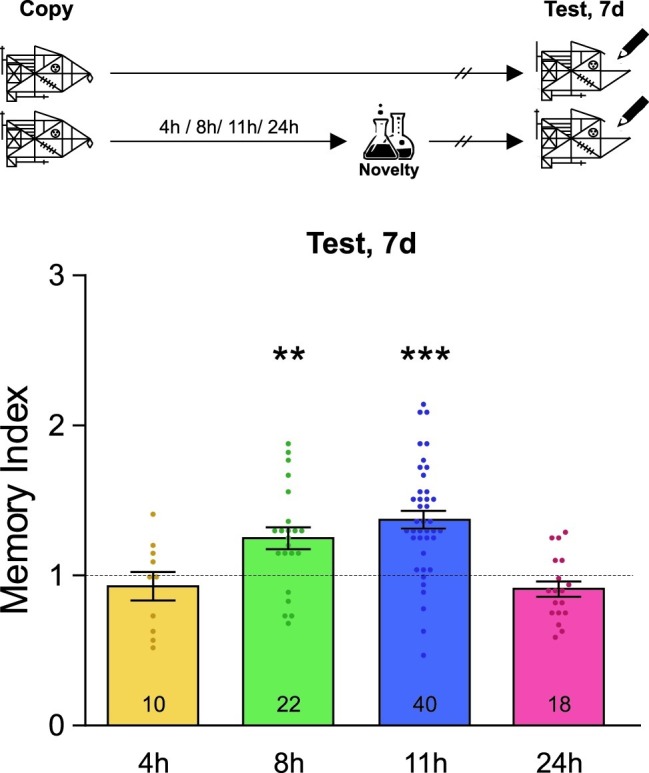
One of the top challenges in education and neuroscience consists in translating laboratory results into strategies to improve learning and memory in teaching environments. In that sense, during the last two decades, researchers have discovered specific temporal windows around learning, during which the intervention with some experiences induces modulatory effects on the formation and/or persistence of memory. Based on these results, the aim of the present study was to design a specific strategy to improve the memory of students in a high-school scenario, by assessing the effect of a novel situation experienced close to learning. We found that the long-term memory about a geometrical figure was more precise in the group of students that faced a novel situation 1 h before or after learning the figure than the control group of students who did not face the novelty. This enhancement was probably triggered by processes acting on memory formation mechanisms that remained evident 45 days after learning, indicating that the improvement was sustained over time. In addition, our results showed that novelty no longer improved the memory if it was experienced 4 h before or after learning. However, far beyond this window of efficacy, when it was faced around 10 h after learning, the novel experience improved the memory persistence tested 7 days later. In summary, our findings characterized different temporal windows of the effectiveness of novelty acting on memory processing, providing a simple and inexpensive strategy that could be used to improve memory formation and persistence in high-school students.
教育和神经科学领域的最大挑战之一在于将实验室研究成果转化为在教学环境中改善学习和记忆的策略。从这个意义上说,在过去二十年中,研究人员发现了学习过程中特定的时间窗口,在此期间,通过一些经历进行干预会对记忆的形成和/或持久性产生调节作用。基于这些结果,本研究的目的是设计一种特定策略,通过评估在学习时经历的新情境的影响,来提高高中生的记忆力。我们发现,在学习几何图形前或后1小时面对新情境的学生组,对该图形的长期记忆比未面对新情境的对照组学生更为精确。这种增强可能是由作用于记忆形成机制的过程触发的,在学习后45天仍很明显,这表明这种改善会随着时间持续。此外,我们的结果表明,如果在学习前或后4小时经历新情境,就不再能提高记忆力。然而,在这个有效窗口之外,如果在学习后约10小时面对新情境,这种新体验会改善7天后测试的记忆持久性。总之,我们的研究结果确定了新情境作用于记忆处理有效性的不同时间窗口,提供了一种简单且低成本的策略,可用于改善高中生的记忆形成和持久性。