Hemmi Keitaro, Kakehashi Ryosuke, Kambayashi Chiaki, Du Preez Louis, Minter Leslie, Furuno Nobuaki, Kurabayashi Atsushi
Amphibian Research Center, Hiroshima University, Hiroshima 739-8526, Japan.
Faculty of Bio-Science, Nagahama Institute of Bio-Science and Technology, Shiga 526-0829, Japan.
Int J Genomics. 2020 Jan 22;2020:6540343. doi: 10.1155/2020/6540343. eCollection 2020.
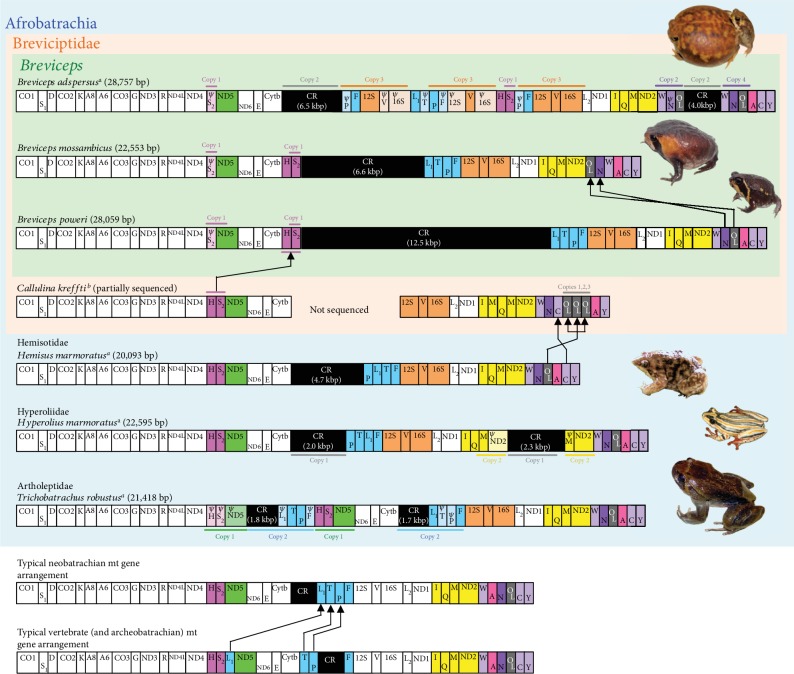
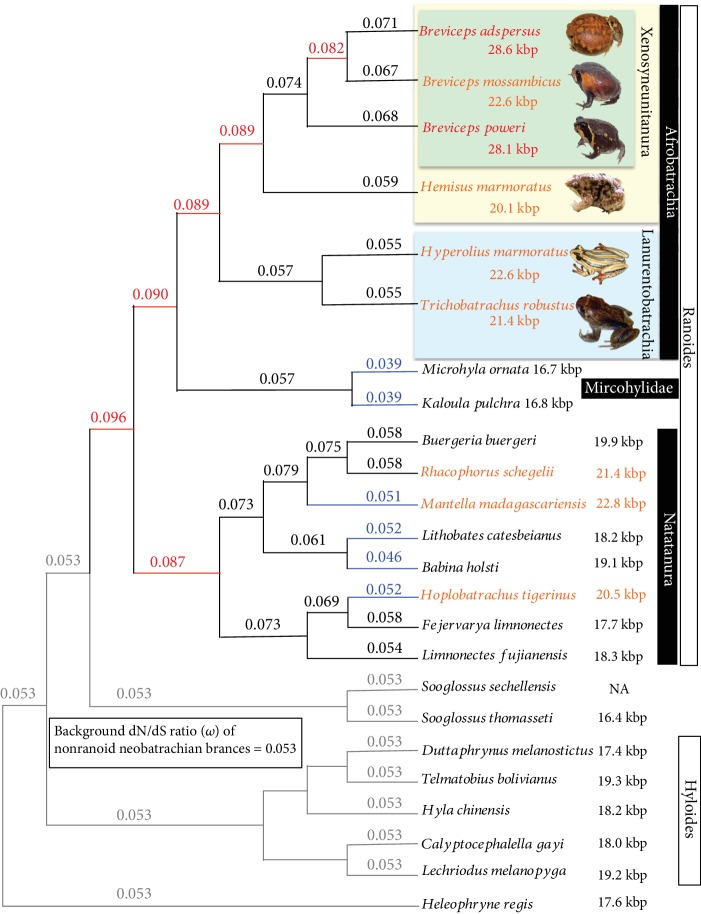
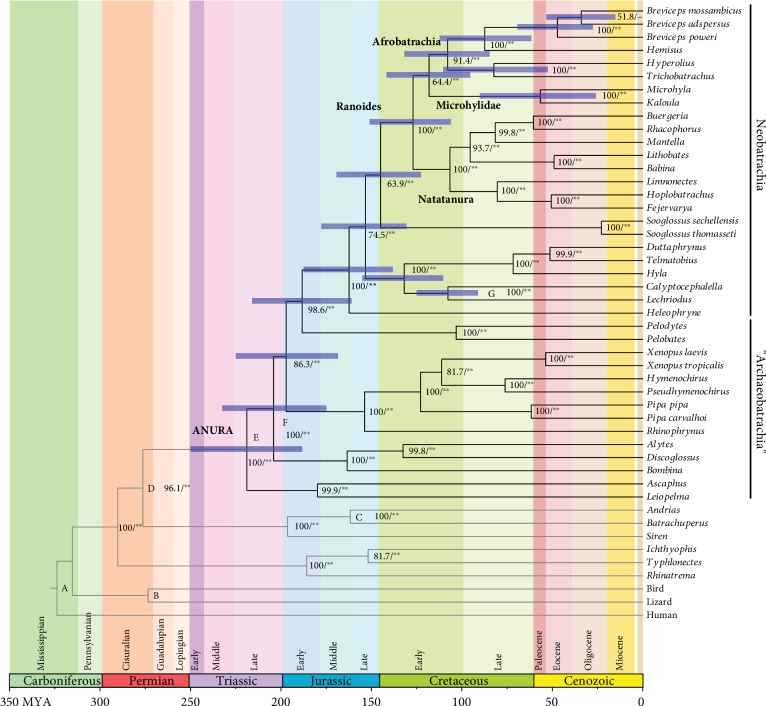
The mitochondrial (mt) genome of the bushveld rain frog (, Brevicipitidae, Afrobatrachia) is the largest (28.8 kbp) among the vertebrates investigated to date. The major cause of genome size enlargement in this species is the duplication of multiple genomic regions. To investigate the evolutionary lineage, timing, and process of mt genome enlargement, we sequenced the complete mtDNAs of two congeneric rain frogs, and . The mt genomic organization, gene content, and gene arrangements of these two rain frogs are very similar to each other but differ from those of . The mt genome (22.5 kbp) does not differ significantly from that of most other afrobatrachians. In contrast, the mtDNA (28.1 kbp) is considerably larger: currently the second largest among vertebrates, after The main causes of genome enlargement differ among species. Unusual elongation (12.5 kbp) of the control region (CR), a single major noncoding region of the vertebrate mt genome, is responsible for the extremely large mt genome in . Based on the current phylogeny and estimated divergence age, it can be concluded that the genome enlargements occurred independently in each species lineage within relatively short periods. Furthermore, a high nucleotide substitution rate and relaxation of selective pressures, which are considered to be involved in changes in genome size, were also detected in afrobatrachian lineages. Our results suggest that these factors were not direct causes but may have indirectly affected mt genome enlargements in .
灌木veld雨蛙(短头蛙科,非洲蛙类)的线粒体(mt)基因组是迄今为止所研究的脊椎动物中最大的(28.8千碱基对)。该物种基因组大小增大的主要原因是多个基因组区域的重复。为了研究mt基因组增大的进化谱系、时间和过程,我们对两种同属雨蛙的完整线粒体DNA进行了测序。这两种雨蛙的mt基因组组织、基因含量和基因排列彼此非常相似,但与[未提及的物种]不同。[未提及的物种]的mt基因组(22.5千碱基对)与大多数其他非洲蛙类的mt基因组没有显著差异。相比之下,[另一种雨蛙]的线粒体DNA(28.1千碱基对)要大得多:目前是脊椎动物中第二大的,仅次于[未提及的物种]。不同[雨蛙]物种基因组增大的主要原因不同。脊椎动物mt基因组的单个主要非编码区域——控制区(CR)异常延长(12.5千碱基对),是[某种雨蛙]线粒体基因组极大的原因。根据当前的[雨蛙]系统发育和估计的分化年龄,可以得出结论,基因组增大在相对较短的时期内于每个物种谱系中独立发生。此外,在非洲蛙类谱系中还检测到高核苷酸替换率和选择压力的放松,这些被认为与基因组大小的变化有关。我们的结果表明,这些因素不是直接原因,但可能间接影响了[雨蛙]的线粒体基因组增大。