Department of Nursing, Hainan Western Central Hospital, Danzhou, Hainan, China (mainland).
Department of Nursing, Cadre Sanatorium of Hainan and Geriatric Hospital of Hainan, Danzhou, Hainan, China (mainland).
Med Sci Monit. 2020 Feb 18;26:e920469. doi: 10.12659/MSM.920469.
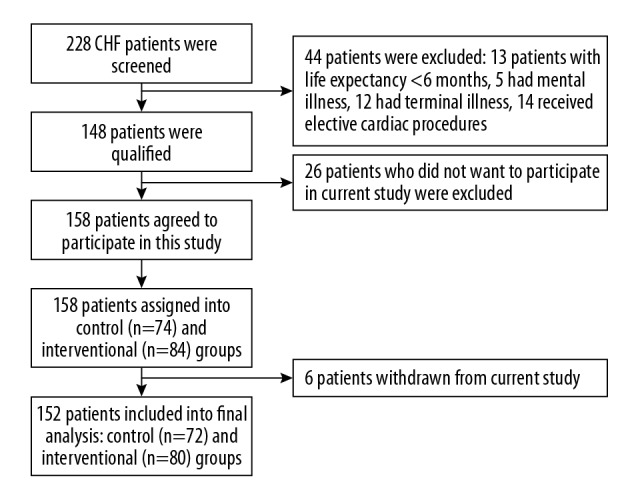
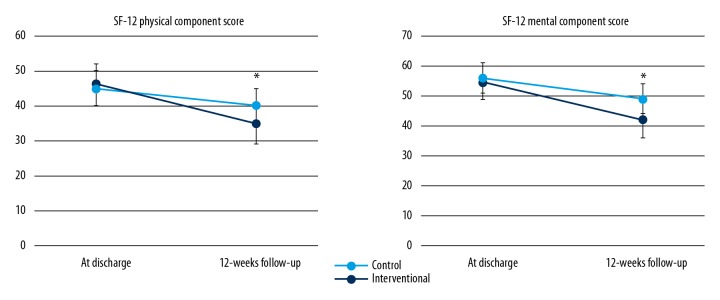
BACKGROUND The aims of the present study were to determine whether a nurse-led program of care can improve medication adherence, quality of life (QoL), rates of rehospitalization, and all-cause mortality for chronic heart failure (CHF) patients. MATERIAL AND METHODS CHF patients were randomly assigned into either a control group or an intervention group. At 12 weeks, patients were followed up to evaluate the rate of medication adherence, QoL (as assessed by SF-12 physical and mental component score [PCS and MCS]), rehospitalization, and all-cause mortality. RESULTS We recruited 152 patients. No significant differences in demographics, comorbidities, CHF severity, or etiology at baseline were observed. At discharge, no significant differences in medications prescription, PCS (46 vs. 45), or MCS (55 vs. 56) were observed. However, at 12-week follow-up, compared to the control group, patients in the intervention group were more likely to keep on medications therapy, with a significantly higher use of angiotensin-converting enzyme inhibitor/angiotensin receptor blocker [73.8% vs. 59.7%], beta-blocker (62.5% vs. 51.4%), and aldosterone receptor antagonist (60% vs. 54.2%). Both PCS (35 vs. 40) and MCS (42 vs. 49) were also significantly lower in the control group versus the intervention groups (P<0.05). Patients in the control group had higher incident rate of rehospitalization (8.0% vs. 5.2% per person-week) than in the intervention group, with an incident rate ratio of 1.54 (95% confidence interval [CI]: 1.06-2.23). CONCLUSIONS A nurse-led discharge program of care can be a cost-effective and feasible approach for management of CHF patients in China.
本研究旨在探讨护士主导的护理方案是否可以提高慢性心力衰竭(CHF)患者的药物依从性、生活质量(QoL)、再住院率和全因死亡率。
将 CHF 患者随机分为对照组和干预组。在 12 周时,对患者进行随访,以评估药物依从性、QoL(通过 SF-12 身体和精神成分评分[PCS 和 MCS]评估)、再住院率和全因死亡率。
共招募了 152 名患者。基线时,两组在人口统计学、合并症、CHF 严重程度或病因方面无显著差异。出院时,两组药物处方、PCS(46 分比 45 分)或 MCS(55 分比 56 分)均无显著差异。然而,在 12 周随访时,与对照组相比,干预组患者更有可能继续药物治疗,血管紧张素转换酶抑制剂/血管紧张素受体阻滞剂的使用率显著更高[73.8%比 59.7%]、β受体阻滞剂(62.5%比 51.4%)和醛固酮受体拮抗剂(60%比 54.2%)。对照组的 PCS(35 分比 40 分)和 MCS(42 分比 49 分)也明显低于干预组(P<0.05)。对照组的再住院率(8.0%比 5.2%/人周)高于干预组,发生率比为 1.54(95%置信区间[CI]:1.06-2.23)。
护士主导的出院护理方案可能是中国 CHF 患者管理的一种具有成本效益且可行的方法。