Campbell Trudy L, Lefaux Béatrice Jenny, Mayer Lori Lee, Namey Marie, Riemer Gisela, Robles-Sanchez Miguel A, White Sarah, Edwards Michael, Minor Charles
J Neurosci Nurs. 2020 Apr;52(2):72-77. doi: 10.1097/JNN.0000000000000495.
Gastrointestinal (GI) adverse events (AEs) are commonly encountered with delayed-release dimethyl fumarate (DMF), an approved treatment for relapsing multiple sclerosis (MS).
Two hundred thirty-nine MS nurses from 7 countries were asked to complete a 2-round Delphi survey developed by a 7-member steering committee. Questions pertained to approaches for mitigating DMF-associated GI AEs.
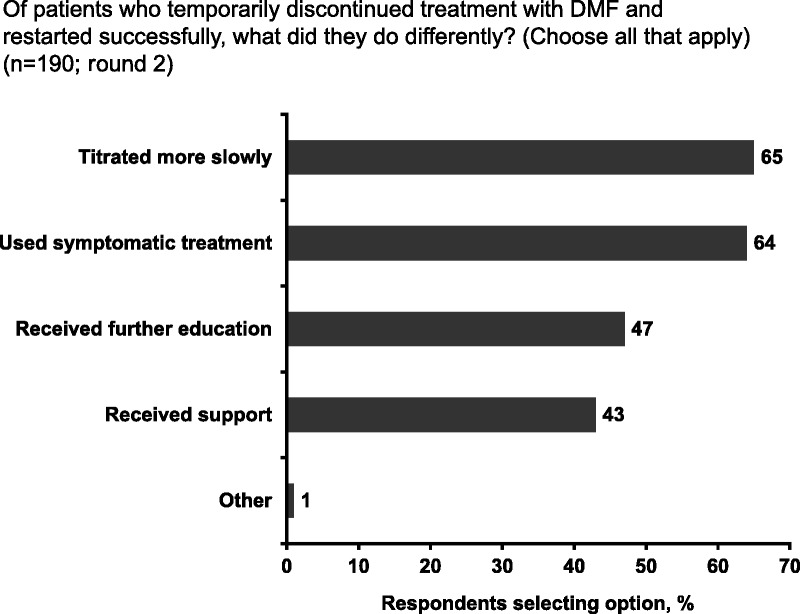
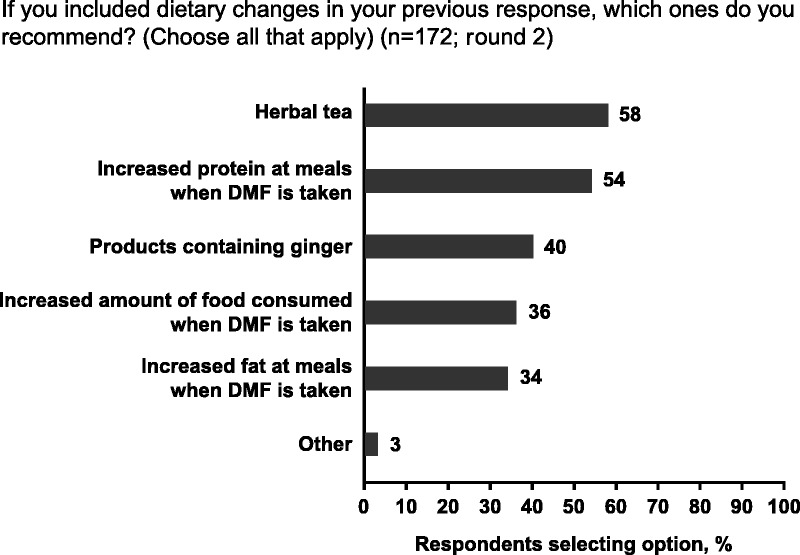
Ninety-six percent of nurses followed the label recommendation for DMF dose titration in round 1, but 77% titrated the DMF dose more slowly than recommended in round 2. Although 86% of nurses advised persons with relapsing forms of MS (PWMS) to take DMF with food, patients were not routinely informed of appropriate types of food to take with DMF. Most nurses recommended both pharmacologic and nonpharmacologic symptomatic therapies for PWMS who experienced GI AEs on DMF. Pharmacologic and nonpharmacologic symptomatic therapies were regarded as equally effective at keeping PWMS on DMF. In round 2, 58% of nurses stated that less than 10% of PWMS who temporarily discontinued DMF went on to permanently discontinue treatment. Sixty-six percent of nurses stated that less than 10% of PWMS permanently discontinued DMF because of GI AEs in the first 6 months of treatment in round 1. Most nurses agreed that patient education on potential DMF-associated GI AEs contributes to adherence.
This first real-world nurse-focused assessment of approaches to caring for PWMS with DMF-associated GI AEs suggests that, with implementation of slow dose titration, symptomatic therapies, and educational consultations, most PWMS can remain on DMF and, when necessary after temporary discontinuation, successfully restart DMF.
胃肠道(GI)不良事件(AE)是缓释富马酸二甲酯(DMF)常见的不良反应,DMF是一种已获批用于复发型多发性硬化症(MS)的治疗药物。
来自7个国家的239名MS护士被要求完成由一个7人指导委员会制定的两轮德尔菲调查。问题涉及减轻与DMF相关的胃肠道AE的方法。
在第一轮中,96%的护士遵循了DMF剂量滴定的标签建议,但在第二轮中,77%的护士滴定DMF剂量的速度比建议的要慢。尽管86%的护士建议复发型MS患者(PWMS)在服用DMF时搭配食物,但并未常规告知患者与DMF一起服用的合适食物类型。大多数护士建议对在服用DMF时出现胃肠道AE的PWMS同时采用药物和非药物对症治疗。药物和非药物对症治疗在使PWMS继续服用DMF方面被认为同样有效。在第二轮中,58%的护士表示,暂时停用DMF的PWMS中,不到10%的人最终永久停药。66%的护士表示,在第一轮治疗的前6个月,因胃肠道AE而永久停用DMF的PWMS不到10%。大多数护士同意,对与DMF相关的潜在胃肠道AE进行患者教育有助于提高依从性。
这项首次以护士为中心的针对患有与DMF相关胃肠道AE的PWMS护理方法的真实世界评估表明,通过实施缓慢剂量滴定、对症治疗和教育咨询,大多数PWMS可以继续服用DMF,并且在必要时,在暂时停药后能够成功重新开始服用DMF。