Department of Nursing, Faculty of Health Sciences, University of Granada, Granada, Spain.
Department of Physiology, "José Mataix Verdú" Institute of Nutrition and Food Technology (INYTA) and Biomedical Research Centre (CIBM), University of Granada, Granada, Spain.
PLoS One. 2020 Feb 18;15(2):e0229079. doi: 10.1371/journal.pone.0229079. eCollection 2020.
To analyse i) the association of physical fitness during early second trimester and late pregnancy with maternal and neonatal outcomes; and ii) to investigate whether physical fitness is associated with the type of birth (vaginal or caesarean section).
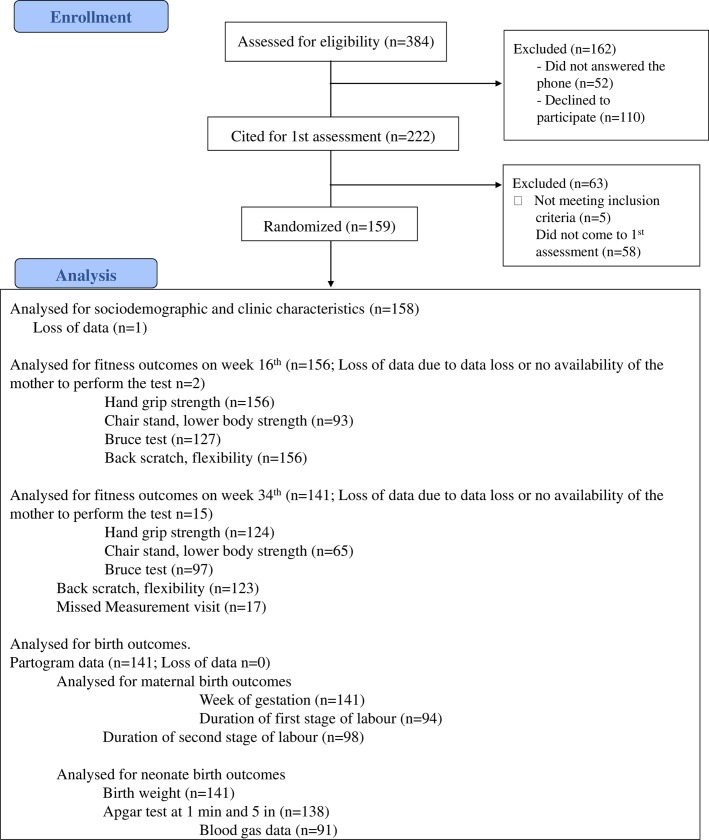
Pregnant women from the GESTAFIT Project (n = 159) participated in this longitudinal study. Maternal physical fitness including upper- and lower-body strength, cardiorespiratory fitness (CRF) and flexibility were measured through objective physical fitness tests at the 16th and 34th gestational weeks. Maternal and neonatal outcomes were collected from obstetric medical records. Umbilical arterial and venous blood gas pH and partial pressure of carbon dioxide (PCO2) and oxygen (PO2), were assessed.
At the 16th week, greater upper-body muscle strength was associated with greater neonatal birth weight (r = 0.191, p<0.05). Maternal flexibility was associated with a more alkaline arterial pH (r = 0.220, p<0.05), higher arterial PO2 (r = 0.237, p<0.05) and lower arterial PCO2 (r = -0.331, p<0.01) in umbilical cord blood. Maternal CRF at the 16th gestational week was related to higher arterial umbilical cord PO2 (r = 0.267, p<0.05). The women who had caesarean sections had lower CRF (p<0.001) at the 16th gestational week and worse clustered overall physical fitness, both at the 16th (-0.227, p = 0.003, confidence interval (CI): -0.376, -0.078) and 34th gestational week (-0.223; p = 0.018; CI: -0.432, -0.015) compared with the women who had vaginal births.
Increasing physical fitness during pregnancy may promote better neonatal outcomes and is associated with a decrease in the risk of caesarean section. This trial was registered at ClinicalTrials.gov (NCT02582567) on October 20, 2015.
分析(i) 孕早期和孕晚期的身体状况与母婴结局的关系;(ii) 探讨身体状况是否与分娩方式(阴道分娩或剖宫产)有关。
159 名参与 GESTAFIT 项目的孕妇参与了这项纵向研究。通过在第 16 周和第 34 周进行客观的体能测试,测量了孕妇的上、下身力量、心肺功能(CRF)和柔韧性等身体状况。从产科病历中收集了母婴结局数据。还评估了脐动脉和静脉血气的 pH 值和二氧化碳分压(PCO2)和氧分压(PO2)。
在第 16 周时,上半身肌肉力量越大,新生儿出生体重越大(r = 0.191,p<0.05)。产妇的柔韧性与脐动脉血更碱性的 pH 值(r = 0.220,p<0.05)、更高的动脉 PO2(r = 0.237,p<0.05)和更低的动脉 PCO2(r = -0.331,p<0.01)有关。第 16 孕周时,产妇的 CRF 与较高的动脉脐动脉 PO2 有关(r = 0.267,p<0.05)。行剖宫产的女性在第 16 孕周时的 CRF 较低(p<0.001),且在第 16 周(-0.227,p = 0.003,置信区间(CI):-0.376,-0.078)和第 34 周(-0.223;p = 0.018;CI:-0.432,-0.015)时整体身体状况聚类较差,与阴道分娩的女性相比。
孕期增加身体状况可能会促进新生儿结局的改善,并与剖宫产风险的降低有关。该试验于 2015 年 10 月 20 日在 ClinicalTrials.gov(NCT02582567)注册。