Michel Lars, Mincu Raluca I, Mrotzek Simone M, Korste Sebastian, Neudorf Ulrich, Rassaf Tienush, Totzeck Matthias
Department of Cardiology and Vascular Medicine, West German Heart and Vascular Center, Medical Faculty, University Hospital Essen, Hufelandstraße 55, 45147, Essen, Germany.
Department of Pediatrics, Medical Faculty, University Hospital Essen, Hufelandstraße 55, 45147, Essen, Germany.
ESC Heart Fail. 2020 Apr;7(2):423-433. doi: 10.1002/ehf2.12589. Epub 2020 Feb 18.
Childhood cancer therapy is associated with a significant risk of therapy-related cardiotoxicity. This meta-analysis aims to evaluate cardiac biomarkers for the detection of cancer therapy-related left ventricular (LV) dysfunction in childhood cancer patients.
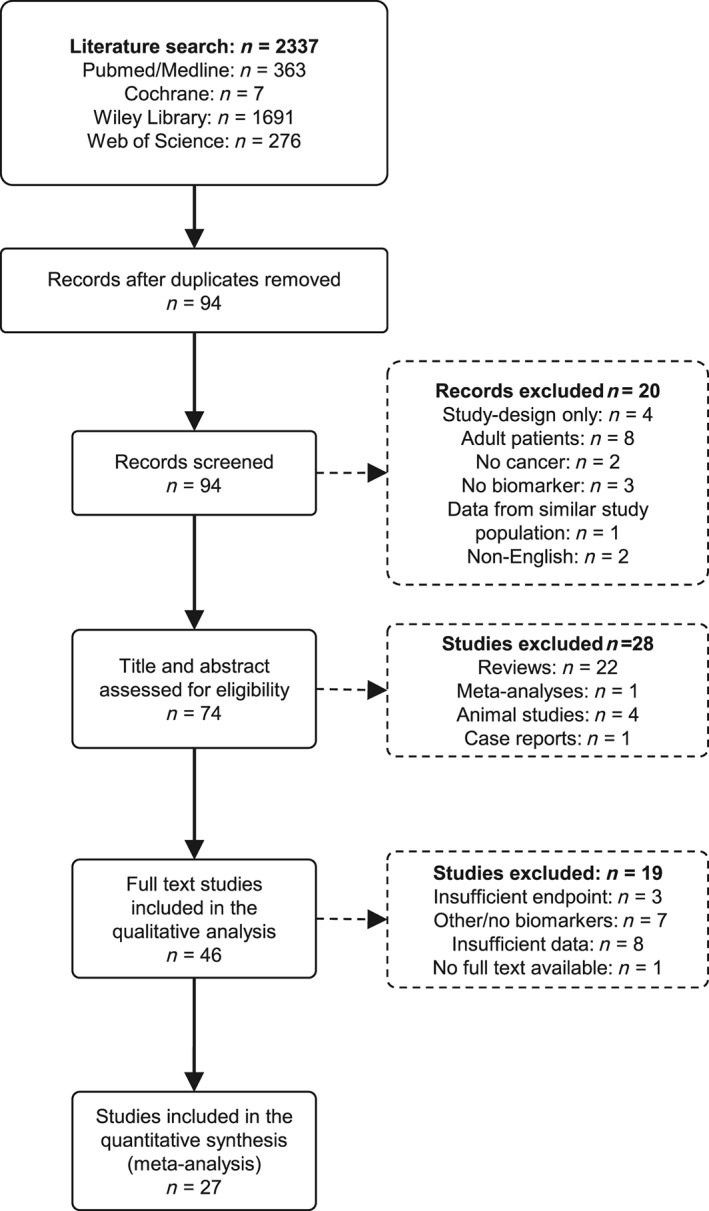
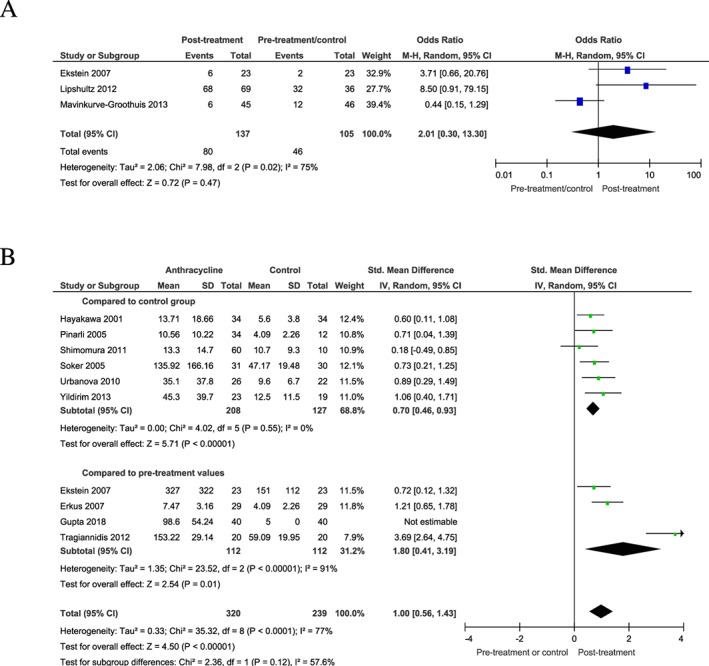
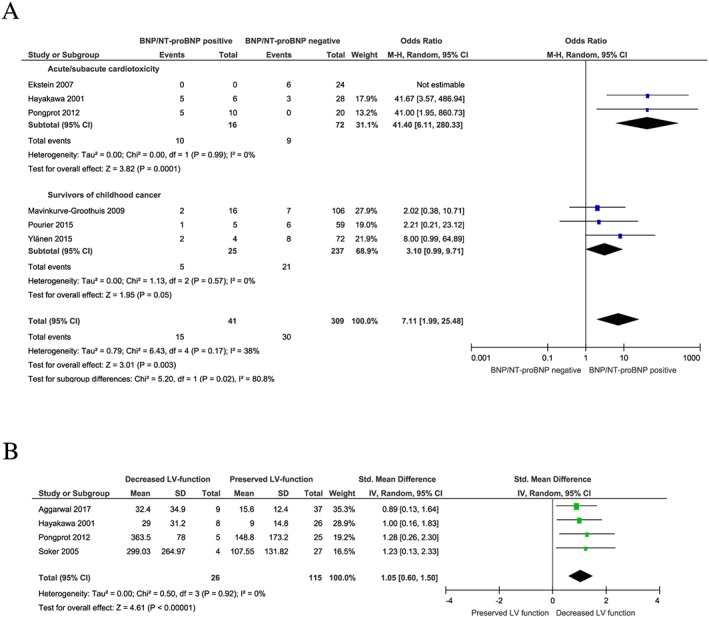
PubMed, Cochrane Library, Wiley Library, and Web of Science were screened for studies investigating brain natriuretic peptide (BNP)/N-terminal proBNP (NT-proBNP) or cardiac troponin in childhood cancer patients. The odds ratios (OR) for elevation of cardiac biomarkers and association with LV dysfunction were calculated using a random-effects model. Data from 27 studies with 1651 subjects were included. BNP/NT-proBNP levels were higher post-treatment compared with controls or pre-treatment values [standardized mean difference = 1.0; 95% confidence interval (CI) = 0.6-1.4; n = 320; P < 0.001]. LV dysfunction was present in 11.76% of included patients, and risk for LV dysfunction was increased in patients with elevated BNP/NT-proBNP (OR = 7.1; 95% CI = 2.0-25.5; n = 350; P = 0.003). The sensitivity of BNP/NT-proBNP for the detection of LV dysfunction was 33.3%, and the specificity was 91.5%. Sensitivity increased when selecting for studies that assessed patients < 5 years after anthracycline exposure and for studies including high cumulative anthracycline doses. Anthracycline chemotherapy was associated with an increased frequency of elevated troponin (OR = 3.7; 95% CI = 2.1-6.5; n = 348; P < 0.001). The available evidence on the association between elevated troponin and LV dysfunction was insufficient for an adequate analysis. In five included studies, the frequency of LV dysfunction was not increased in patients with elevated troponin (OR = 2.5; 95% CI = 0.5-13.2; n = 179; P = 0.53).
BNP/NT-proBNP is associated with cardiotoxicity in paediatric cancer patients receiving anthracycline therapy, but owing to low sensitivity, BNP/NT-proBNP has to be evaluated in the context of further parameters including clinical assessment and echocardiography. Future studies are needed to determine whether troponin serves as a marker for cardiotoxicity in children. Standardized recommendations for the application of cardiac biomarkers in children undergoing cardiotoxic cancer therapy may benefit management and clinical outcome.
儿童癌症治疗与显著的治疗相关心脏毒性风险相关。本荟萃分析旨在评估心脏生物标志物,以检测儿童癌症患者中与癌症治疗相关的左心室(LV)功能障碍。
检索了PubMed、Cochrane图书馆、Wiley图书馆和Web of Science,以查找研究儿童癌症患者脑钠肽(BNP)/N末端前脑钠肽(NT-proBNP)或心肌肌钙蛋白的研究。使用随机效应模型计算心脏生物标志物升高的比值比(OR)以及与左心室功能障碍的关联。纳入了27项研究共1651名受试者的数据。与对照组或治疗前值相比,治疗后BNP/NT-proBNP水平更高[标准化均数差=1.0;95%置信区间(CI)=0.6-1.4;n=320;P<0.001]。纳入患者中11.76%存在左心室功能障碍,BNP/NT-proBNP升高的患者左心室功能障碍风险增加(OR=7.1;95%CI=2.0-25.5;n=350;P=0.003)。BNP/NT-proBNP检测左心室功能障碍的敏感性为33.3%,特异性为91.5%。当选择评估蒽环类药物暴露后<5年患者的研究以及包括高累积蒽环类药物剂量的研究时,敏感性增加。蒽环类化疗与肌钙蛋白升高频率增加相关(OR=3.7;95%CI=2.1-6.5;n=348;P<0.001)。关于肌钙蛋白升高与左心室功能障碍之间关联的现有证据不足以进行充分分析。在五项纳入研究中,肌钙蛋白升高的患者左心室功能障碍频率未增加(OR=2.5;95%CI=0.5-13.2;n=179;P=0.53)。
BNP/NT-proBNP与接受蒽环类治疗的儿科癌症患者的心脏毒性相关,但由于敏感性较低,必须结合包括临床评估和超声心动图在内的其他参数来评估BNP/NT-proBNP。需要进一步研究以确定肌钙蛋白是否可作为儿童心脏毒性的标志物。关于心脏生物标志物在接受心脏毒性癌症治疗的儿童中的应用的标准化建议可能有助于管理和临床结局。