Wits Research Institute for Malaria, School of Pathology, Faculty of Health Sciences, University of the Witwatersrand, Johannesburg, South Africa.
Inqaba Biotechnical Industries, PO Box 14356, Hatfield, 0028, Pretoria, South Africa.
Parasit Vectors. 2020 Feb 18;13(1):87. doi: 10.1186/s13071-020-3962-1.
Anopheles funestus (s.s.) is a primary vector of the malaria parasite Plasmodium falciparum in Africa, a human pathogen that causes almost half a million deaths each year. The population structure of An. funestus was examined in samples from Uganda and the southern African countries of Malawi, Mozambique, Zambia and Zimbabwe.
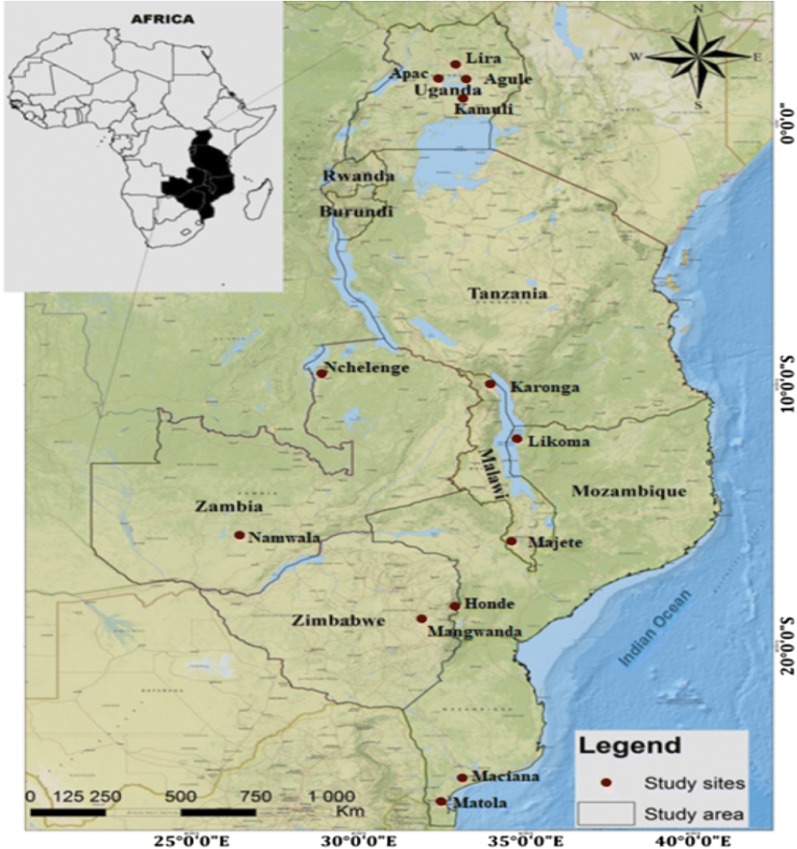
Twelve microsatellites were used to estimate the genetic diversity and differentiation of An. funestus from 13 representative locations across five countries. These were comprised of four sites from Uganda, three from Malawi and two each from Mozambique, Zambia and Zimbabwe.
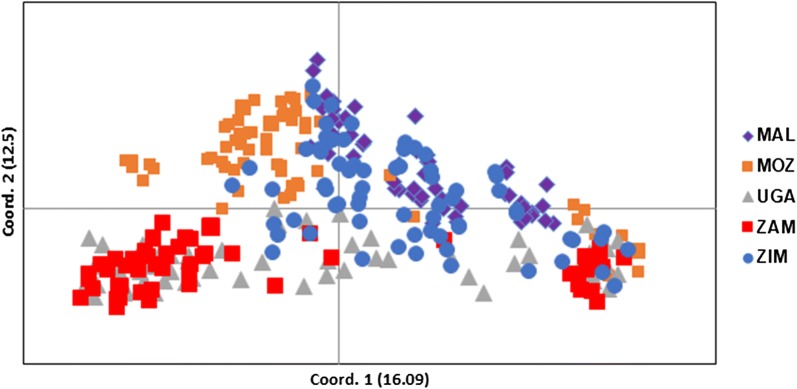
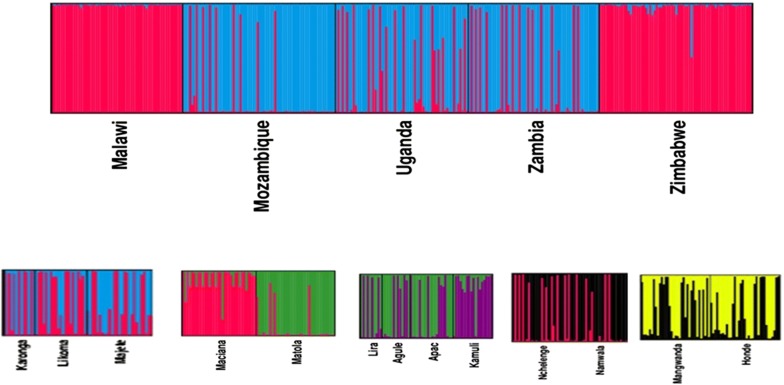
All loci were highly polymorphic across the populations with high allelic richness and heterozygosity. A high genetic diversity was observed with 2-19 alleles per locus and an average number of seven alleles. Overall, expected heterozygosity (H) ranged from 0.65 to 0.79. When samples were pooled three of the 12 microsatellite loci showed Hardy-Weinberg equilibrium. Unsupervised Bayesian clustering analysis of microsatellite data revealed two clusters with An. funestus samples from Mozambique, Uganda and Zambia falling into one group and Malawi and Zimbabwe into another. The overall genetic differentiation between the populations was moderate (F = 0.116). Pairwise differentiation between the pairs was low but significant. A weak but significant correlation was established between genetic and geographical distance for most populations.
High genetic diversity revealed by the loci with low to moderate differentiation, identified two clusters among the An. funestus populations. Further research on the population dynamics of An. funestus in east and southern Africa is essential to understand the implications of this structuring and what effect it may have on the efficient implementation of mosquito vector control strategies.
致倦库蚊(s.s.)是非洲间日疟原虫(Plasmodium falciparum)的主要传播媒介,这种人类病原体每年导致近 50 万人死亡。本研究在乌干达和马拉维、莫桑比克、赞比亚和津巴布韦等南部非洲国家的样本中检查了致倦库蚊的种群结构。
使用 12 个微卫星来估计来自五个国家 13 个代表性地点的致倦库蚊的遗传多样性和分化。这些样本包括来自乌干达的四个地点、马拉维的三个地点、莫桑比克的两个地点、赞比亚的两个地点和津巴布韦的两个地点。
所有种群的所有位点都高度多态,具有丰富的等位基因和杂合度。观察到遗传多样性较高,每个位点有 2-19 个等位基因,平均 7 个等位基因。总体而言,预期杂合度(H)范围为 0.65 至 0.79。当将样本汇总时,12 个微卫星位点中的 3 个显示出哈迪-温伯格平衡。微卫星数据分析的无监督贝叶斯聚类分析显示出两个聚类,莫桑比克、乌干达和赞比亚的致倦库蚊样本聚集在一个群组中,马拉维和津巴布韦的样本聚集在另一个群组中。种群间的总体遗传分化程度适中(F=0.116)。大多数种群之间的成对分化程度较低但显著。大多数种群中都建立了遗传距离与地理距离之间的弱但显著的相关性。
低至中等分化的位点揭示了高度的遗传多样性,确定了致倦库蚊种群中的两个聚类。进一步研究东非和南部非洲致倦库蚊的种群动态对于了解这种结构的影响以及它可能对蚊媒控制策略的有效实施产生的影响至关重要。