Institute of Analytical Chemistry, Chemo- and Biosensors, University of Regensburg, Universitätsstraße 31, 93053, Regensburg, Germany.
Anal Bioanal Chem. 2020 Sep;412(24):6295-6305. doi: 10.1007/s00216-020-02503-0. Epub 2020 Feb 18.
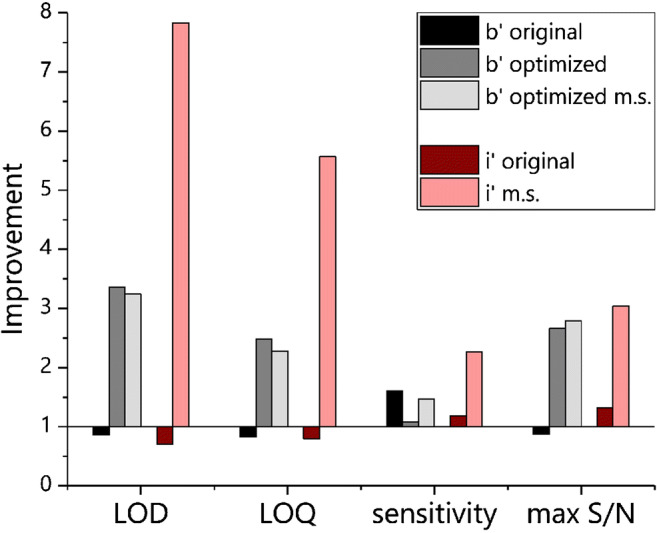
Magnetized liposome (magnetosomes) labels can overcome diffusion limitations in bioassays through fast and easy magnetic attraction. Our aim therefore was to advance the understanding of factors influencing their synthesis focusing on encapsulation strategies and synthesis parameters. Magnetosome synthesis is governed by the surface chemistry and the size of the magnetic nanoparticles used. We therefore studied the two possible magnetic labelling strategies, which are the incorporation of small, hydrophobic magnetic nanoparticles (MNPs) into the bilayer core (b-liposomes) and the entrapment of larger hydrophilic MNPs into the liposomes' inner cavity (i-liposomes). Furthermore, they were optimized and compared for application in a DNA bioassay. The major obstacles observed for each of these strategies were on the one hand the need for highly concentrated hydrophilic MNPs, which is limited by their colloidal stability and costs, and on the other hand the balancing of magnetic strength vs. size for the hydrophobic MNPs. In the end, both strategies yielded magnetosomes with good performance, which improved the limit of detection of a non-magnetic DNA hybridization assay by a factor of 3-8-fold. Here, i-liposomes with a magnetization yield of 5% could be further improved through a simple magnetic pre-concentration step and provided in the end an 8-fold improvement of the limit of detection compared with non-magnetic conditions. In the case of b-liposomes, Janus-like particles were generated during the synthesis and yielded a fraction of 15% magnetosomes directly. Surprisingly, further magnetic pre-concentration did not improve their bioassay performance. It is thus assumed that magnetosomes pull normal liposomes through the magnetic field towards the surface and the presence of more magnetosomes is not needed. The overall stability of magnetosomes during storage and magnetic action, their superior bioassay performance, and their adaptability towards size and surface chemistry of MNPs makes them highly valuable signal enhancers in bioanalysis and potential tools for bioseparations. Graphical abstract.
磁性脂质体(磁小体)标签可以通过快速简便的磁吸引克服生物测定中的扩散限制。因此,我们的目标是通过重点研究封装策略和合成参数来加深对影响其合成的因素的理解。磁小体的合成受用于合成的磁性纳米颗粒的表面化学性质和尺寸控制。因此,我们研究了两种可能的磁性标记策略,即将小的疏水性磁性纳米颗粒(MNPs)掺入双层核心(b-脂质体)和将较大的亲水性 MNPs 包封在脂质体的内腔(i-脂质体)中。此外,还对它们进行了优化并比较了它们在 DNA 生物测定中的应用。对于每种策略,观察到的主要障碍一方面是需要高浓度的亲水性 MNPs,这受到其胶体稳定性和成本的限制,另一方面是需要平衡疏水性 MNPs 的磁性强度与尺寸。最终,这两种策略都产生了性能良好的磁小体,这将非磁性 DNA 杂交测定的检测限提高了 3-8 倍。在此,通过简单的磁预浓缩步骤,磁化率为 5%的 i-脂质体可以进一步提高,最终与非磁性条件相比,检测限提高了 8 倍。对于 b-脂质体,在合成过程中会产生类似 Janus 的颗粒,并且直接产生 15%的磁小体分数。令人惊讶的是,进一步的磁预浓缩并没有改善它们的生物测定性能。因此,可以假设磁小体通过磁场将正常的脂质体拉向表面,并且不需要更多的磁小体。磁小体在储存和磁作用过程中的整体稳定性、它们优越的生物测定性能以及它们对 MNPs 的尺寸和表面化学性质的适应性,使它们成为生物分析中非常有价值的信号增强剂,并且可能成为生物分离的工具。