• 文献检索
  • 文档翻译
  • 深度研究
  • 学术资讯
  • Suppr Zotero 插件Zotero 插件
  • 邀请有礼
  • 套餐&价格
  • 历史记录
应用&插件
Suppr Zotero 插件Zotero 插件浏览器插件Mac 客户端Windows 客户端微信小程序
定价
高级版会员购买积分包购买API积分包
服务
文献检索文档翻译深度研究API 文档MCP 服务
关于我们
关于 Suppr公司介绍联系我们用户协议隐私条款
关注我们

Suppr 超能文献

核心技术专利:CN118964589B侵权必究
粤ICP备2023148730 号-1Suppr @ 2026

文献检索

告别复杂PubMed语法,用中文像聊天一样搜索,搜遍4000万医学文献。AI智能推荐,让科研检索更轻松。

立即免费搜索

文件翻译

保留排版,准确专业,支持PDF/Word/PPT等文件格式,支持 12+语言互译。

免费翻译文档

深度研究

AI帮你快速写综述,25分钟生成高质量综述,智能提取关键信息,辅助科研写作。

立即免费体验

三个月大的婴儿对恐惧面孔表现出更强的行为和神经敏感性。

Three-month-old infants show enhanced behavioral and neural sensitivity to fearful faces.

机构信息

Department of Psychology, Ryerson University, Toronto, Ontario, Canada; Diagnostic Imaging, Hospital for Sick Children, Toronto, Ontario, Canada; Neurosciences and Mental Health Program, Research Institute, Hospital for Sick Children, Toronto, Ontario, Canada.

Department of Psychology, Ryerson University, Toronto, Ontario, Canada.

出版信息

Dev Cogn Neurosci. 2020 Apr;42:100759. doi: 10.1016/j.dcn.2020.100759. Epub 2020 Jan 28.

DOI:10.1016/j.dcn.2020.100759
PMID:32072932
原文链接:https://pmc.ncbi.nlm.nih.gov/articles/PMC7015984/
Abstract

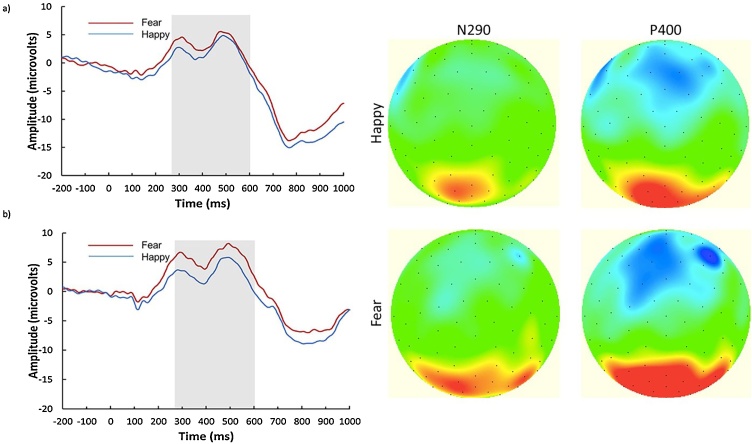
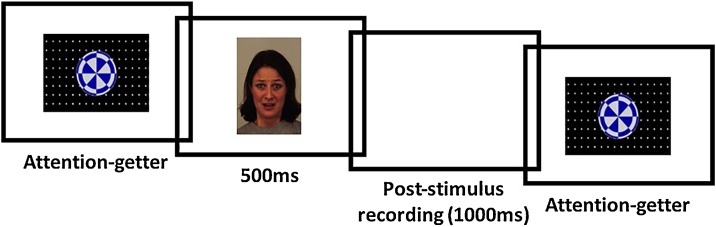
An important feature of the development of emotion recognition in infants is the emergence of a robust attentional bias for fearful faces. There is some debate about when this enhanced sensitivity to fearful expressions develops. The current study explored whether 3-month-olds demonstrate differential behavioral and neural responding to happy and fearful faces. Three-month-old infants (n = 69) participated in a behavioral task that assessed whether they show a visual preference for fearful faces and an event-related potential (ERP) task that assessed their neural responses to fearful and happy faces. Infants showed a looking preference for fearful over happy faces. They also showed differential neural responding over occiptotemporal regions that have been implicated in face perception (i.e., N290, P400), but not over frontocentral regions that have been implicated in attentional processes (i.e., Nc). These findings suggest that 3-month-olds display an early perceptual sensitivity to fearful faces, which may presage the emergence of the attentional bias for fearful faces in older infants. Tracking the ontogeny of this phenomenon is necessary to understand its relationship with later developmental outcomes.

摘要

婴儿情绪识别发展的一个重要特征是对恐惧面孔出现强烈的注意力偏向。对于这种对恐惧表情的敏感性何时增强,存在一些争议。本研究探讨了 3 个月大的婴儿是否对快乐和恐惧面孔表现出不同的行为和神经反应。69 名 3 个月大的婴儿(n=69)参加了一项行为任务,评估他们是否对恐惧面孔表现出视觉偏好,以及一项事件相关电位(ERP)任务,评估他们对恐惧和快乐面孔的神经反应。婴儿对恐惧面孔的注视时间明显长于对快乐面孔的注视时间。他们还在涉及面孔感知的枕颞区域(即 N290、P400)而不是涉及注意力过程的额中央区域(即 Nc)表现出不同的神经反应。这些发现表明,3 个月大的婴儿对恐惧面孔表现出早期的感知敏感性,这可能预示着较大婴儿对恐惧面孔的注意力偏向的出现。追踪这种现象的发生对于理解它与后期发展结果的关系是必要的。

https://cdn.ncbi.nlm.nih.gov/pmc/blobs/a0db/7015984/04feb9c7129d/gr4.jpg
https://cdn.ncbi.nlm.nih.gov/pmc/blobs/a0db/7015984/77c2b79adef1/gr1.jpg
https://cdn.ncbi.nlm.nih.gov/pmc/blobs/a0db/7015984/2ee9c0d5ca1a/gr2.jpg
https://cdn.ncbi.nlm.nih.gov/pmc/blobs/a0db/7015984/7a44ed93a242/gr3.jpg
https://cdn.ncbi.nlm.nih.gov/pmc/blobs/a0db/7015984/04feb9c7129d/gr4.jpg
https://cdn.ncbi.nlm.nih.gov/pmc/blobs/a0db/7015984/77c2b79adef1/gr1.jpg
https://cdn.ncbi.nlm.nih.gov/pmc/blobs/a0db/7015984/2ee9c0d5ca1a/gr2.jpg
https://cdn.ncbi.nlm.nih.gov/pmc/blobs/a0db/7015984/7a44ed93a242/gr3.jpg
https://cdn.ncbi.nlm.nih.gov/pmc/blobs/a0db/7015984/04feb9c7129d/gr4.jpg

相似文献

1
Three-month-old infants show enhanced behavioral and neural sensitivity to fearful faces.三个月大的婴儿对恐惧面孔表现出更强的行为和神经敏感性。
Dev Cogn Neurosci. 2020 Apr;42:100759. doi: 10.1016/j.dcn.2020.100759. Epub 2020 Jan 28.
2
Signatures of emotional face processing measured by event-related potentials in 7-month-old infants.7 个月大婴儿的事件相关电位测量的情绪面孔处理特征。
Dev Psychobiol. 2023 Mar;65(2):e22361. doi: 10.1002/dev.22361.
3
What drives the attentional bias for fearful faces? An eye-tracking investigation of 7-month-old infants' visual scanning patterns.是什么导致了对恐惧面孔的注意力偏差?一项对7个月大婴儿视觉扫描模式的眼动追踪研究。
Infancy. 2020 Sep;25(5):658-676. doi: 10.1111/infa.12351. Epub 2020 Jun 21.
4
Neural correlates of facial emotion processing in infancy.婴儿期面部情绪处理的神经关联。
Dev Sci. 2019 May;22(3):e12758. doi: 10.1111/desc.12758. Epub 2018 Oct 16.
5
An ERP study of emotional face processing in the adult and infant brain.一项关于成人和婴儿大脑中情绪面孔加工的事件相关电位研究。
Child Dev. 2007 Jan-Feb;78(1):232-45. doi: 10.1111/j.1467-8624.2007.00994.x.
6
Fearful but not happy expressions boost face detection in human infants.恐惧而非快乐的表情能提高人类婴儿对面部的检测能力。
Proc Biol Sci. 2017 Sep 13;284(1862). doi: 10.1098/rspb.2017.1054.
7
The developmental emergence of unconscious fear processing from eyes during infancy.婴儿期无意识的眼部恐惧加工的发展性出现。
J Exp Child Psychol. 2016 Feb;142:334-43. doi: 10.1016/j.jecp.2015.09.009. Epub 2015 Oct 20.
8
Looking to the eyes influences the processing of emotion on face-sensitive event-related potentials in 7-month-old infants.注视眼睛会影响7个月大婴儿对面部敏感事件相关电位的情绪处理。
Dev Neurobiol. 2015 Oct;75(10):1154-63. doi: 10.1002/dneu.22204. Epub 2014 Jun 26.
9
Putting the face in context: Body expressions impact facial emotion processing in human infants.将面部置于情境中:身体表情影响人类婴儿的面部情绪处理。
Dev Cogn Neurosci. 2016 Jun;19:115-21. doi: 10.1016/j.dcn.2016.01.004. Epub 2016 Feb 17.
10
Infants' neural responses to emotional faces are related to maternal anxiety.婴儿对情绪面孔的神经反应与母亲的焦虑有关。
J Child Psychol Psychiatry. 2022 Feb;63(2):152-164. doi: 10.1111/jcpp.13429. Epub 2021 May 16.

引用本文的文献

1
Using novel neural measures to explore the development of infant attention bias to threat.运用新颖的神经测量方法探索婴儿对威胁的注意力偏向的发展。
Dev Psychol. 2025 Aug 28. doi: 10.1037/dev0002066.
2
Associations between attentional biases to fearful faces and social-emotional development in infants with and without an older sibling with autism.注意到恐惧面孔的婴儿与有或没有自闭症年长兄弟姐妹的社会情感发展之间的关联。
Infant Behav Dev. 2023 May;71:101811. doi: 10.1016/j.infbeh.2023.101811. Epub 2023 Mar 16.
3
Signatures of emotional face processing measured by event-related potentials in 7-month-old infants.

本文引用的文献

1
Early development of attention to threat-related facial expressions.注意与威胁相关的面部表情的早期发展。
PLoS One. 2018 May 16;13(5):e0197424. doi: 10.1371/journal.pone.0197424. eCollection 2018.
2
The impact of negative affect on attention patterns to threat across the first 2 years of life.负性情绪对生命最初 2 年对威胁的注意模式的影响。
Dev Psychol. 2017 Dec;53(12):2219-2232. doi: 10.1037/dev0000408. Epub 2017 Oct 12.
3
Fearful but not happy expressions boost face detection in human infants.恐惧而非快乐的表情能提高人类婴儿对面部的检测能力。
7 个月大婴儿的事件相关电位测量的情绪面孔处理特征。
Dev Psychobiol. 2023 Mar;65(2):e22361. doi: 10.1002/dev.22361.
4
Infant and maternal responses to emotional facial expressions: A longitudinal study.婴儿和产妇对情绪面部表情的反应:一项纵向研究。
Infant Behav Dev. 2023 May;71:101818. doi: 10.1016/j.infbeh.2023.101818. Epub 2023 Feb 3.
5
Associations between vocal emotion recognition and socio-emotional adjustment in children.儿童语音情感识别与社会情感适应之间的关联。
R Soc Open Sci. 2021 Nov 17;8(11):211412. doi: 10.1098/rsos.211412. eCollection 2021 Nov.
6
Peak selection and latency jitter correction in developmental event-related potentials.发育事件相关电位中的峰选择和潜伏期抖动校正。
Dev Psychobiol. 2021 Nov;63(7):e22193. doi: 10.1002/dev.22193.
7
Maternal odor reduces the neural response to fearful faces in human infants.母体气味降低人类婴儿对恐惧面孔的神经反应。
Dev Cogn Neurosci. 2020 Oct;45:100858. doi: 10.1016/j.dcn.2020.100858. Epub 2020 Sep 8.
Proc Biol Sci. 2017 Sep 13;284(1862). doi: 10.1098/rspb.2017.1054.
4
Recognizing facial expressions of emotion in infancy: A replication and extension.识别婴儿期的情感面部表情:一项重复与扩展研究。
Dev Psychobiol. 2017 May;59(4):507-514. doi: 10.1002/dev.21515. Epub 2017 Apr 3.
5
Maternal anxiety predicts attentional bias towards threat in infancy.母亲的焦虑预示着婴儿期对威胁的注意力偏向。
Emotion. 2017 Aug;17(5):874-883. doi: 10.1037/emo0000275. Epub 2017 Feb 16.
6
The Cortical Development of Specialized Face Processing in Infancy.婴儿期专门面部加工的皮层发育
Child Dev. 2016 Sep;87(5):1581-600. doi: 10.1111/cdev.12543. Epub 2016 May 31.
7
The development of attention to dynamic facial emotions.对动态面部表情的注意力发展。
J Exp Child Psychol. 2016 Jul;147:100-10. doi: 10.1016/j.jecp.2016.03.005. Epub 2016 Apr 8.
8
Face Gender Influences the Looking Preference for Smiling Expressions in 3.5-Month-Old Human Infants.面部性别影响3.5个月大人类婴儿对微笑表情的注视偏好。
PLoS One. 2015 Jun 11;10(6):e0129812. doi: 10.1371/journal.pone.0129812. eCollection 2015.
9
Attention to Faces Expressing Negative Emotion at 7 Months Predicts Attachment Security at 14 Months.7个月大时对表达负面情绪的面孔的关注可预测14个月大时的依恋安全性。
Child Dev. 2015 Sep-Oct;86(5):1321-32. doi: 10.1111/cdev.12380. Epub 2015 May 22.
10
The two-process theory of face processing: modifications based on two decades of data from infants and adults.面孔加工的双加工理论:基于婴儿和成人二十年数据的修正。
Neurosci Biobehav Rev. 2015 Mar;50:169-79. doi: 10.1016/j.neubiorev.2014.10.009. Epub 2014 Oct 25.