Montalti Marco, Kawalec Anna, Leoni Erica, Dallolio Laura
Department of Biomedical and Neuromotor Sciences, Unit of Hygiene, Public Health and Medical Statistics, University of Bologna, via San Giacomo 12, Bologna 40126, Italy.
Department of Hygiene, Wroclaw Medical University, Mikulicza-Radeckiego 7, Wroclaw 50-345, Poland.
Vaccines (Basel). 2020 Feb 14;8(1):86. doi: 10.3390/vaccines8010086.
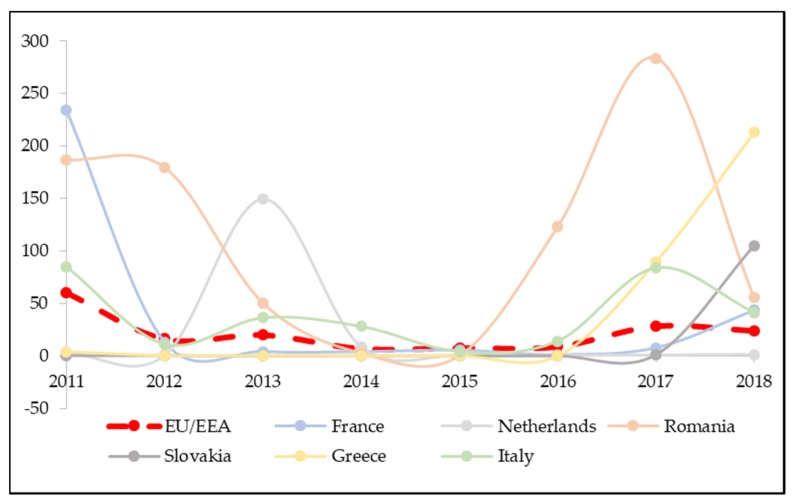
Starting from 2016, a major measles epidemic affected EU/EEA countries, after the measles incidence rate had progressively decreased from 2011 to 2015.
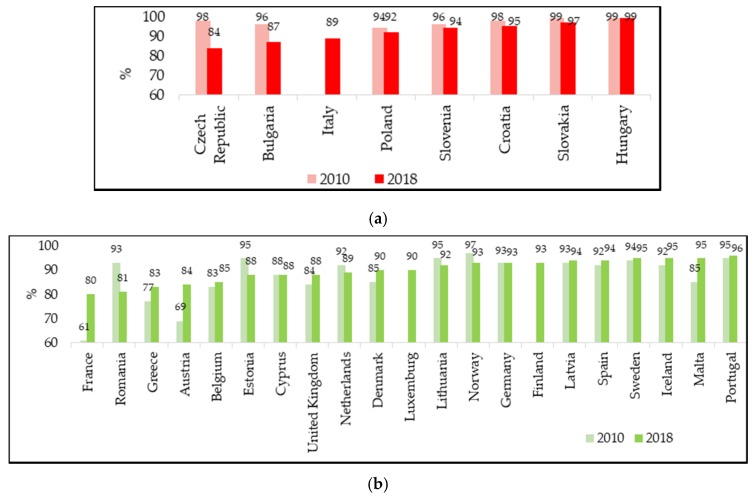
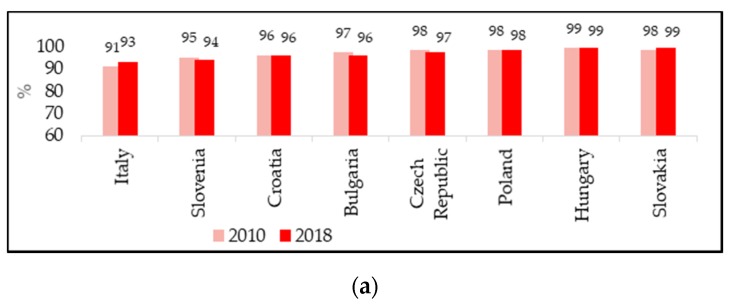
This study describes measles incidences (ECDC reports), the vaccination coverages (VCs) (WHO/UNICEF reports) and the vaccination strategies, whether mandatory or recommended (ECDC Vaccine Scheduler), in 30 European countries over the last decade.
VCs were higher in countries with historically mandatory vaccination. However, in these countries, VCs declined between 2010 and 2018, in two cases to levels below 90% at the second dose. Instead, 9 and 12 countries with recommended vaccination increased their VCs, respectively, for the first and the second dose. Overall, the countries with VC ≥ 95% decreased from 20 to 15 for the first dose and from 10 to 7 for the second dose. This trend led Italy, France and Germany to make vaccination mandatory. In Italy this provision was introduced in 2017, and together with the catch-up campaigns on children between 1 and 15 years at school entry, led immediately to a strong effect: the first dose VC passed from 87% in 2016 to 93% in 2018, and from 82% to 89% for the second dose.
Mandatory vaccination is certainly a policy producing positive effects; however, it seems to require additional strategies in order to reach the WHO goal of 95% of VC. Measures such as catch-up action on susceptible populations and communication strategies aimed at increasing awareness and acceptance should be considered.
自2016年起,在2011年至2015年麻疹发病率逐渐下降之后,一场重大麻疹疫情影响了欧盟/欧洲经济区国家。
本研究描述了过去十年中30个欧洲国家的麻疹发病率(欧洲疾病预防控制中心报告)、疫苗接种覆盖率(世卫组织/联合国儿童基金会报告)以及疫苗接种策略,无论这些策略是强制性的还是推荐性的(欧洲疾病预防控制中心疫苗接种计划)。
在历史上实行强制性疫苗接种的国家中,疫苗接种覆盖率较高。然而,在这些国家,2010年至2018年期间疫苗接种覆盖率有所下降,有两个国家的第二剂接种率降至90%以下。相反,9个和12个实行推荐性疫苗接种的国家,第一剂和第二剂的疫苗接种覆盖率分别有所提高。总体而言,第一剂疫苗接种覆盖率≥95%的国家从20个减少到15个,第二剂从10个减少到7个。这一趋势导致意大利、法国和德国实行强制性疫苗接种。意大利在2017年出台了这一规定,并与针对1至15岁入学儿童的补种活动一起,立即产生了显著效果:第一剂疫苗接种覆盖率从2016年的87%提高到2018年的93%,第二剂从82%提高到89%。
强制性疫苗接种无疑是一项能产生积极效果的政策;然而,为了实现世卫组织95%疫苗接种覆盖率的目标,似乎还需要其他策略。应考虑采取诸如对易感人群进行补种行动以及旨在提高认识和接受度的宣传策略等措施。