Instituto de Neurociencia, Universidad de Valparaíso, Valparaiso, Chile.
BMC Biol. 2020 Feb 19;18(1):17. doi: 10.1186/s12915-020-0742-5.
In insects, continuous growth requires the periodic replacement of the exoskeleton. Once the remains of the exoskeleton from the previous stage have been shed during ecdysis, the new one is rapidly sclerotized (hardened) and melanized (pigmented), a process collectively known as tanning. The rapid tanning that occurs after ecdysis is critical for insect survival, as it reduces desiccation, and gives the exoskeleton the rigidity needed to support the internal organs and to provide a solid anchor for the muscles. This rapid postecdysial tanning is triggered by the "tanning hormone", bursicon. Since bursicon is released into the hemolymph, it has naturally been assumed that it would act on the epidermal cells to cause the tanning of the overlying exoskeleton.
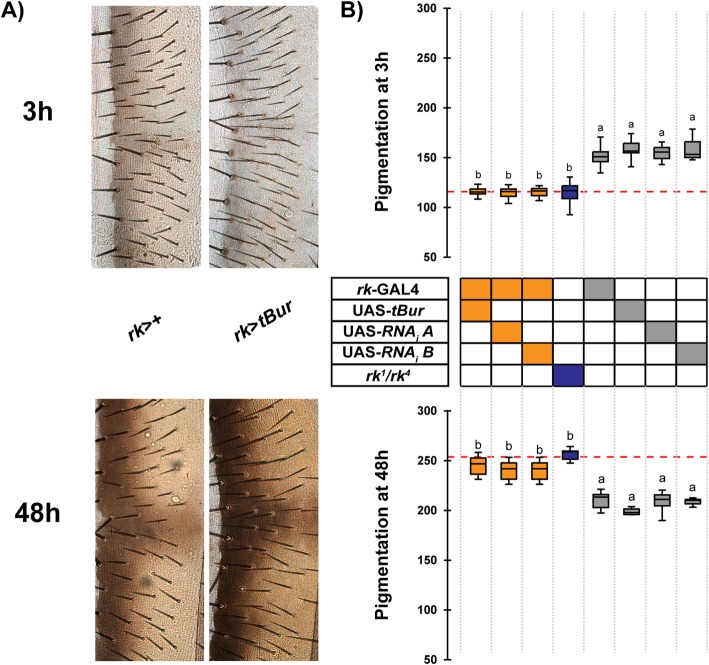
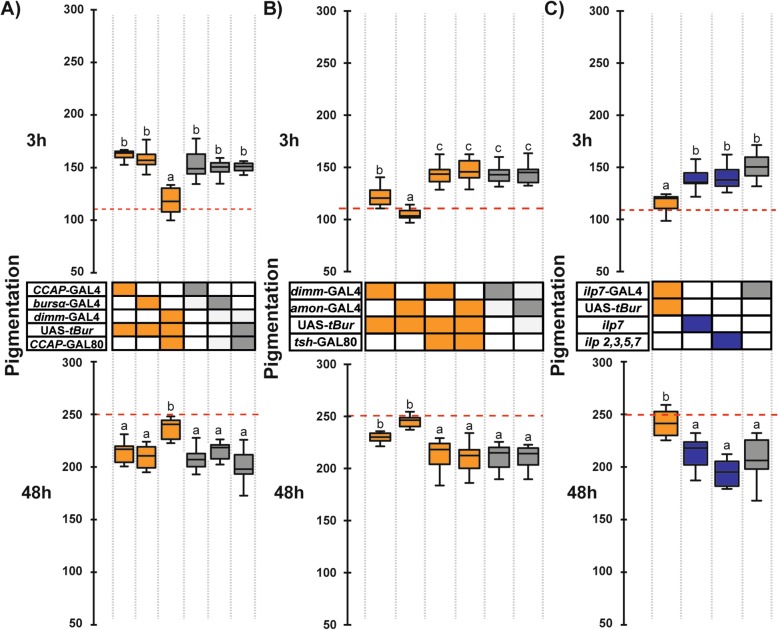
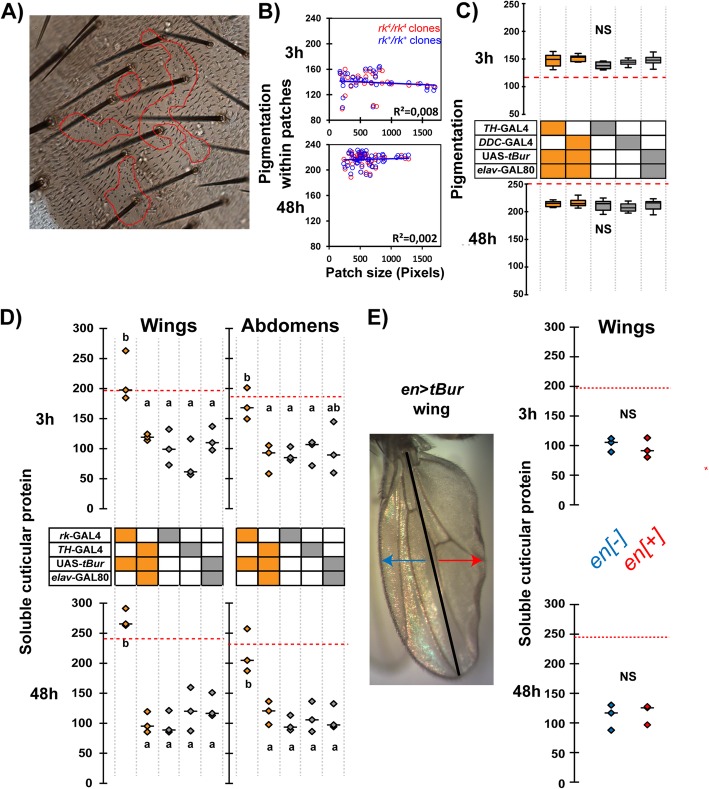
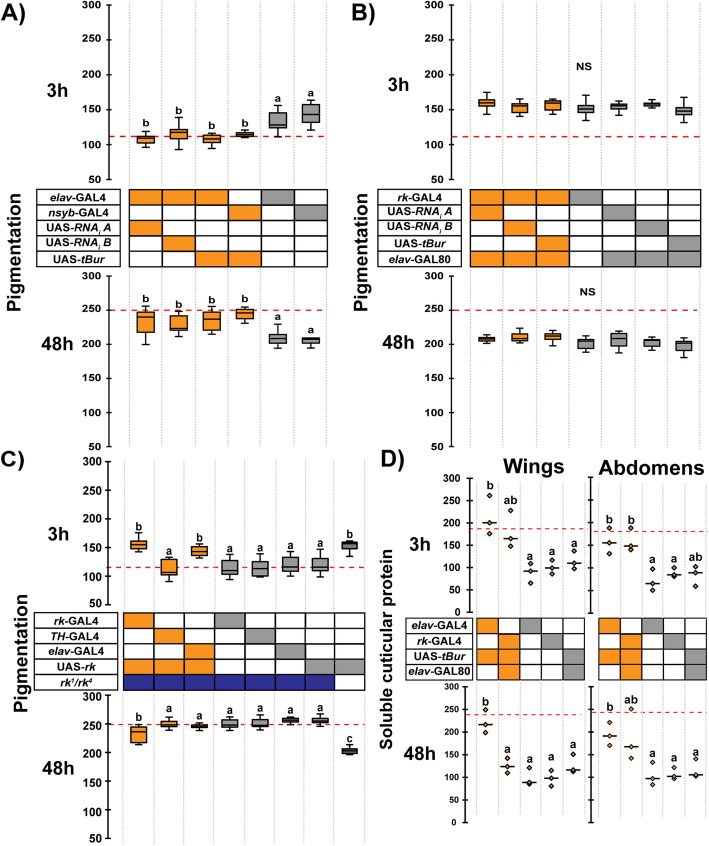
Here we investigated the site of bursicon action in Drosophila by examining the consequences on tanning of disabling the bursicon receptor (encoded by the rickets gene) in different tissues. To our surprise, we found that rapid tanning does not require rickets function in the epidermis but requires it instead in peptidergic neurons of the ventral nervous system (VNS). Although we were unable to identify the signal that is transmitted from the VNS to the epidermis, we show that neurons that express the Drosophila insulin-like peptide ILP7, but not the ILP7 peptide itself, are involved. In addition, we found that some of the bursicon targets involved in melanization are different from those that cause sclerotization.
Our findings show that bursicon does not act directly on the epidermis to cause the tanning of the overlying exoskeleton but instead requires an intermediary messenger produced by peptidergic neurons within the central nervous system. Thus, this work has uncovered an unexpected layer of control in a process that is critical for insect survival, which will significantly alter the direction of future research aimed at understanding how rapid postecdysial tanning occurs.
在昆虫中,连续生长需要周期性地更换外骨骼。一旦蜕皮过程中前一阶段的外骨骼残留物脱落,新的外骨骼就会迅速硬化(变硬)和黑化(着色),这个过程统称为鞣制。蜕皮后发生的快速鞣制对昆虫的生存至关重要,因为它可以减少脱水,并使外骨骼具有支撑内脏的刚性,并为肌肉提供坚实的锚固点。这种快速的蜕皮后鞣制是由“鞣制激素”bursicon 触发的。由于bursicon 被释放到血淋巴中,人们自然认为它会作用于表皮细胞,导致覆盖的外骨骼鞣制。
在这里,我们通过检查不同组织中 bursicon 受体(由 rickets 基因编码)失活对鞣制的影响,研究了 Drosophila 中 bursicon 的作用部位。令我们惊讶的是,我们发现快速鞣制不需要表皮中的 rickets 功能,而是需要腹神经索(VNS)中的肽能神经元。尽管我们无法确定从 VNS 传递到表皮的信号,但我们表明表达果蝇胰岛素样肽 ILP7 的神经元而不是 ILP7 肽本身参与其中。此外,我们发现一些参与黑化的 bursicon 靶标与引起硬化的靶标不同。
我们的研究结果表明,bursicon 不会直接作用于表皮,使覆盖的外骨骼鞣制,而是需要由中枢神经系统内的肽能神经元产生的中间信使。因此,这项工作揭示了一个在对昆虫生存至关重要的过程中意想不到的控制层,这将极大地改变未来旨在了解快速蜕皮后鞣制如何发生的研究方向。