Pereira Rosana Aparecida, de Souza Fabiana Bolela, Rigobello Mayara Carvalho Godinho, Pereira José Rafael, da Costa Laís Rosa Moreno, Gimenes Fernanda Raphael Escobar
Department of General and Specialized Nursing, University of São Paulo at Ribeirão Preto, Ribeirao Preto, São Paulo, Brazil
Department of General and Specialized Nursing, University of São Paulo at Ribeirão Preto, Ribeirao Preto, São Paulo, Brazil.
BMJ Open Qual. 2020 Feb;9(1). doi: 10.1136/bmjoq-2019-000882.
Patients with nasogastric/nasoenteric tube (NGT/NET) are at increased risk of adverse outcomes due to errors occurring during oral medication preparation and administration.
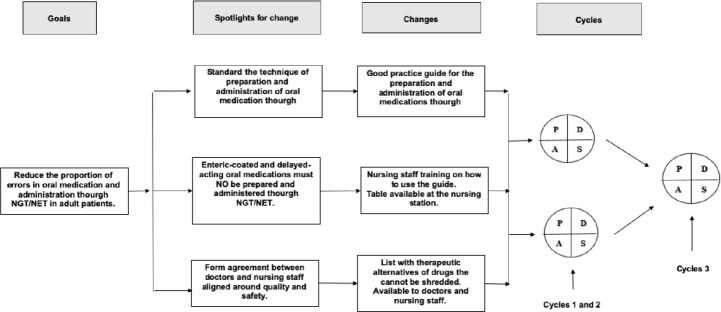
To implement a quality improvement programme to reduce the proportion of errors in oral medication preparation and administration through NGT/NET in adult patients.
An observational study was carried out, comparing outcome measures before and after implementation of the integrated quality programme to improve oral medication preparation and administration through NGT/NET. A collaborative approach based on Plan-Do-Study-Act (PDSA) cycle was used and feedback was given during multidisciplinary meetings.
Good practice guidance for oral medication preparation and administration through NGT/NET was developed and implemented at the hospital sites; nurses were given formal training to use the good practice guidance; a printed list of oral medications that should never be crushed was provided to all members of the multidisciplinary team, and a printed table containing therapeutic alternatives for drugs that should never be crushed was provided to prescribers at the prescribing room.
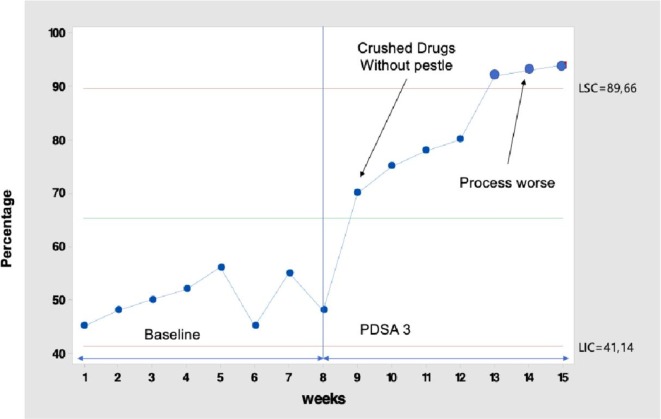
Improvement was observed in the following measures: crushing enteric-coated tablets and mixing drugs during medication preparation (from 54.9% in phase I to 26.2% in phase II; p 0.0010) and triturating pharmaceutical form of modified action or dragee (from 32.8 in phase I to 19.7 in phase II; p 0.0010). Worsening was observed though in the following measures: crush compressed to a fine and homogeneous powder (from 7.4%% in phase I to 95% phase II; p 0.0010) and feeding tube obstruction (from 41.8% in phase I to 52.5% phase II; p 0.0950).
Our results highlight how a collaborative quality improvement approach based on PDSA cycles can meet the challenge of reducing the proportion of errors in oral medication preparation and administration through NGT/NET in adult patients. Some changes may lead to unintended consequences though. Thus, continuous monitoring for these consequences will help caregivers to prevent poor patient outcomes.
由于口服药物制备和给药过程中出现的错误,鼻胃管/鼻肠管(NGT/NET)患者出现不良后果的风险增加。
实施一项质量改进计划,以降低成年患者通过NGT/NET进行口服药物制备和给药时的错误比例。
开展一项观察性研究,比较实施综合质量计划以改进通过NGT/NET进行口服药物制备和给药前后的结果指标。采用基于计划-执行-研究-改进(PDSA)循环的协作方法,并在多学科会议期间提供反馈。
制定并在医院各科室实施通过NGT/NET进行口服药物制备和给药的良好实践指南;对护士进行使用该良好实践指南的正式培训;向多学科团队的所有成员提供一份不应碾碎的口服药物打印清单,并在处方室向开处方者提供一份包含不应碾碎药物的治疗替代方案的打印表格。
在以下指标上观察到改善:药物制备过程中碾碎肠溶衣片和混合药物(从第一阶段的54.9%降至第二阶段的26.2%;p<0.0010)以及研磨缓释制剂或糖衣丸(从第一阶段的32.8降至第二阶段的19.7;p<0.0010)。不过,在以下指标上观察到恶化情况:碾碎压制成细而均匀的粉末(从第一阶段的7.4%升至第二阶段的95%;p<0.0010)和饲管堵塞(从第一阶段的41.8%升至第二阶段的52.5%;p = 0.0950)。
我们的结果凸显了基于PDSA循环的协作式质量改进方法如何能够应对降低成年患者通过NGT/NET进行口服药物制备和给药时的错误比例这一挑战。不过,有些改变可能会导致意外后果。因此,持续监测这些后果将有助于护理人员预防患者出现不良结局。