Mainali Kumar, Shrestha Bharat Babu, Sharma Ravi Kumar, Adhikari Arjun, Gurarie Eliezer, Singer Michael, Parmesan Camille
Department of Integrative Biology The University of Texas at Austin Austin TX USA.
Department of Biology University of Maryland College Park MD USA.
Ecol Evol. 2020 Jan 28;10(3):1209-1222. doi: 10.1002/ece3.5968. eCollection 2020 Feb.
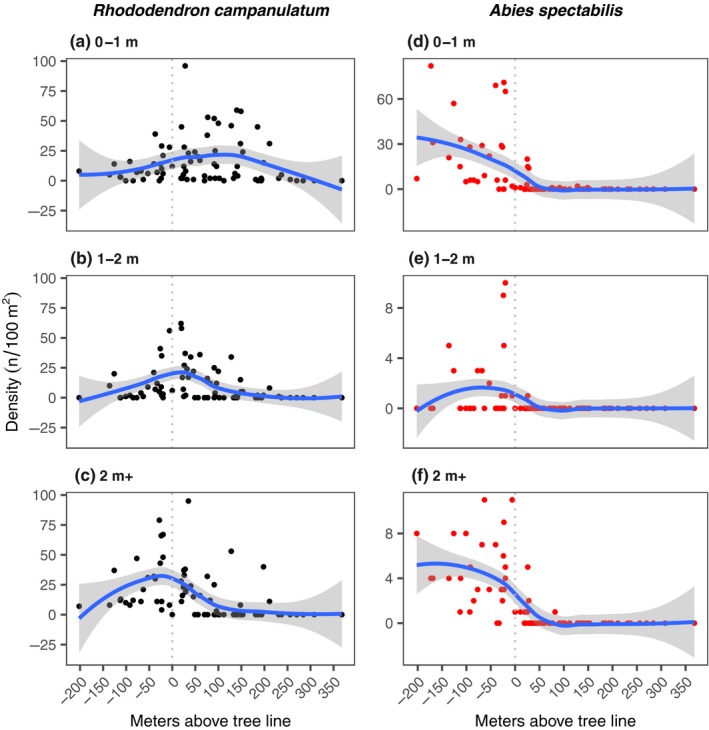
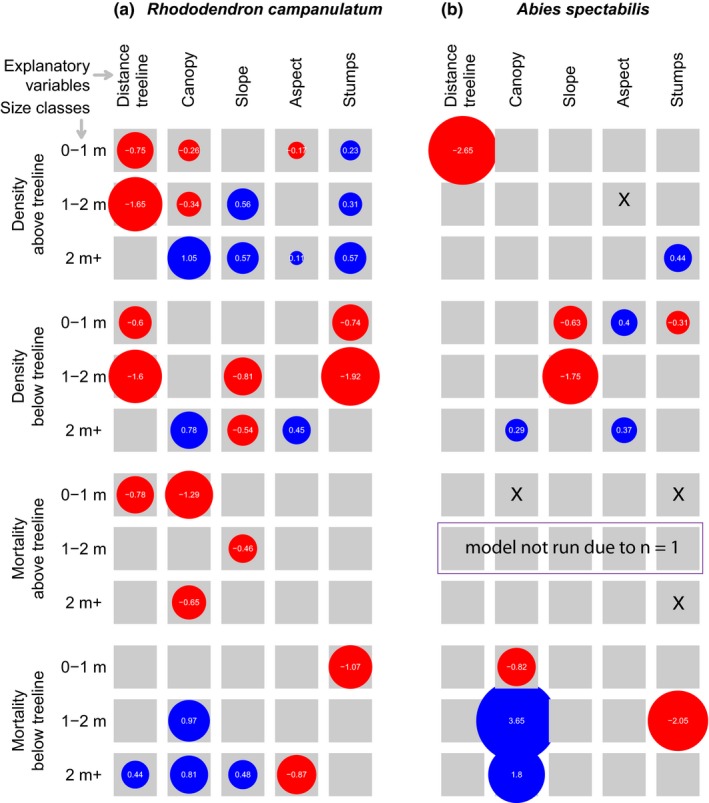
Alpine treelines are expected to shift upward due to recent climate change. However, interpretation of changes in montane systems has been problematic because effects of climate change are frequently confounded with those of land use changes. The eastern Himalaya, particularly Langtang National Park, Central Nepal, has been relatively undisturbed for centuries and thus presents an opportunity for studying climate change impacts on alpine treeline uncontaminated by potential confounding factors.We studied two dominant species, and , above and below the treeline on two mountains. We constructed 13 transects, each spanning up to 400 m in elevation, in which we recorded height and state (dead or alive) of all trees, as well as slope, aspect, canopy density, and measures of anthropogenic and animal disturbance.All size classes of plants had lower mortality above treeline than below it, and young plants (<2 m tall) were at higher density above treeline than below. shows little evidence of a position change from the historic treeline, with a sudden extreme drop in density above treeline compared to below. Recruitment, as measured by size-class distribution, was greater above treeline than below for both species but is confined to ~25 m above treeline whereas is luxuriantly growing up to 200 m above treeline. . Evidence suggests that the elevational limits of have shifted upward both because (a) young plants above treeline benefited from facilitation of recruitment by surrounding vegetation, allowing upward expansion of recruitment, and (b) temperature amelioration to mature plants increased adult survival. We predict that the current pure stand of growing above treeline will be colonized by that will, in turn, outshade and eventually relegate to be a minor component of the community, as is the current situation below the treeline.
由于近期的气候变化,高山林线预计将向上移动。然而,对山地系统变化的解释一直存在问题,因为气候变化的影响常常与土地利用变化的影响相互混淆。东喜马拉雅地区,特别是尼泊尔中部的朗塘国家公园,几个世纪以来相对未受干扰,因此为研究气候变化对未受潜在混杂因素污染的高山林线的影响提供了一个机会。我们研究了两座山上林线上下的两种优势树种。我们构建了13条样带,每条样带海拔跨度达400米,在样带中我们记录了所有树木的高度和状态(死树或活树),以及坡度、坡向、树冠密度,以及人为和动物干扰的测量数据。所有大小级别的某植物在林线以上的死亡率低于林线以下,并且林线以上小于2米高的幼龄某植物密度高于林线以下。某树种几乎没有证据表明其位置相对于历史林线发生了变化,与林线以下相比,林线以上密度突然急剧下降。通过大小级分布衡量的更新情况,两种树种在林线以上都比林线以下更显著,但某树种局限于林线以上约25米的范围,而另一树种则在林线以上高达200米的范围内繁茂生长。有证据表明,某树种的海拔上限已经向上移动,这既是因为(a)林线以上的幼龄植物受益于周围植被对更新的促进作用,使得更新得以向上扩展,也是因为(b)成熟植株所处温度的改善提高了成年植株的存活率。我们预测,目前生长在林线以上的某树种的纯林将被另一树种所占据,而这另一树种反过来又会遮蔽并最终使某树种成为群落中的次要组成部分,就如同目前林线以下的情况一样。