Klinik für Innere Medizin II, Abt. Hämatologie und Intern. Onkologie, Universitätsklinikum Jena, Jena, Germany.
Zentrum für Klinische Studien, Universitätsklinikum Jena, Jena, Germany.
J Cancer Res Clin Oncol. 2020 Apr;146(4):1065-1077. doi: 10.1007/s00432-020-03139-4. Epub 2020 Feb 20.
Hemophagocytic lymphohistiocytosis (HLH) is a severe hyperinflammatory syndrome emerging from a deregulated immune response due to various triggers. In adults, systematic data are sparse, which is why recommendations on diagnosis and management have been adopted from pediatric guidelines. A nationwide clinical registry with associated consulting service as collaborative initiative of HLH-specialized pediatricians and hematologists was initiated to better characterize HLH in adults.
Patients with proven or suspected HLH were registered by 44 institutions. Both HLH-2004 diagnostic criteria and the HScore (www.saintantoine.aphp.fr/score/) were used to confirm HLH diagnosis. Data referring to underlying disease, treatment, outcome, clinical presentation and laboratory findings were recorded.
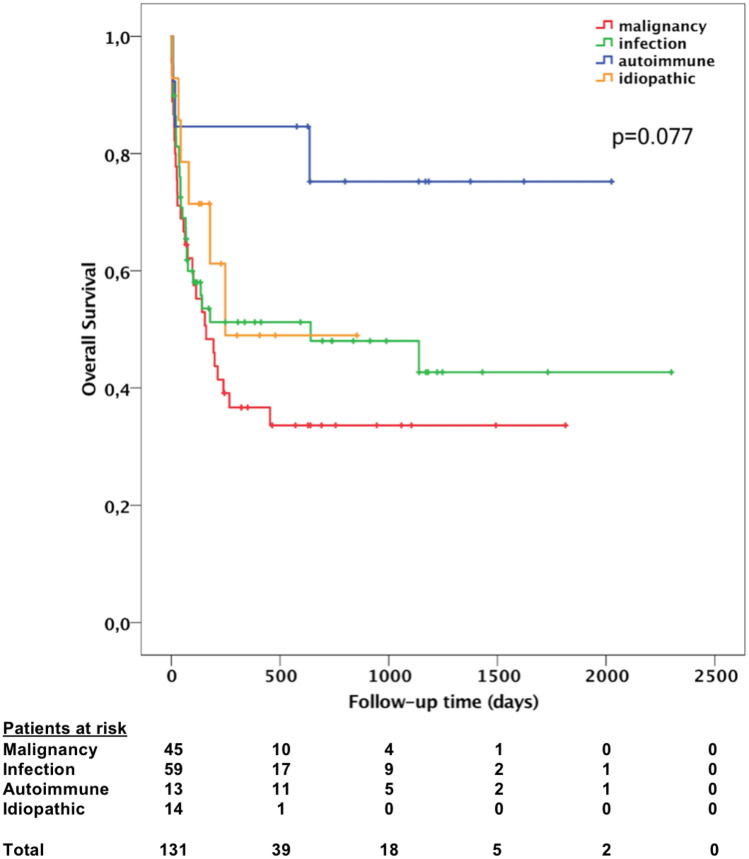
The study included 137 patients and provides the first systematic data on adult HLH in Germany. Median age was 50 years with a wide range (17-87 years), 87 patients (63.5%) were male. Most common triggering diseases were infections in 61 patients (44.5%) and malignancies in 48 patients (35%). Virtually all patients had elevated ferritin concentrations, and 74% had peak concentrations greater than 10,000 µg/l. At time of analysis, 67 of 131 patients (51%) had died. Patients with malignancy-associated HLH had the shortest median survival (160 days), however no statistically significant difference between subgroups was observed (p = 0.077). Platelets under 20*10/l and low albumin concentrations (< 20 g/l) were associated with poor overall and 30-day survival.
Close multidisciplinary case consultation and cooperation is mandatory when treating adult HLH patients. Early contact with reference centers is recommended, especially in relapsing or refractory disease.
噬血细胞性淋巴组织细胞增生症(HLH)是一种严重的炎症综合征,由各种触发因素引起的免疫反应失调导致。在成人中,系统数据较少,因此诊断和管理建议是从儿科指南中采用的。作为 HLH 专科儿科医生和血液学家的合作倡议,启动了一项全国性的临床登记处和相关咨询服务,以更好地描述成人 HLH。
44 家机构登记了经证实或疑似 HLH 的患者。同时使用 HLH-2004 诊断标准和 HScore(www.saintantoine.aphp.fr/score/)来确认 HLH 诊断。记录了与基础疾病、治疗、结局、临床表现和实验室检查结果相关的数据。
该研究纳入了 137 例患者,提供了德国成人 HLH 的首个系统数据。中位年龄为 50 岁(范围 17-87 岁),87 例(63.5%)为男性。最常见的触发疾病是感染 61 例(44.5%)和恶性肿瘤 48 例(35%)。几乎所有患者的铁蛋白浓度均升高,74%的患者峰值浓度大于 10,000µg/l。在分析时,131 例患者中有 67 例(51%)死亡。恶性肿瘤相关 HLH 的患者中位生存时间最短(160 天),但亚组之间无统计学差异(p=0.077)。血小板计数<20*10/l 和低白蛋白浓度(<20g/l)与总生存率和 30 天生存率差相关。
治疗成人 HLH 患者时需要密切的多学科病例咨询和合作。建议早期与参考中心联系,尤其是在复发或难治性疾病时。