Department of Medical and Surgical Sciences, University of Bologna, Bologna, Emilia-Romagna, Italy
Medical Department of Integrated Care Models, Maggiore Hospital Carlo Alberto Pizzardi, Bologna, Emilia-Romagna, Italy.
BMJ Open Diabetes Res Care. 2020 Feb;8(1). doi: 10.1136/bmjdrc-2019-000957.
The role of diabetes as a predictor of mortality after stroke remains uncertain, and there are very few data for pre-diabetes. This study investigated the association of pre-diabetes and diabetes with 30-day and 1-year mortality after ischemic stroke (IS) and primary intracerebral hemorrhage (ICH).
Between 2006 and 2013, 2076 patients with IS and 586 patients with ICH (median age 79) were admitted to hospital within 24 hours after stroke onset and were treated in a stroke unit, where they underwent measurement of glycated hemoglobin (HbA1c). Diabetes was retrospectively defined based on medical history, diagnosis during hospital stay or HbA1c ≥6.5% (48 mmol/mol). Pre-diabetes was defined as HbA1c of 5.7%-6.4% (39-47 mmol/mol). Stroke severity was measured using the National Institutes of Health Stroke Scale (NIHSS). HRs were used to test the association of pre-diabetes and diabetes with 30-day and 1-year mortality after stroke onset.
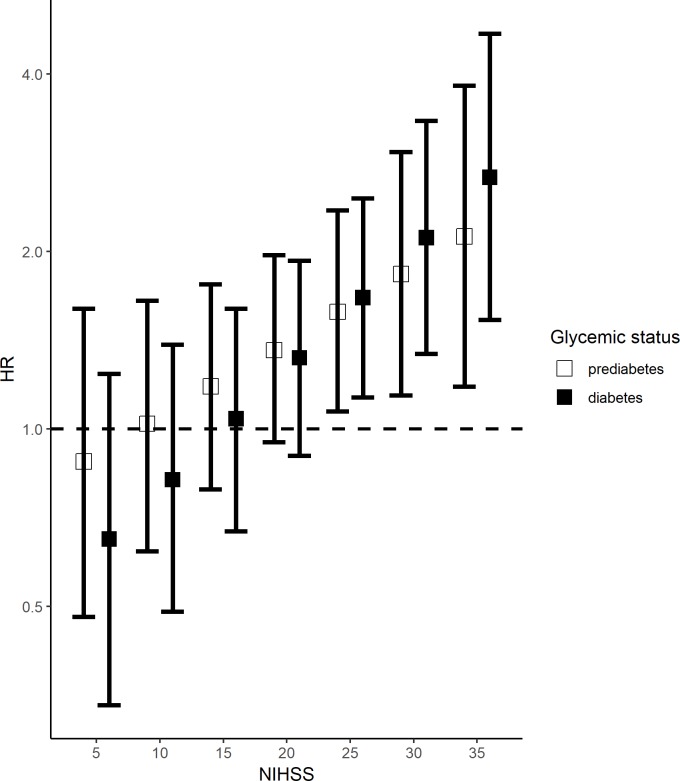
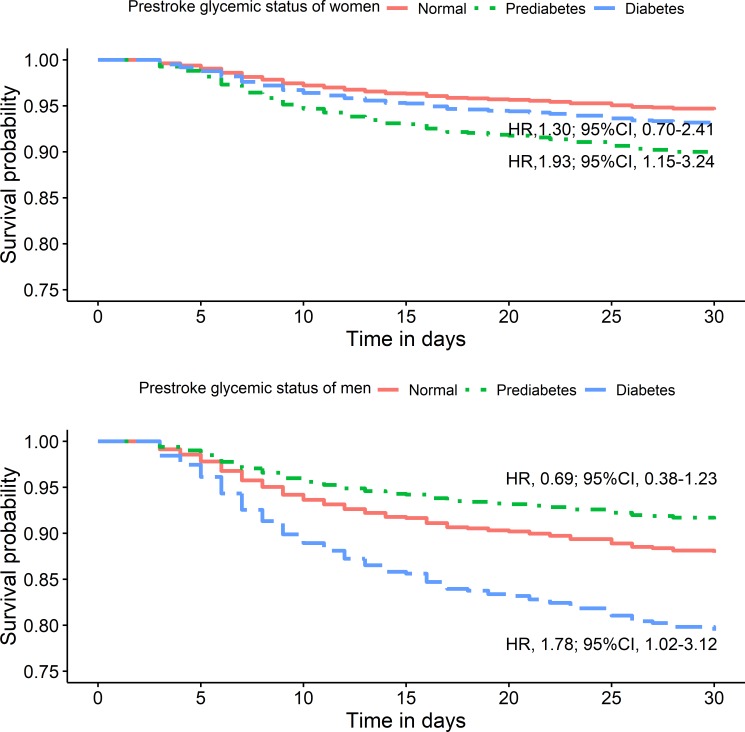
Among patients with IS, 830 had pre-diabetes and 632 had diabetes; 280 died within 30 days and the other 77 within 1 year. Among patients with ICH, 106 had pre-diabetes and 56 had diabetes; 150 died within 30 days and the other 92 within 1 year. In both stroke subtypes, pre-diabetes and diabetes were associated with higher 30-day mortality. In IS, however, the association was limited to patients with prestroke disability and very severe stroke. At NIHSS 25, HR was 1.58 (95% CI 1.07 to 2.35) for pre-diabetes and 1.67 (95% CI 1.14 to 2.46) for diabetes compared with normoglycemia. In ICH, the association was limited to women for pre-diabetes (HR 1.93, 95% CI 1.15 to 3.24) and to men for diabetes (HR 1.78, 95% CI 1.02 to 3.12). Prestroke glycemic status was unrelated to 1-year mortality.
Both pre-diabetes and diabetes predict short-term mortality after acute stroke, but the association varies depending on both prestroke and stroke-related characteristics. These findings may explain the heterogeneous results obtained by previous studies.
糖尿病作为中风后死亡率的预测因素仍存在不确定性,而对于前驱糖尿病的数据则非常有限。本研究旨在探讨前驱糖尿病和糖尿病与缺血性中风(IS)和原发性脑出血(ICH)后 30 天和 1 年死亡率之间的关系。
在 2006 年至 2013 年间,2076 例 IS 患者和 586 例 ICH 患者(中位年龄 79 岁)在中风发作后 24 小时内入院,并在卒中单元接受糖化血红蛋白(HbA1c)检测。糖尿病根据病史、住院期间的诊断或 HbA1c≥6.5%(48mmol/mol)进行回顾性定义。前驱糖尿病定义为 HbA1c 为 5.7%-6.4%(39-47mmol/mol)。中风严重程度采用美国国立卫生研究院中风量表(NIHSS)进行评估。使用 HR 来检验前驱糖尿病和糖尿病与中风后 30 天和 1 年死亡率之间的关系。
在 IS 患者中,830 例患有前驱糖尿病,632 例患有糖尿病;280 例在 30 天内死亡,其余 77 例在 1 年内死亡。在 ICH 患者中,106 例患有前驱糖尿病,56 例患有糖尿病;150 例在 30 天内死亡,其余 92 例在 1 年内死亡。在两种中风类型中,前驱糖尿病和糖尿病均与较高的 30 天死亡率相关。然而,在 IS 中,这种关联仅限于有前驱残疾和极重度中风的患者。在前驱 NIHSS 为 25 时,与血糖正常相比,前驱糖尿病的 HR 为 1.58(95%CI 1.07-2.35),糖尿病的 HR 为 1.67(95%CI 1.14-2.46)。在 ICH 中,这种关联仅限于女性的前驱糖尿病(HR 1.93,95%CI 1.15-3.24)和男性的糖尿病(HR 1.78,95%CI 1.02-3.12)。前驱血糖状态与 1 年死亡率无关。
前驱糖尿病和糖尿病均预测急性中风后的短期死亡率,但这种关联取决于前驱和与中风相关的特征。这些发现可能解释了先前研究中获得的异质性结果。