Huguenard Claire J C, Cseresznye Adam, Evans James E, Oberlin Sarah, Langlois Heather, Ferguson Scott, Darcey Teresa, Nkiliza Aurore, Dretsch Michael, Mullan Michael, Crawford Fiona, Abdullah Laila
The Roskamp Institute, Sarasota, FL, United States.
School of Life, Health and Chemical Sciences, The Open University, Milton Keynes, United Kingdom.
Front Physiol. 2020 Jan 31;11:12. doi: 10.3389/fphys.2020.00012. eCollection 2020.
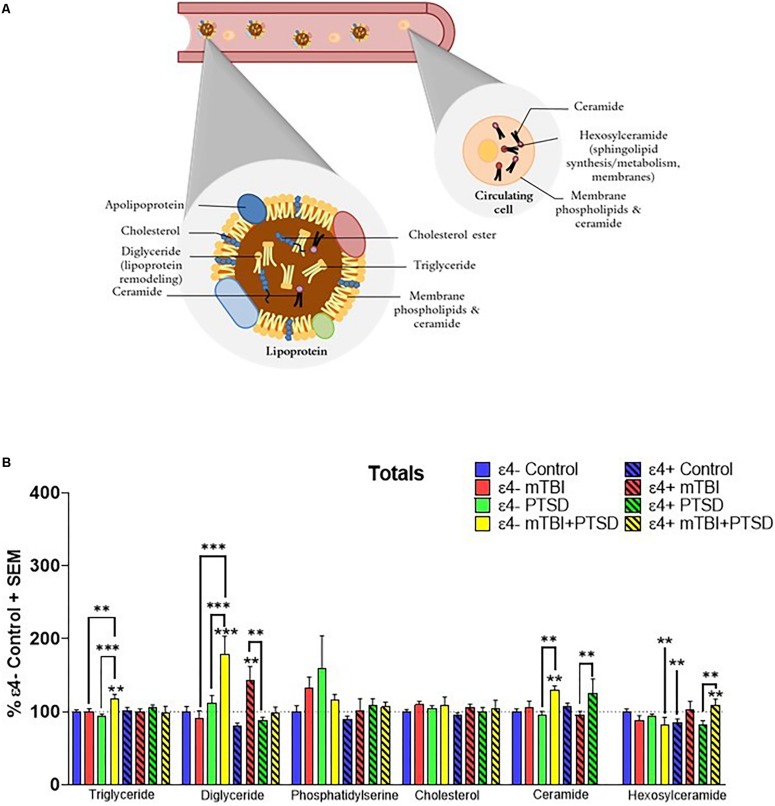
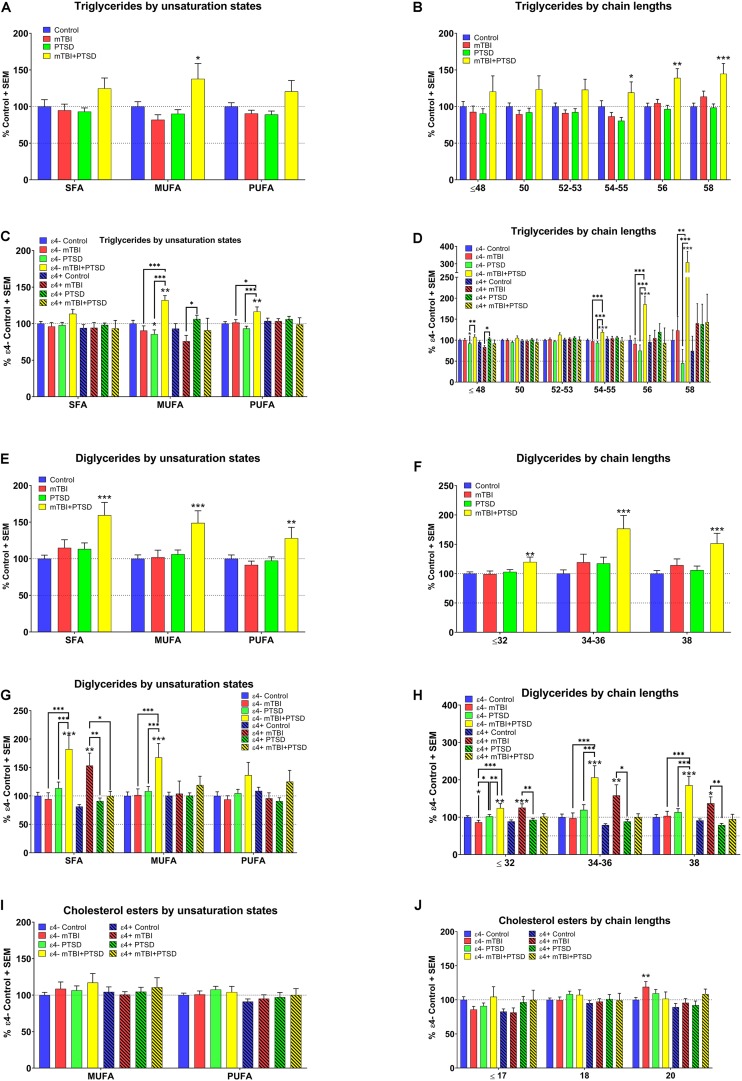
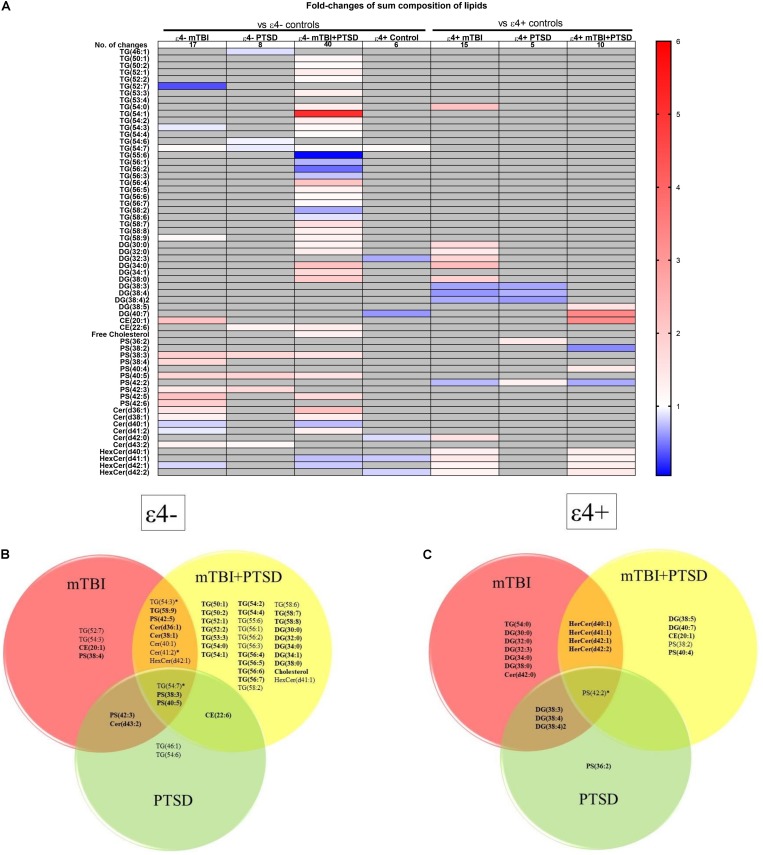
The differential diagnosis between mild Traumatic Brain Injury (mTBI) sequelae and Post-Traumatic Stress Disorder (PTSD) is challenging due to their symptomatic overlap and co-morbidity. As such, there is a need to develop biomarkers which can help with differential diagnosis of these two conditions. Studies from our group and others suggest that blood and brain lipids are chronically altered in both mTBI and PTSD. Therefore, examining blood lipids presents a minimally invasive and cost-effective approach to identify promising biomarkers of these conditions. Using liquid chromatography-mass spectrometry (LC-MS) we examined hundreds of lipid species in the blood of healthy active duty soldiers ( = 52) and soldiers with mTBI ( = 21), PTSD ( = 34) as well as co-morbid mTBI and PTSD ( = 13) to test whether lipid levels were differentially altered with each. We also examined if the apolipoprotein E () ε4 allele can affect the association between diagnosis and peripheral lipid levels in this cohort. We show that several lipid classes are altered with diagnosis and that there is an interaction between diagnosis and the ε4 carrier status on these lipids. Indeed, total lipid levels as well as both the degree of unsaturation and chain lengths are differentially altered with diagnosis and ε4 status, specifically long chain unsaturated triglycerides (TG) and both saturated and mono-unsaturated diglycerides (DG). Additionally, an examination of lipid species reveals distinct profiles in each diagnostic group stratified by ε4 status, mainly in TG, saturated DG species and polyunsaturated phosphatidylserines. In summary, we show that peripheral lipids are promising biomarker candidates to assist with the differential diagnosis of mTBI and PTSD. Further, ε4 carrier status alone and in interaction with diagnosis has a strong influence on peripheral lipid levels. Therefore, examining ε4 status along with peripheral lipid levels could help with differential diagnosis of mTBI and PTSD.
轻度创伤性脑损伤(mTBI)后遗症与创伤后应激障碍(PTSD)之间的鉴别诊断具有挑战性,因为它们存在症状重叠和共病情况。因此,需要开发能够有助于这两种病症鉴别诊断的生物标志物。我们团队和其他团队的研究表明,mTBI和PTSD患者的血液和脑脂质都会发生长期改变。因此,检测血脂是一种微创且经济高效的方法,可用于识别这些病症有前景的生物标志物。我们使用液相色谱 - 质谱联用仪(LC - MS)检测了健康现役士兵(n = 52)、患有mTBI的士兵(n = 21)、患有PTSD的士兵(n = 34)以及同时患有mTBI和PTSD的士兵(n = 13)血液中的数百种脂质种类,以测试每种情况下脂质水平是否存在差异变化。我们还研究了载脂蛋白E(ApoE)ε4等位基因是否会影响该队列中诊断与外周脂质水平之间的关联。我们发现,几种脂质类别会随诊断情况而改变,并且诊断与ε4携带者状态在这些脂质上存在相互作用。实际上,总脂质水平以及不饱和度和链长程度都会随诊断情况和ε4状态而发生差异变化,特别是长链不饱和甘油三酯(TG)以及饱和和单不饱和甘油二酯(DG)。此外,对脂质种类的检测揭示了按ε4状态分层的每个诊断组中的不同谱型,主要体现在TG、饱和DG种类和多不饱和磷脂酰丝氨酸中。总之,我们表明外周脂质是有助于mTBI和PTSD鉴别诊断的有前景的生物标志物候选物。此外,单独的ε4携带者状态以及与诊断的相互作用对外周脂质水平有很大影响。因此,检测ε4状态以及外周脂质水平有助于mTBI和PTSD的鉴别诊断。