Chen Tao, Yu Wenquan, Xie Xiaoling, Ge Huaizhi, Fu Yuchuan, Yang Di, Zhou Lu, Liu Xiaozheng, Yan Zhihan
Department of Radiology, The Second Affiliated Hospital and Yuying Children's Hospital of Wenzhou Medical University, Wenzhou, China.
Department of Radiology, Zhejiang Hospital, Hangzhou, China.
Front Neurol. 2020 Jan 31;11:17. doi: 10.3389/fneur.2020.00017. eCollection 2020.
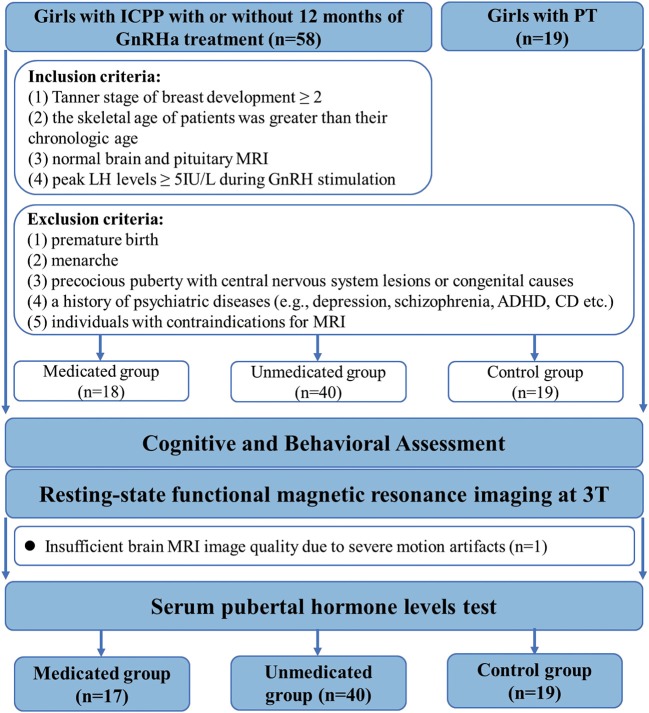
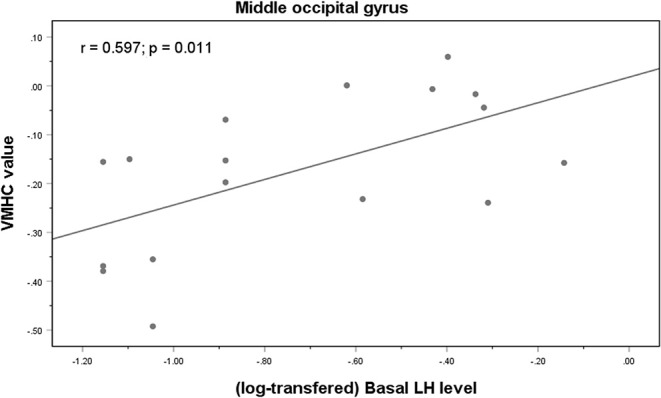
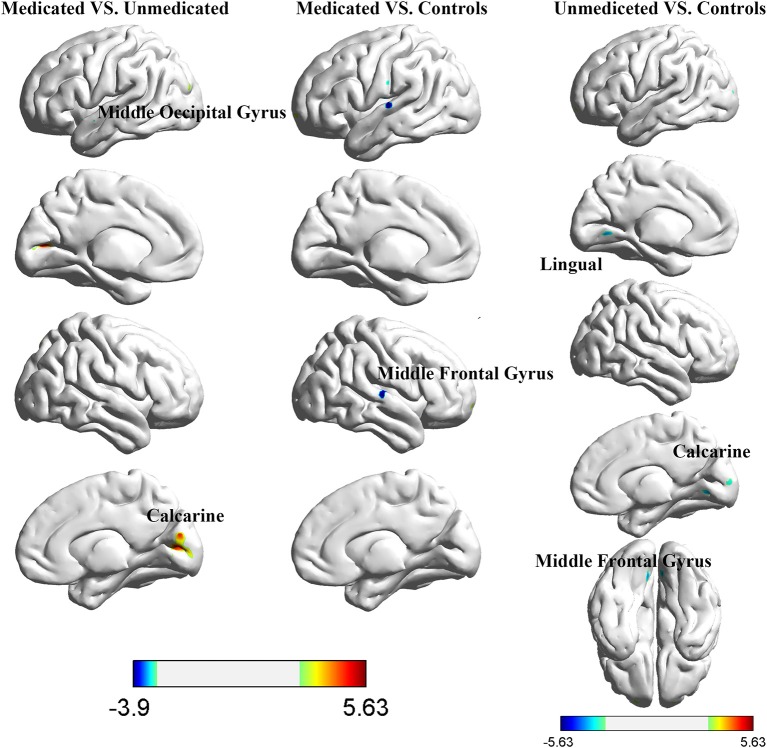
The pubertal growth suppressive effects of gonadotropin hormone releasing hormone agonists (GnRHa) are well-known, although it remains unclear if long-term GnRHa treatment influences the brain function of treated children. The present study investigated the differences in the homotopic resting-state functional connectivity patterns in girls with idiopathic central precocious puberty (ICPP) with and without GnRHa treatment using voxel-mirrored homotopic connectivity (VMHC). Eighteen girls with ICPP who underwent 12 months of GnRHa treatment, 40 treatment-naïve girls with ICPP, and 19 age-matched girls with premature thelarche underwent resting-state functional magnetic resonance imaging using a 3T MRI. VMHC method was performed to explore the differences in the resting-state interhemispheric functional connectivity. The levels of serum pubertal hormones, including luteinizing hormone (LH), follicular-stimulating hormone, and estradiol, were assessed. Correlation analyses among the results of clinical laboratory examinations, neuropsychological scales, and VMHC values of different brain regions were performed with the data of the GnRHa treated group. Significant decreases in VMHC of the lingual, calcarine, superior temporal, and middle frontal gyri were identified in the untreated group, compared with the control group. Medicated patients showed decreased VMHC in the superior temporal gyrus, when compared with the controls. Compared to the unmedicated group, the medicated group showed a significant increase in VMHC in the calcarine and middle occipital gyrus. Moreover, a positive correlation was observed between basal LH levels and VMHC of the middle occipital gyrus in medicated patients. These findings indicate that long-term treatment with GnRHa was associated with increased interhemispheric functional connectivity within several areas responsible for memory and visual process in patients with ICPP. Higher interhemispheric functional connectivity in the middle occipital gyrus was related to higher basal LH production in the girls who underwent treatment. The present study adds to the growing body of research associated with the effects of GnRHa on brain function.
促性腺激素释放激素激动剂(GnRHa)对青春期生长的抑制作用是众所周知的,不过长期GnRHa治疗是否会影响接受治疗儿童的脑功能仍不清楚。本研究采用体素镜像同伦连接(VMHC)技术,调查了接受GnRHa治疗和未接受GnRHa治疗的特发性中枢性性早熟(ICPP)女孩在同伦静息态功能连接模式上的差异。18名接受了12个月GnRHa治疗的ICPP女孩、40名未接受过治疗的ICPP女孩以及19名年龄匹配的乳房过早发育女孩接受了3T磁共振成像的静息态功能磁共振成像检查。采用VMHC方法探究静息态半球间功能连接的差异。评估了血清青春期激素水平,包括促黄体生成素(LH)、促卵泡生成素和雌二醇。对GnRHa治疗组的数据进行了临床实验室检查结果、神经心理量表和不同脑区VMHC值之间的相关性分析。与对照组相比,未治疗组舌回、距状回、颞上回和额中回的VMHC显著降低。与对照组相比,接受药物治疗的患者颞上回的VMHC降低。与未用药组相比,用药组距状回和枕中回的VMHC显著增加。此外,在接受药物治疗的患者中,基础LH水平与枕中回的VMHC呈正相关。这些发现表明,长期使用GnRHa治疗与ICPP患者负责记忆和视觉处理的几个区域内半球间功能连接增加有关。接受治疗的女孩枕中回较高的半球间功能连接与较高的基础LH分泌有关。本研究为GnRHa对脑功能影响的相关研究增添了新内容。