Parmar Dharti Rajubhai, Mehta Shruti Parthiv, Sutariya Priyanka Vaibhav, Bhatia Yashpreetsingh Amarjitsingh, Gupta Nidhi Kantharia
Department of Prosthodontics, College of Dental Science and Research Center, Ahmedabad, Gujarat, India.
J Indian Prosthodont Soc. 2020 Jan-Mar;20(1):69-75. doi: 10.4103/jips.jips_239_19. Epub 2020 Jan 27.
The study was conducted to evaluate the effect of increased vertical dimension on the lip positions at smile in dentulous subjects.
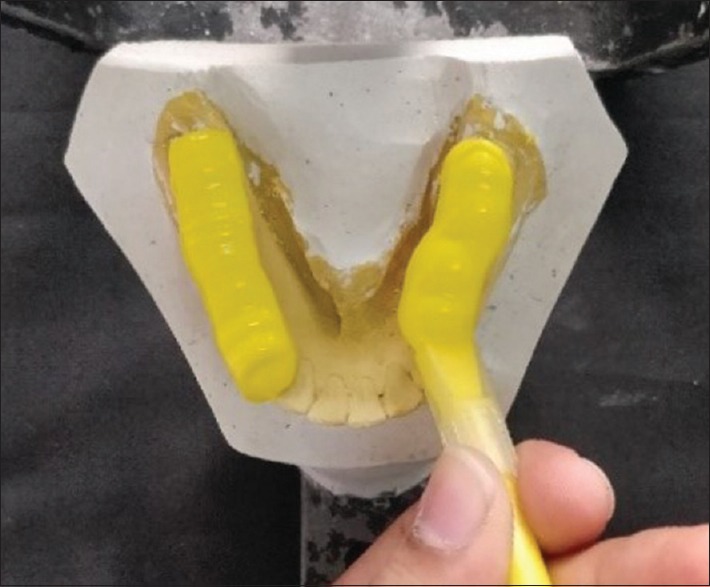
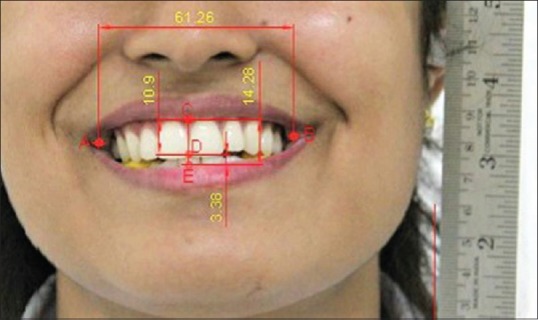
Thirty individuals aged between 22 and 30 years were selected for the study. Poly-vinyl siloxane (Jet Bite, Coltene, Switzerland) interocclusal bite records of varying thickness of +1, +2, +3, and +4 mm were made using articulated stone casts for all the participants, respectively. Posed smile photographs at different increased vertical dimensions of +1, +2, +3, and +4 mm were captured with D-SLR camera (Nikon D3200 of 18 megapixels with macro lens, Japan) mounted on tripod stand keeping a uniform distance of five feet from the face. Head positioning device (Genoray CBCT Machine Papaya 3D Plus, Unicorn DenMart, India) was used to stabilize the head position of the participants. Interlabial gap height, intercommissural width, smile index (width/height ratio), incisal edge-to-upper lip distance, incisal edge-to-lower lip distance, and display zone area measurements were made in AutoCAD software (Autodesk, Inc., California, USA).
One-way repeated measures ANOVA tests (α = 0.05) and Bonferroni's post hoc tests were performed for statistical analysis.
With increasing occlusal vertical dimension, the interlabial gap height, incisal edge-to-lower lip distance, and display zone area increased significantly ( < 0.001). The smile index decreased significantly as the occlusal vertical dimension increased ( < 0.001). No significant difference was found in intercommissural width and incisal edge-to-upper lip distance.
It was found that an increase in occlusal vertical dimension led to an increase in interlabial gap height, incisal edge-to-lower lip distance, and display zone area measurements, whereas the width of smile and incisal edge-to-upper lip distance did not change with increasing occlusal vertical dimension.
本研究旨在评估垂直距离增加对无牙颌患者微笑时唇部位置的影响。
对比研究。
选取30名年龄在22至30岁之间的个体进行研究。分别为所有参与者使用全口义齿石膏模型制作厚度为+1、+2、+3和+4毫米的不同厚度的聚醚橡胶(Jet Bite,Coltene,瑞士)咬合记录。使用安装在三脚架上的数码单反相机(尼康D3200,1800万像素,微距镜头,日本),在距离面部五英尺的均匀距离处,拍摄垂直距离增加+1、+2、+3和+4毫米时的 posed 微笑照片。使用头部定位装置(Genoray CBCT Machine Papaya 3D Plus,Unicorn DenMart,印度)稳定参与者的头部位置。在AutoCAD软件(Autodesk公司,加利福尼亚州,美国)中进行唇间隙高度、口角间宽度、微笑指数(宽度/高度比)、切缘至下唇距离、切缘至上唇距离和显示区面积测量。
采用单向重复测量方差分析(α = 0.05)和Bonferroni事后检验进行统计分析。
随着咬合垂直距离增加,唇间隙高度、切缘至下唇距离和显示区面积显著增加(<0.001)。随着咬合垂直距离增加,微笑指数显著降低(<0.001)。口角间宽度和切缘至上唇距离未发现显著差异。
发现咬合垂直距离增加导致唇间隙高度、切缘至下唇距离和显示区面积测量值增加,而微笑宽度和切缘至上唇距离并未随咬合垂直距离增加而改变。