Walker McCall, Blackwell Jacob N, Stafford Patrick, Patel Paras, Mazimba Sula, Mehta Nishaki, Cho Yeilim, Mangrum Michael, Nazarian Saman, Bilchick Kenneth, Kwon Younghoon
Division of Cardiology, Department of Medicine, University of Texas Southwestern University, USA.
Department of Internal Medicine, University of Virginia, USA.
Sleep Disord. 2020 Feb 5;2020:3029836. doi: 10.1155/2020/3029836. eCollection 2020.
Obstructive sleep apnea (OSA) has been linked to sudden cardiac death (SCD). Prolonged QT is a recognized electrocardiographic (ECG) marker of abnormal ventricular repolarization linked to increased risk of SCD. We hypothesized that individuals with OSA have more pronounced abnormality in daytime QT interval.
We reviewed consecutive patients who underwent clinically indicated polysomnography with 12-lead ECG within 1 year at a single center. Heart rate-corrected QT interval (QTc) was compared by OSA severity class (normal/mild: apnea-hypopnea index (AHI) < 15/hr ( = 72); moderate: 15-30 ( = 72); moderate: 15-30 ( = 72); moderate: 15-30 (.
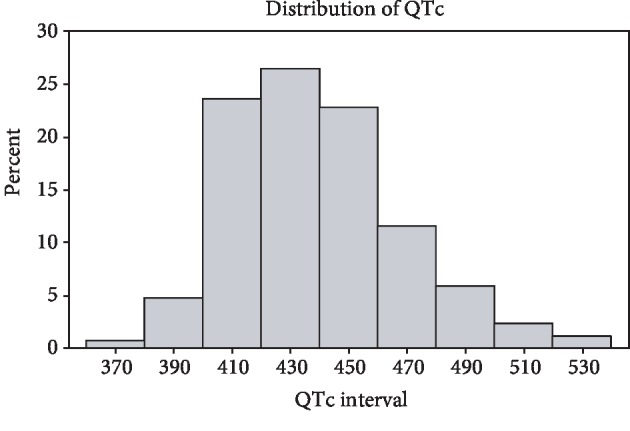
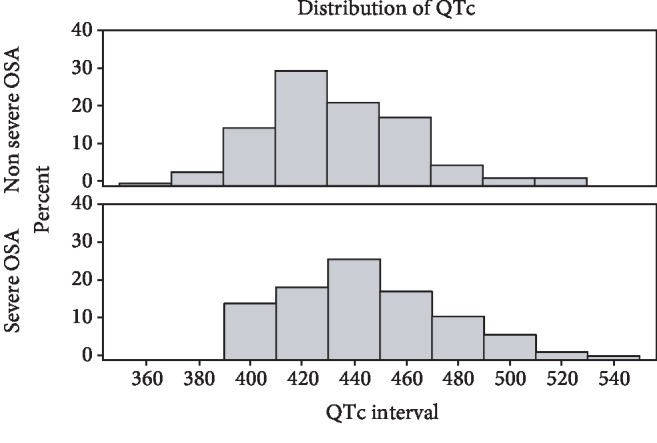
A total of 249 patients were included. QTc was similar between the normal/mild and moderate groups, and the overall QTc trend increased across OSA (normal/mild: 435.6 ms; moderate: 431.36; severe: 444.4; trend = 0.03). Abnormal QTc was found amongst 34% of male and 31% of female patients. Patients with severe OSA had longer QTc compared with normal/mild OSA (mean difference (95% CI): 10.0 ms (0.5, 19.0), trend = 0.03). Abnormal QTc was found amongst 34% of male and 31% of female patients. Patients with severe OSA had longer QTc compared with normal/mild OSA (mean difference (95% CI): 10.0 ms (0.5, 19.0), trend = 0.03). Abnormal QTc was found amongst 34% of male and 31% of female patients. Patients with severe OSA had longer QTc compared with normal/mild OSA (mean difference (95% CI): 10.0 ms (0.5, 19.0), trend = 0.03). Abnormal QTc was found amongst 34% of male and 31% of female patients. Patients with severe OSA had longer QTc compared with normal/mild OSA (mean difference (95% CI): 10.0 ms (0.5, 19.0).
In a sleep clinic cohort, severe OSA was associated with higher QTc and clinically defined abnormal QTc compared with nonsevere OSA.
阻塞性睡眠呼吸暂停(OSA)与心源性猝死(SCD)有关。QT间期延长是公认的与心室复极异常相关的心电图(ECG)标志物,与SCD风险增加有关。我们假设OSA患者白天QT间期异常更为明显。
我们回顾了在单一中心1年内接受临床指示的多导睡眠图检查并同时进行12导联心电图检查的连续患者。根据OSA严重程度分级(正常/轻度:呼吸暂停低通气指数(AHI)<15次/小时(n = 72);中度:15 - 30次/小时(n = 72);重度:>30次/小时(n = 105))比较心率校正后的QT间期(QTc)。
共纳入249例患者。正常/轻度组和中度组的QTc相似,且整个OSA组的QTc总体呈上升趋势(正常/轻度:435.6毫秒;中度:431.36毫秒;重度:444.4毫秒;P趋势 = 0.03)。34%的男性患者和31%的女性患者存在异常QTc。与正常/轻度OSA患者相比,重度OSA患者的QTc更长(平均差异(95%置信区间):10.0毫秒(0.5,19.0),P趋势 = 0.03)。34%的男性患者和31%的女性患者存在异常QTc。与正常/轻度OSA患者相比,重度OSA患者的QTc更长(平均差异(95%置信区间):10.0毫秒(0.5,19.0),P趋势 = 0.03)。34%的男性患者和31%的女性患者存在异常QTc。与正常/轻度OSA患者相比,重度OSA患者的QTc更长(平均差异(95%置信区间):10.0毫秒(0.5,19.0),P趋势 = 0.03)。34%的男性患者和31%的女性患者存在异常QTc。与正常/轻度OSA患者相比,重度OSA患者的QTc更长(平均差异(95%置信区间):10.0毫秒(0.5,19.0)。
在睡眠诊所队列中,与非重度OSA相比,重度OSA与更高的QTc以及临床定义的异常QTc相关。