Singh Yogen, Tissot Cecile, Fraga María V, Yousef Nadya, Cortes Rafael Gonzalez, Lopez Jorge, Sanchez-de-Toledo Joan, Brierley Joe, Colunga Juan Mayordomo, Raffaj Dusan, Da Cruz Eduardo, Durand Philippe, Kenderessy Peter, Lang Hans-Joerg, Nishisaki Akira, Kneyber Martin C, Tissieres Pierre, Conlon Thomas W, De Luca Daniele
Department of Paediatrics - Neonatology and Paediatric Cardiology, Cambridge University Hospitals and University of Cambridge School of Clinical Medicine, Biomedical Campus, Hills Road, Cambridge, CB2 0QQ, UK.
Addenbrooke's Hospital, Box 402, Cambridge, UK.
Crit Care. 2020 Feb 24;24(1):65. doi: 10.1186/s13054-020-2787-9.
Point-of-care ultrasound (POCUS) is nowadays an essential tool in critical care. Its role seems more important in neonates and children where other monitoring techniques may be unavailable. POCUS Working Group of the European Society of Paediatric and Neonatal Intensive Care (ESPNIC) aimed to provide evidence-based clinical guidelines for the use of POCUS in critically ill neonates and children.
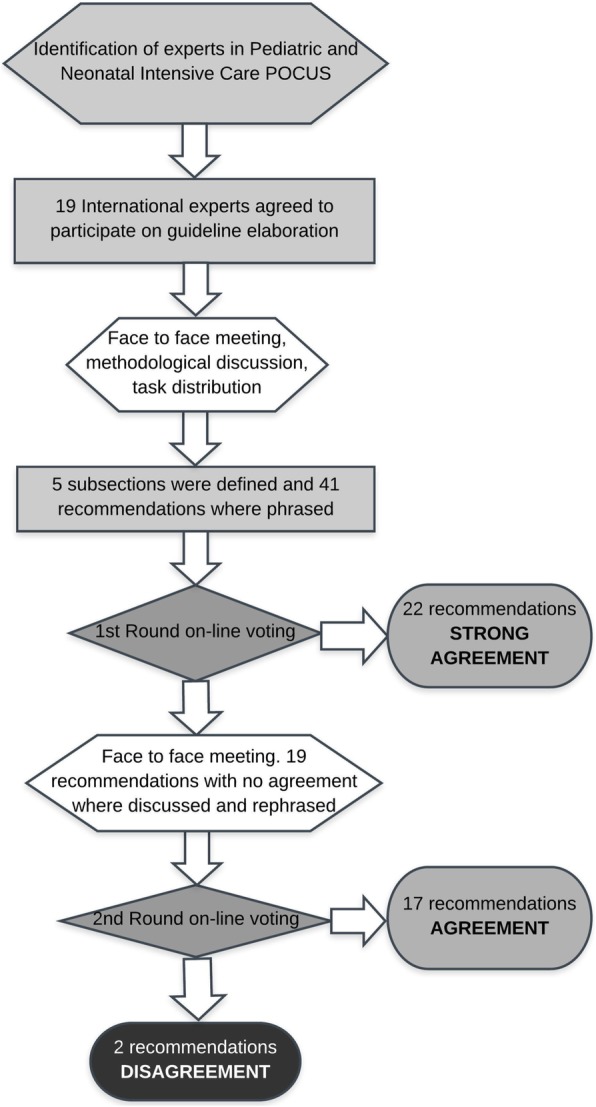
Creation of an international Euro-American panel of paediatric and neonatal intensivists expert in POCUS and systematic review of relevant literature. A literature search was performed, and the level of evidence was assessed according to a GRADE method. Recommendations were developed through discussions managed following a Quaker-based consensus technique and evaluating appropriateness using a modified blind RAND/UCLA voting method. AGREE statement was followed to prepare this document.
Panellists agreed on 39 out of 41 recommendations for the use of cardiac, lung, vascular, cerebral and abdominal POCUS in critically ill neonates and children. Recommendations were mostly (28 out of 39) based on moderate quality of evidence (B and C).
Evidence-based guidelines for the use of POCUS in critically ill neonates and children are now available. They will be useful to optimise the use of POCUS, training programs and further research, which are urgently needed given the weak quality of evidence available.
即时超声检查(POCUS)如今是重症监护中的一项重要工具。在新生儿和儿童中,当其他监测技术可能无法使用时,其作用似乎更为重要。欧洲儿科和新生儿重症监护学会(ESPNIC)的POCUS工作组旨在为重症新生儿和儿童使用POCUS提供循证临床指南。
组建一个由精通POCUS的欧美儿科和新生儿重症监护专家组成的国际小组,并对相关文献进行系统综述。进行文献检索,并根据GRADE方法评估证据水平。通过采用基于贵格会的共识技术进行管理的讨论,并使用改良的盲法RAND/加州大学洛杉矶分校投票方法评估适宜性,制定了相关建议。本文件遵循AGREE声明编写。
小组成员就41项关于在重症新生儿和儿童中使用心脏、肺部、血管、脑部和腹部POCUS的建议中的39项达成了一致。建议大多(39项中的28项)基于中等质量的证据(B级和C级)。
目前已有关于在重症新生儿和儿童中使用POCUS的循证指南。鉴于现有证据质量薄弱,这些指南将有助于优化POCUS的使用、培训计划及进一步研究,而这些都是迫切需要的。