Immunodeficiency Centre for Wales, University Hospital of Wales, Cardiff, UK
Tenovus Institute, Division of Infection & Immunity, Cardiff University, Cardiff, UK.
J Clin Pathol. 2020 Sep;73(9):587-592. doi: 10.1136/jclinpath-2019-206235. Epub 2020 Feb 24.
An association between antibody deficiency and clozapine use in individuals with schizophrenia has recently been reported. We hypothesised that if clozapine-associated hypogammaglobulinaemia was clinically relevant this would manifest in referral patterns.
Retrospective case note review of patients referred and assessed by Immunology Centre for Wales (ICW) between January 2005 and July 2018 with extraction of clinical and immunological features for individuals with diagnosis of schizophrenia-like illness.
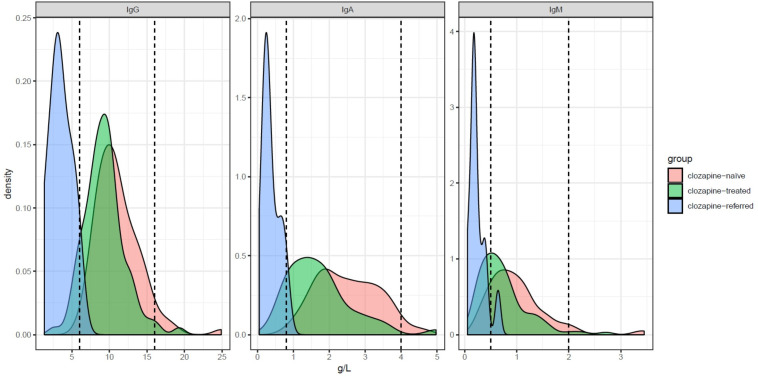
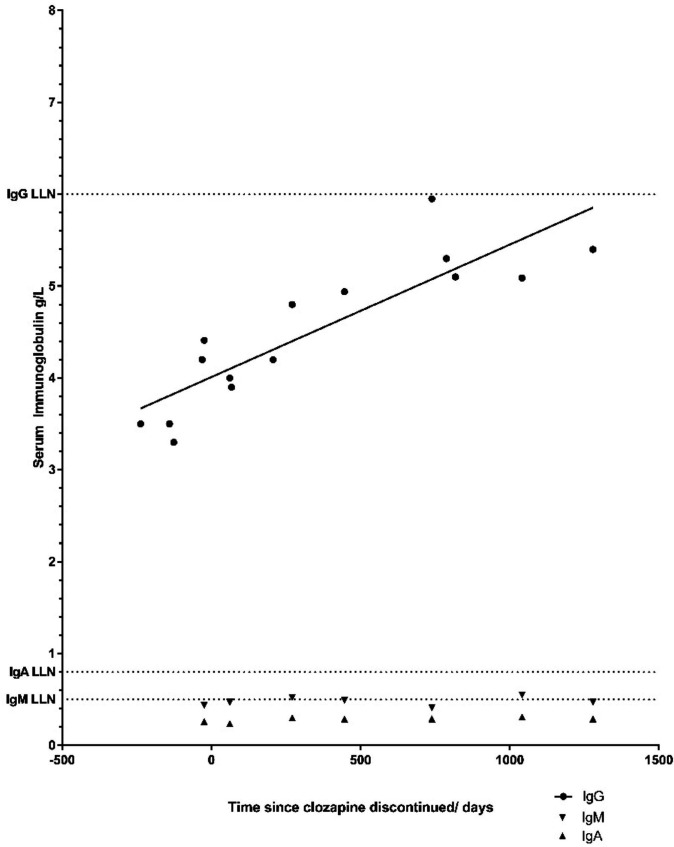
1791 adult patients were assessed at ICW during this period; 23 patients had a psychiatric diagnosis of schizophrenia or schizoaffective disorder. Principal indications for referral were findings of low calculated globulin and immunoglobulins. Clozapine was the single most commonly prescribed antipsychotic (17/23), disproportionately increased relative to reported use in the general schizophrenia population (OR 6.48, 95% CI: 1.79 to 23.5). Clozapine therapy was noted in 6/7 (86%) of patients subsequently requiring immunoglobulin replacement therapy (IgRT). Marked reduction of class-switched memory B cells (CSMB) and plasmablasts were observed in clozapine-treated individuals relative to healthy age-matched controls. Clozapine duration is associated with CSMB decline. One patient discontinued clozapine, with gradual recovery of IgG levels without use of IgRT.
Our findings are consistent with enrichment of clozapine-treatment within schizophrenic individuals referred for ICW assessment over the last 13 years. These individuals displayed clinical patterns closely resembling the primary immunodeficiency common variable immunodeficiency, however appears reversible on drug cessation. This has diagnostic, monitoring and treatment implications for psychiatry and immunology teams and directs prospective studies to address causality and the wider implications for this patient group.
最近有报道称,精神分裂症患者的抗体缺乏与氯氮平的使用有关。我们假设,如果氯氮平相关的低丙种球蛋白血症具有临床意义,那么这将表现在转介模式上。
回顾性病例记录审查了 2005 年 1 月至 2018 年 7 月期间在威尔士免疫中心(ICW)转介和评估的患者,提取了有类似精神分裂症诊断的个体的临床和免疫学特征。
在此期间,ICW 共评估了 1791 名成年患者;23 名患者的精神科诊断为精神分裂症或分裂情感障碍。转介的主要指征是球蛋白和免疫球蛋白计算值低。氯氮平是最常开的抗精神病药物(17/23),与一般精神分裂症人群的报告使用量不成比例地增加(OR 6.48,95%CI:1.79 至 23.5)。在需要免疫球蛋白替代治疗(IgRT)的 6/7(86%)患者中发现了氯氮平治疗。与健康年龄匹配的对照相比,接受氯氮平治疗的患者观察到类别转换记忆 B 细胞(CSMB)和浆母细胞明显减少。氯氮平的持续时间与 CSMB 的下降有关。一名患者停用氯氮平,在未使用 IgRT 的情况下 IgG 水平逐渐恢复。
我们的发现与过去 13 年来,ICW 评估转介的精神分裂症患者中氯氮平治疗的富集情况一致。这些患者表现出与原发性免疫缺陷病常见变异性免疫缺陷非常相似的临床模式,但停药后似乎可以逆转。这对精神病学和免疫学团队具有诊断、监测和治疗意义,并指导前瞻性研究以确定这种患者群体的因果关系和更广泛的影响。