Boldrini Luca, Placidi Elisa, Dinapoli Nicola, Azario Luigi, Cellini Francesco, Massaccesi Mariangela, Chiesa Silvia, Gambacorta Maria Antonietta, Mattiucci Gian Carlo, Piccari Danila, Teodoli Stefania, De Spirito Marco, Valentini Vincenzo
Polo Scienze Oncologiche ed Ematologiche, Istituto di Radiologia, Università Cattolica del Sacro Cuore, Fondazione Policlinico Universitario Agostino Gemelli, Largo Francesco Vito, 1 - 00168 Roma, Italy.
Polo Scienze delle immagini, di laboratorio e infettivologiche, Università Cattolica del Sacro Cuore, Fondazione Policlinico Universitario Agostino Gemelli, Largo Francesco Vito, 1 - 00168 Roma, Italy.
Tech Innov Patient Support Radiat Oncol. 2018 Mar 31;6:5-10. doi: 10.1016/j.tipsro.2018.02.002. eCollection 2018 Jun.
Aim of this paper is to investigate the plan quality of a tri-Co-60 MRI-Hybrid system for intensity-modulated radiation therapy (IMRT) in patients affected by locally advanced rectal cancer (LARC) undergoing neo-adjuvant radiotherapy.
Ten consecutive LARC patients were selected. Tri-Co-60 step and shoot IMRT plans were generated simulating the presence of the magnetic field (B) or not (B) with the dedicated treatment planning system (TPS).The total planned dose was 45 Gy in 25 fractions to the mesorectum and the pelvic nodes (planning target volume 2, PTV2) and 55 Gy to the tumor and correspondent mesorectum (PTV1) through simultaneous integrated boost (SIB). Tri-Co-60 IMRT plans were compared with Volumetric Modulated Arc Therapy (VMAT) and IMRT plans for Linear Accelerator (Linac).
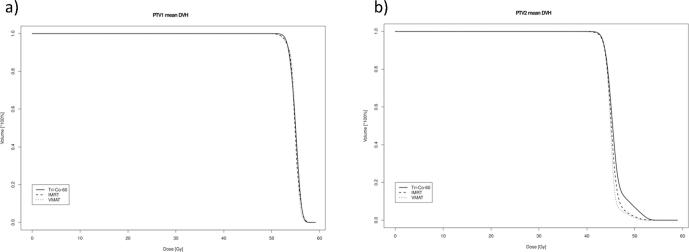
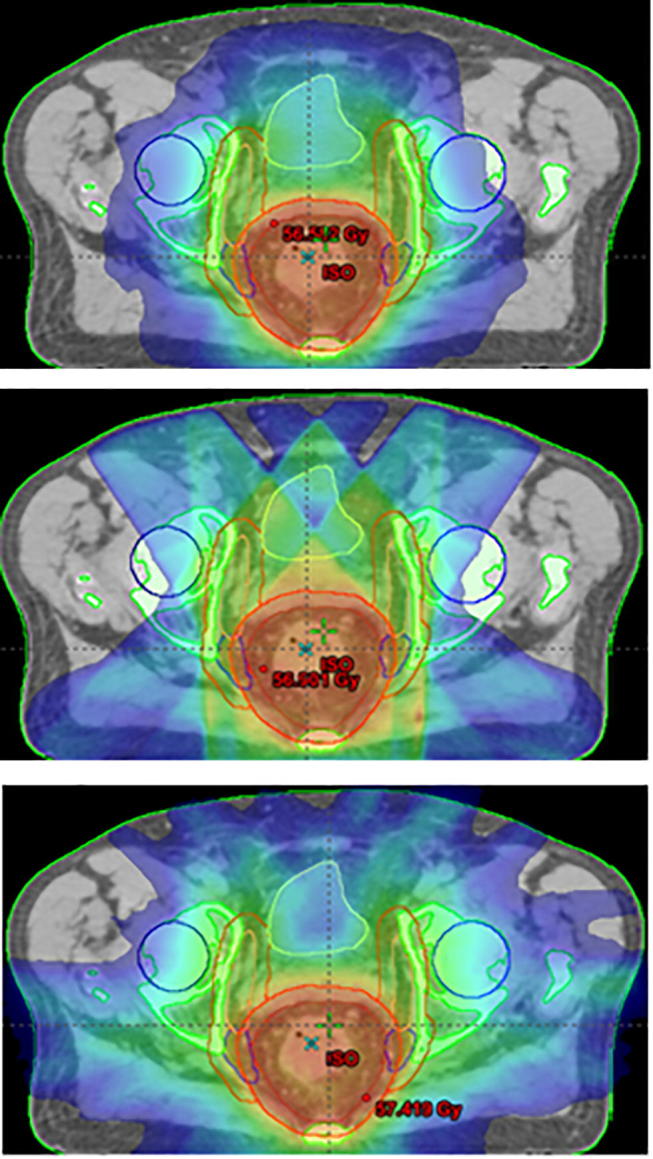
B and B tri-Co-60 IMRT plans showed no relevant differences. Mean values of PTV1 and PTV2 receiving at least 95% of the D (V) were higher than 95% in all treatment plans. All plans met the V constraint for the PTV1. Mean values of V for the PTV2 were 14.8, 5.0, and 7.3% respectively for tri-Co-60, VMAT and IMRT. Mean Wu's HI values were similar in all plans (7.4-7.8%). All plans met the V constraint for small bowel, but mean V value was higher with tri-Co-60.Bladder irradiation was comparable and always lower than the chosen D max 65 Gy constraint.Mean values of V and V to the body and median skin doses were higher with tri-Co-60 plans.
Treatment plans with Tri-Co-60 step and shoot IMRT met the dose-volume objectives in patients with LARC. Nevertheless, a larger volume of normal tissue received low-moderate doses when compared with Linac based VMAT and IMRT.
本文旨在研究一种用于新辅助放疗的局部晚期直肠癌(LARC)患者调强放射治疗(IMRT)的三联钴-60 MRI混合系统的计划质量。
连续选取10例LARC患者。使用专用治疗计划系统(TPS)生成三联钴-60静态调强放疗计划,分别模拟有磁场(B)和无磁场(B)的情况。通过同步整合加量(SIB),计划总剂量为直肠系膜和盆腔淋巴结(计划靶区2,PTV2)45 Gy,分25次照射,肿瘤及相应直肠系膜(PTV1)55 Gy。将三联钴-60调强放疗计划与容积调强弧形放疗(VMAT)计划以及直线加速器(Linac)调强放疗计划进行比较。
B和B三联钴-60调强放疗计划显示无显著差异。在所有治疗计划中,接受至少95%处方剂量(D)的PTV1和PTV2的平均值均高于95%。所有计划均满足PTV1的体积约束。三联钴-60、VMAT和调强放疗计划的PTV2的平均体积分别为14.8%、5.0%和7.3%。所有计划的平均吴氏均匀性指数值相似(7.4 - 7.8%)。所有计划均满足小肠的体积约束,但三联钴-60的平均体积值更高。膀胱照射情况相当,且始终低于选定的65 Gy最大剂量约束。三联钴-60计划的身体平均体积和体积以及皮肤中位剂量更高。
三联钴-60静态调强放疗的治疗计划满足了LARC患者的剂量体积目标。然而,与基于直线加速器的VMAT和调强放疗相比,更大体积的正常组织接受了低至中等剂量的照射。