Bier Nadja S, Schares Gereon, Johne Annette, Martin Annett, Nöckler Karsten, Mayer-Scholl Anne
German Federal Institute for Risk Assessment (BfR), Department for Biological Safety, Berlin, Germany.
Friedrich-Loeffler-Institut, Federal Research Institute for Animal Health, Greifswald, Insel Riems, Germany.
Food Waterborne Parasitol. 2019 Feb 8;14:e00038. doi: 10.1016/j.fawpar.2019.e00038. eCollection 2019 Mar.
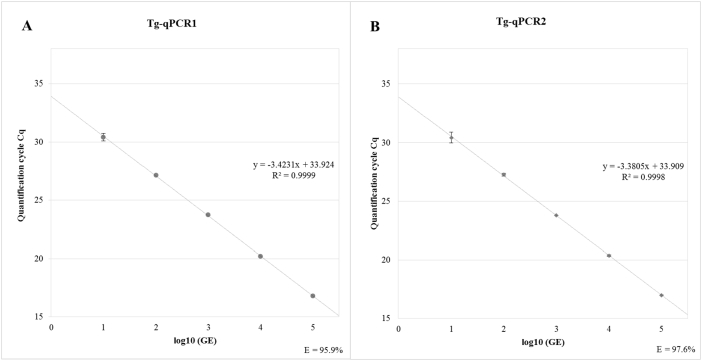
Comparison of epidemiological data on the occurrence of tissue cysts in meat is hampered by the lack of standardization and a great variety of methods for molecular detection. Therefore, this study aimed to compare and validate three different polymerase chain reaction (PCR) methods for detection of DNA in pork. Analytical performance characteristics of two real time PCRs (qPCRs; Tg-qPCR1, Tg-qPCR2) and one conventional endpoint PCR (cPCR), all targeting the 529 repeated element, were assessed using genomic DNA of three clonal types prevailing in Europe and North America. qPCR efficiencies for all three clonal types ranged between 93.8 and 94.4% (Tg-qPCR1) and 94.3-95.6% (Tg-qPCR2). Tg-qPCR1 and Tg-qPCR2 showed an overall PCR performance score of 85% and displayed a similar 95% detection limit of 1.067 and 1.561 genome equivalents per PCR reaction (GE/PCR), respectively. However, DNA could be detected at concentrations as low as 0.1 GE/PCR. Reliable quantification is possible over 4 log ranges from 10 to 100 GE/PCR with mean repeatability relative standard deviations of ≤11% and reproducibility relative standard deviations of ≤12.7%. Presumably, both qPCRs are similarly suitable for sensitive and specific detection of DNA in pork. In contrast, the cPCR using primer pair TOX5/Tox-8 proved to be highly sensitive with a detection limit of 1.41 GE/PCR, but not suitable for detection of DNA in pork as unspecific amplification of porcine DNA was observed resulting in bands with similar size to the desired -specific PCR product.
肉类组织囊肿发生情况的流行病学数据比较受到缺乏标准化以及分子检测方法种类繁多的阻碍。因此,本研究旨在比较和验证三种不同的聚合酶链反应(PCR)方法用于检测猪肉中的DNA。使用欧洲和北美流行的三种克隆类型的基因组DNA,评估了两种实时PCR(qPCR;Tg-qPCR1、Tg-qPCR2)和一种传统终点PCR(cPCR)的分析性能特征,所有这些方法均靶向529重复元件。所有三种克隆类型的qPCR效率在93.8%至94.4%(Tg-qPCR1)和94.3%至95.6%(Tg-qPCR2)之间。Tg-qPCR1和Tg-qPCR2的总体PCR性能得分均为85%,每PCR反应的95%检测限分别为1.067和1.561个基因组当量(GE/PCR)。然而,DNA可在低至0.1 GE/PCR的浓度下检测到。在10至100 GE/PCR的4个对数范围内可以进行可靠定量,平均重复性相对标准偏差≤11%,再现性相对标准偏差≤12.7%。推测这两种qPCR同样适用于猪肉中DNA的灵敏和特异检测。相比之下,使用引物对TOX5/Tox-8的cPCR被证明具有高度灵敏性,检测限为1.41 GE/PCR,但不适用于猪肉中DNA的检测,因为观察到猪DNA的非特异性扩增,导致出现与所需特异性PCR产物大小相似的条带。