Department of Pediatrics, University of Alabama at Birmingham, Birmingham, Alabama.
Institute for Cancer Outcomes and Survivorship, University of Alabama at Birmingham, Birmingham, Alabama.
Cancer. 2020 May 15;126(10):2174-2182. doi: 10.1002/cncr.32773. Epub 2020 Feb 25.
Cognitive impairment in survivors of blood or bone marrow transplantation (BMT) is well documented. However, to the authors' knowledge, the clinical relevance of self-endorsed cognitive problems and their relation to objectively assessed cognitive impairment is not known.
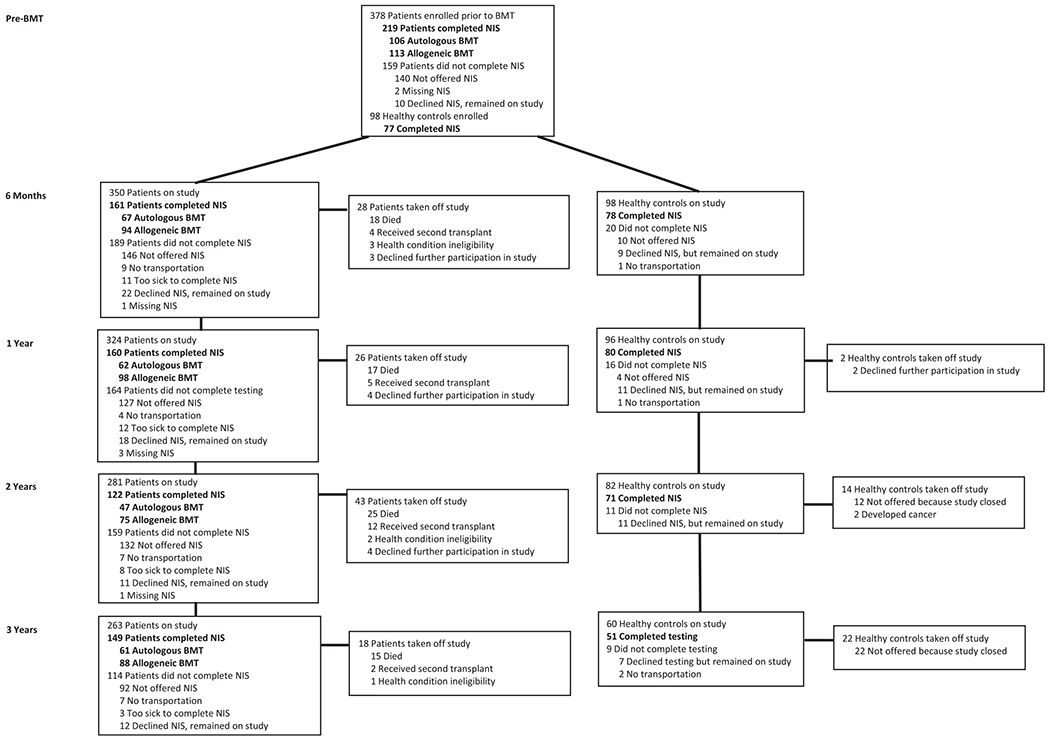
The authors assessed cognitive impairment in 378 BMT recipients (median age, 52.2 years, 40% of whom were female and 68% of whom were non-Hispanic white) and 98 healthy controls at 5 predetermined time points: at baseline (before BMT) and at 6 months, 1 year, 2 years, and 3 years after BMT. Self-endorsed cognitive problems were evaluated using the Neuropsychological Impairment Scale (NIS) and correlated with a standardized 2-hour battery of objective cognitive testing at each time point. The authors examined the magnitude of difference in self-endorsed cognitive problems between BMT recipients and healthy controls, and the rate of change in scores over time. Multivariable analyses were used to identify clinical and/or demographic variables associated with self-endorsed cognitive problems. The authors also examined the association between cognitive impairment and returning to work after BMT.
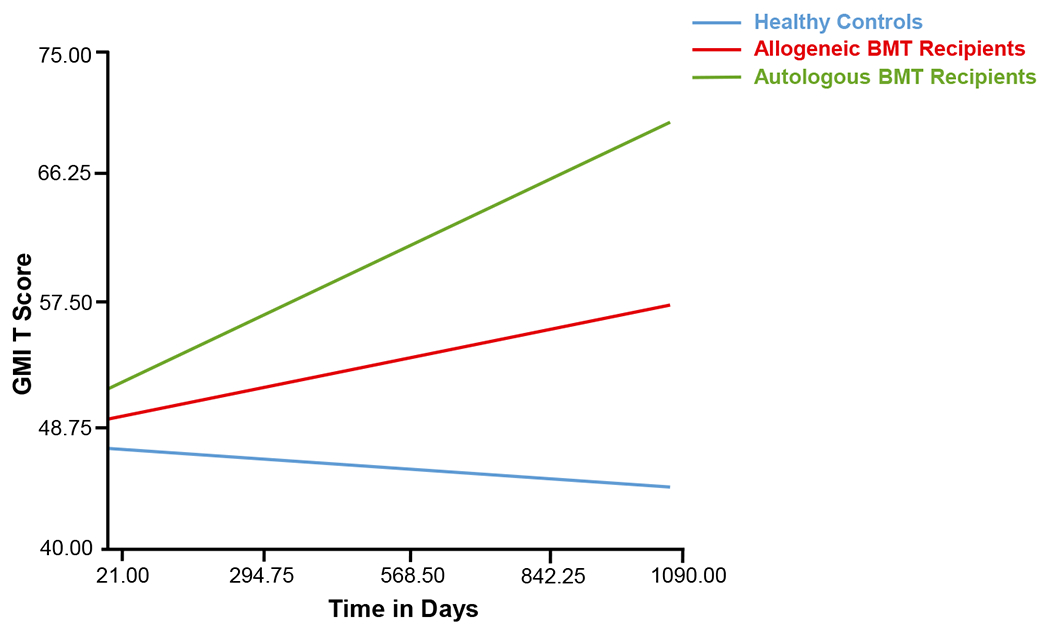
Compared with healthy controls, BMT recipients endorsed more cognitive problems (P < .001) at all time points, and the rate of change in NIS scores was found to be significantly greater in BMT recipients. Fatigue was associated with greater endorsement of cognitive problems at 1 year after BMT (odds ratio, 4.23; 95% CI, 2.1-8.3 [P < .001]). Overall, there was a statistically significant, modest correlation noted between self-endorsed cognitive problems and objective cognitive impairment (range, 0.401-0.445 [P ≤ .01]). Higher self-endorsed cognitive problems were associated with a 3.7-fold (P = .02) higher odds of not returning to work at 3 years after BMT.
The results of the current study demonstrated that self-endorsed cognitive problems can help to identify vulnerable patient subpopulations for detailed cognitive assessment and possible cognitive remediation.
有大量文献记录了血液或骨髓移植(BMT)幸存者的认知障碍。然而,据作者所知,自我报告的认知问题的临床意义及其与客观评估的认知障碍的关系尚不清楚。
作者在 5 个预定时间点评估了 378 名 BMT 受者(中位年龄 52.2 岁,40%为女性,68%为非西班牙裔白人)和 98 名健康对照者的认知障碍:基线(BMT 前)和 BMT 后 6 个月、1 年、2 年和 3 年。使用神经心理损伤量表(NIS)评估自我报告的认知问题,并在每个时间点与标准化的 2 小时客观认知测试结果相关联。作者比较了 BMT 受者与健康对照者自我报告的认知问题的差异程度,以及随时间变化的评分变化率。多变量分析用于确定与自我报告的认知问题相关的临床和/或人口统计学变量。作者还研究了认知障碍与 BMT 后重返工作的关系。
与健康对照组相比,BMT 受者在所有时间点都报告了更多的认知问题(P<0.001),并且 NIS 评分的变化率在 BMT 受者中明显更高。BMT 后 1 年时,疲劳与更大程度的认知问题报告相关(比值比,4.23;95%置信区间,2.1-8.3[P<0.001])。总体而言,自我报告的认知问题与客观认知障碍之间存在显著、适度的相关性(范围,0.401-0.445[P≤0.01])。更高的自我报告认知问题与 BMT 后 3 年不重返工作的可能性增加了 3.7 倍(P=0.02)。
本研究结果表明,自我报告的认知问题有助于识别脆弱的患者亚群,以便进行详细的认知评估和可能的认知矫正。