Morawiec Mateusz, Grajcar Adam, Zalecki Władysław, Garcia-Mateo Carlos, Opiela Marek
Department of Engineering Materials and Biomaterials, Silesian University of Technology, 18A Konarskiego Street, 44-100 Gliwice, Poland.
Łukasiewicz Research Network-Institute for Ferrous Metallurgy, 12-14 K. Miarki Street, 44-100 Gliwice, Poland.
Materials (Basel). 2020 Feb 21;13(4):958. doi: 10.3390/ma13040958.
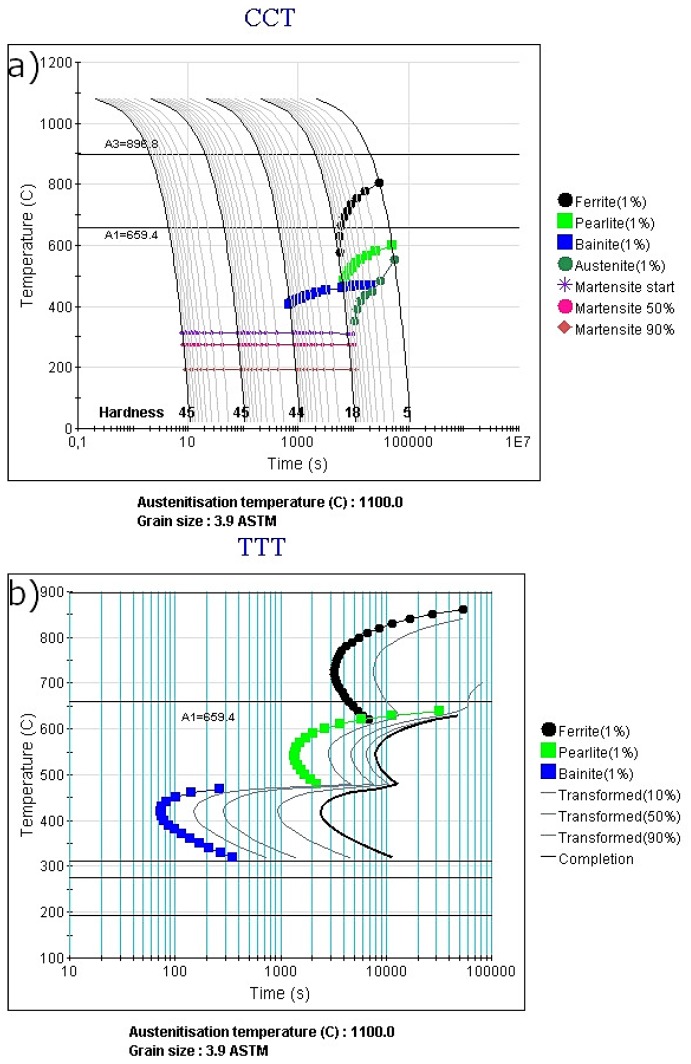
The work presents results of phase transformation kinetics of hot-rolled 5% Mn steel subjected to different heat treatments. Three different schedules were introduced: isothermal holding in a bainite region, coiling simulation and intercritical annealing. The evolution of microstructure components was investigated using dilatometric and metallographic analyses. According to obtained results, the medium-Mn steel exhibits high resistance for γ/α transformation during the bainite transformation and coiling simulation (upon cooling from the austenite region). During 5 h isothermal holding, no bainite and/or ferrite formation was detected. This results in the formation of martensite upon cooling to room temperature. Differently, when the steel was subjected to the intercritical annealing at 720 and 700 °C (upon heating from room temperature), a final microstructure consisted of ferrite, martensite and retained austenite. At 700 °C, no fresh martensite formation was detected upon cooling to room temperature. This means that the austenite was enriched in carbon during the intercritical annealing step enough to keep its thermal stability.
该研究展示了经过不同热处理的热轧5%锰钢的相变动力学结果。引入了三种不同的工艺:在贝氏体区等温保温、卷取模拟和临界区退火。使用膨胀分析和金相分析研究了微观结构组分的演变。根据所得结果,中锰钢在贝氏体转变和卷取模拟过程中(从奥氏体区冷却时)对γ/α转变具有高抗性。在5小时等温保温过程中,未检测到贝氏体和/或铁素体形成。这导致冷却至室温时形成马氏体。不同的是,当钢在720和700°C进行临界区退火时(从室温加热),最终微观结构由铁素体、马氏体和残余奥氏体组成。在700°C时,冷却至室温未检测到新的马氏体形成。这意味着在临界区退火步骤中奥氏体富集了足够的碳以保持其热稳定性。