Genome Analysis Center, 1-1-1 Fujimi, Kofu, Yamanashi, Japan.
Lung Cancer and Respiratory Disease Center, 1-1-1 Fujimi, Kofu, Yamanashi, Japan.
Sci Rep. 2020 Feb 25;10(1):3391. doi: 10.1038/s41598-020-60361-3.
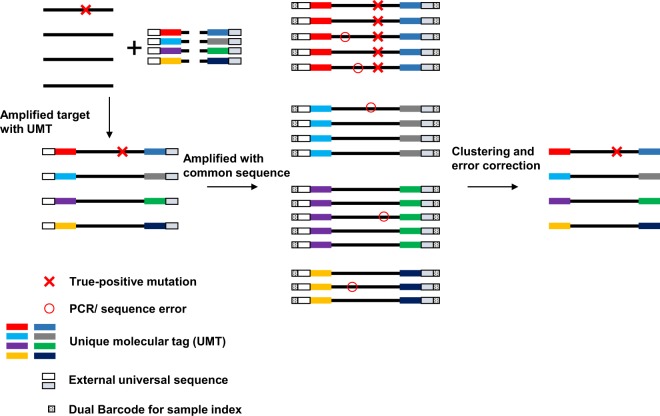
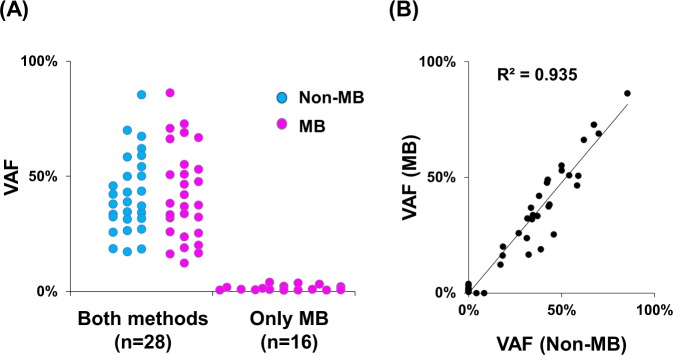
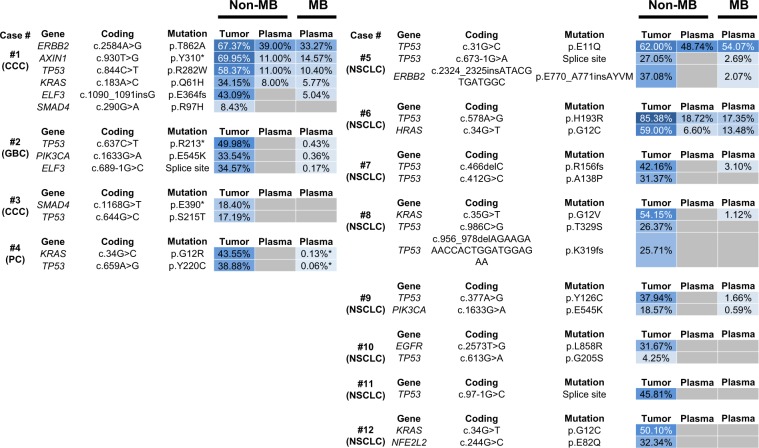
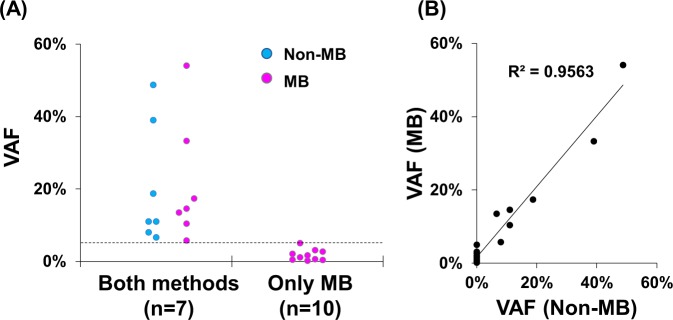
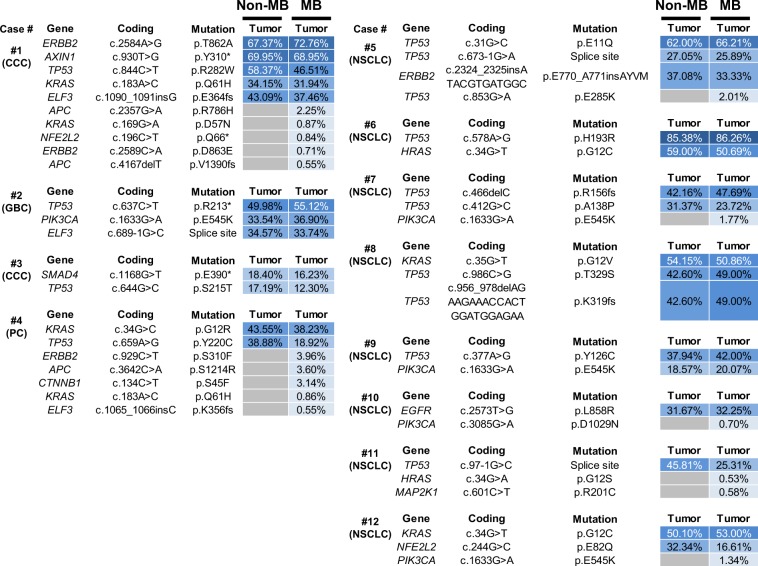
Conventional next generation sequencing analysis has provided important insights into cancer genetics. However, the detection of rare (low allele fraction) variants remains difficult because of the error-prone nucleotide changes derived from sequencing/PCR errors. To eliminate the false-positive variants and detect genuine rare variants, sequencing technology combined with molecular barcodes will be useful. Here, we used the newly developed dual-molecular barcode technology (Ion AmpliSeq HD) to analyze somatic mutations in 24 samples (12 tumor tissues and 12 plasma) from 12 patients with biliary-pancreatic and non-small cell lung cancers. We compared the results between next generation sequencing analysis with or without molecular barcode technologies. The variant allele fraction (VAF) between non-molecular barcode and molecular barcode sequencing was correlated in plasma DNA (R = 0.956) and tumor (R = 0.935). Both methods successfully detected high VAF mutations, however, rare variants were only identified by molecular barcode sequencing and not by non-molecular barcode sequencing. Some of these rare variants in tumors were annotated as pathogenic, and therefore subclonal driver mutations could be observed. Furthermore, the very low VAF down to 0.17% were identified in cell free DNA in plasma. These results demonstrate that the dual molecular barcode sequencing technologies can sensitively detect rare somatic mutations, and will be important in the investigation of the clonal and subclonal architectures of tumor heterogeneity.
传统的下一代测序分析为癌症遗传学提供了重要的见解。然而,由于测序/PCR 错误导致的易错核苷酸变化,稀有(低等位基因分数)变体的检测仍然很困难。为了消除假阳性变体并检测真正的稀有变体,测序技术与分子条码相结合将是有用的。在这里,我们使用新开发的双分子条码技术(Ion AmpliSeq HD)分析了来自 12 名患有胆管-胰腺和非小细胞肺癌的患者的 24 个样本(12 个肿瘤组织和 12 个血浆)中的体细胞突变。我们比较了有无分子条码技术的下一代测序分析的结果。血浆 DNA 中非分子条码和分子条码测序之间的变异等位基因分数(VAF)具有相关性(R=0.956)和肿瘤(R=0.935)。两种方法都成功地检测到高 VAF 突变,但只有分子条码测序才能检测到稀有变体,而非分子条码测序则不能。肿瘤中的一些稀有变体被注释为致病性,因此可以观察到亚克隆驱动突变。此外,在血浆中的无细胞 DNA 中也可以检测到非常低的 VAF 低至 0.17%。这些结果表明,双分子条码测序技术可以敏感地检测稀有体细胞突变,这对于研究肿瘤异质性的克隆和亚克隆结构将是重要的。