Department of Respiratory Medicine, First Affiliated People's Hospital of Shaoyang College, Shaoyang, Hunan 422001, People's Republic of China.
Department of Respiratory and Critical Medicine, Second Xiangya Hospital, Central South University, Changsha, Hunan 410011, People's Republic of China.
Int J Chron Obstruct Pulmon Dis. 2020 Feb 3;15:249-259. doi: 10.2147/COPD.S237545. eCollection 2020.
Depression is reported in association with chronic obstructive pulmonary disease (COPD). However, to date, no multidimensional indices have taken depression into consideration to predict COPD patients' prognosis. This study aimed to determine whether a new multidimensional index named CODEXS, based on comorbidities, airflow obstruction, dyspnea, previous exacerbation and depression assessed by Self-Rating Depression Scale (SDS), could predict 1-year exacerbations.
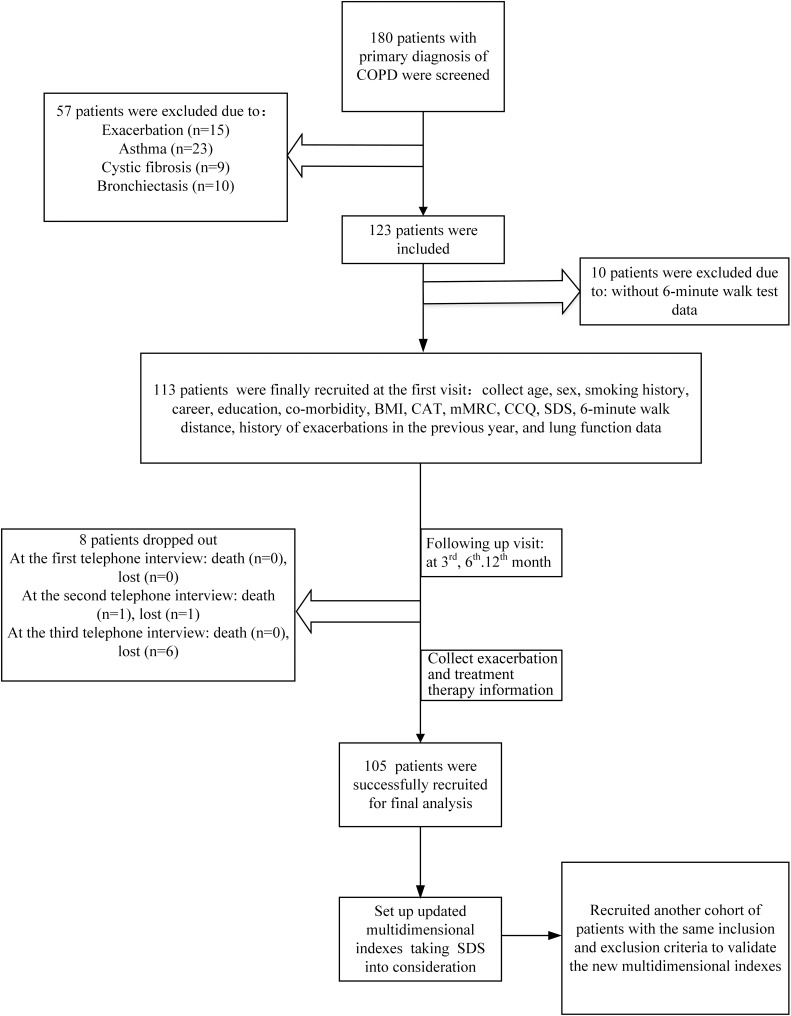
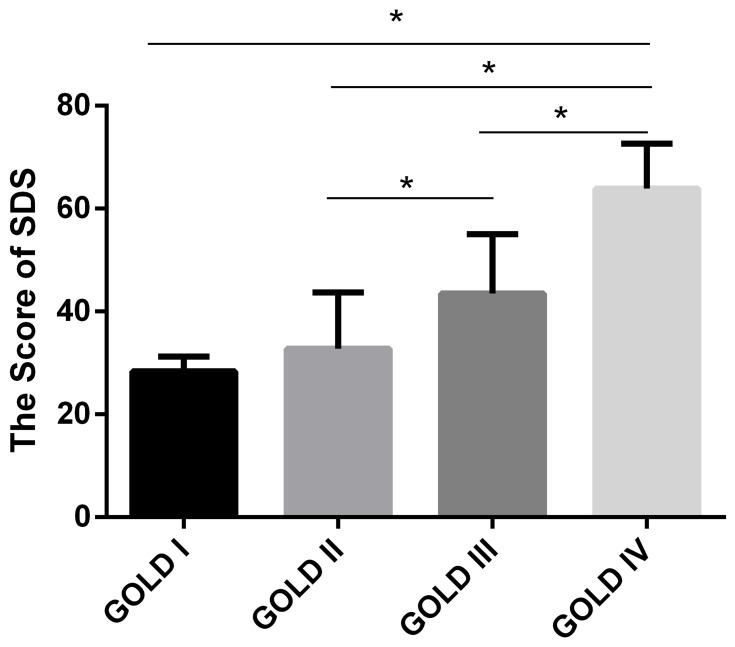
This was a prospective study, patients with stable COPD were used to develop CODEXS at the first visit, and followed up in the 3rd, 6th, and 12th months. After the last visit, patients were divided into frequent and infrequent exacerbators. Another cohort of COPD patients was used for validation. The SDS scoring system in the multidimensional indices ranged from 0 to 4 based on the modified SDS value, representing no depression (25-39 [0], 40-49 [1]), mild depression (50-59), moderate depression (60-69), and severe depression (≥70). Comorbidity, dyspnea, airflow obstruction, and severe exacerbations were calculated according to CODEX thresholds.
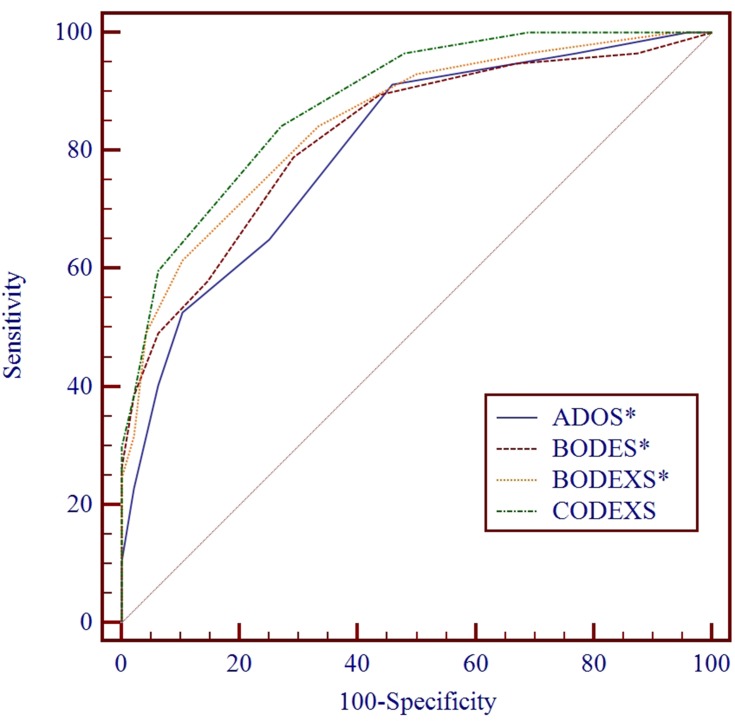
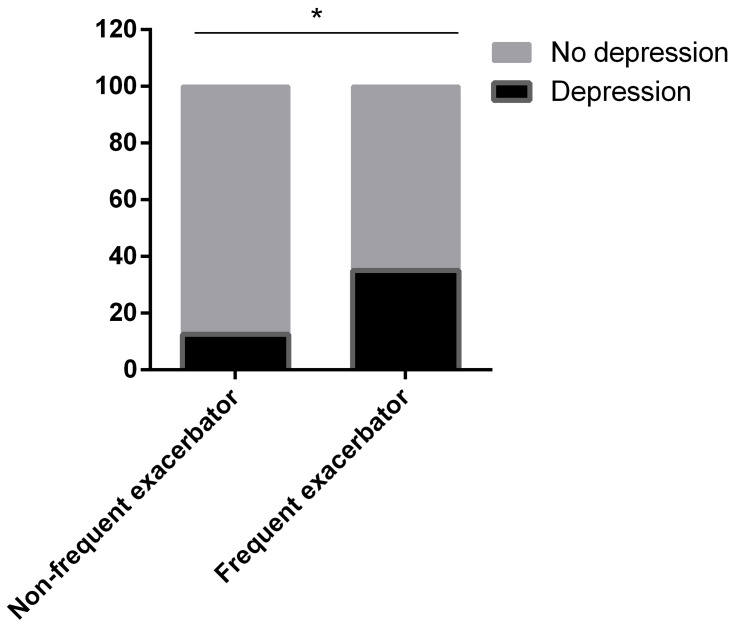
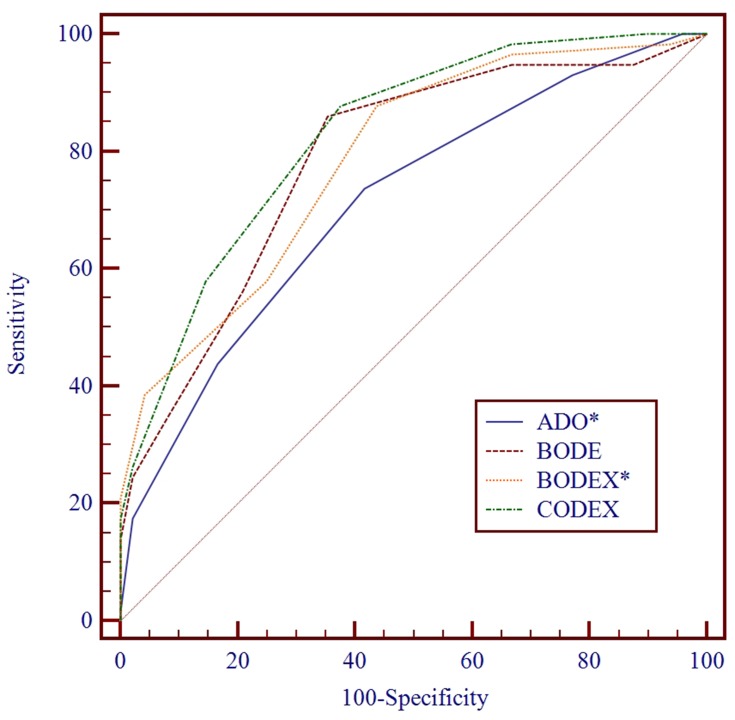
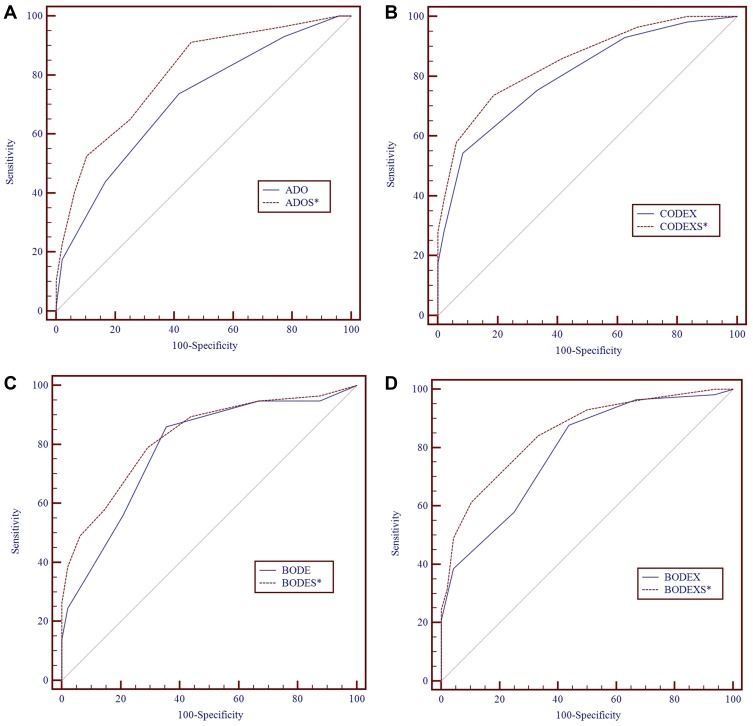
Two sets of 105 and 107 patients were recruited in the development and validation cohorts, respectively. Depression was demonstrated as an independent risk factor for frequent exacerbators (odds ratio (OR)= 1.14, 95% confidence interval (CI) = 1.06-1.23, < 0.001). The prevalence of depression in frequent exacerbators (35.09%) was higher than that in infrequent exacerbators. CODEXS was significantly associated with exacerbation (OR =2.91; 95% CI, 1.89-4.48, <0.001). Receiver operating characteristic (ROC) curve comparison showed that CODEXS was superior to BODEX(BMI, airflow obstruction, dyspnea, previous exacerbation), BODE (BMI, airflow obstruction, dyspnea, exercise), and updated ADO (age, dyspnea, and airflow obstruction) indices, confirmed by the validation cohort with sensitivity at 85.94% and specificity at 76.74%.
Depression is an independent risk factor for COPD exacerbation. CODEXS is a useful predictor for predicting frequent exacerbators within 1 year and is superior to other previously published indices.
据报道,抑郁症与慢性阻塞性肺疾病(COPD)有关。然而,迄今为止,还没有多维指标将抑郁症纳入其中来预测 COPD 患者的预后。本研究旨在确定一种新的多维指数 CODEXS,该指数基于共病、气流阻塞、呼吸困难、既往加重和通过自评抑郁量表(SDS)评估的抑郁情况,是否可以预测 1 年的加重情况。
这是一项前瞻性研究,在首次就诊时使用稳定的 COPD 患者来开发 CODEXS,并在第 3、6 和 12 个月进行随访。在最后一次就诊后,患者被分为频繁加重者和不频繁加重者。另一批 COPD 患者用于验证。多维指标中的 SDS 评分系统根据改良 SDS 值范围为 0 至 4,代表无抑郁(25-39 [0],40-49 [1])、轻度抑郁、中度抑郁、重度抑郁和严重抑郁(≥70)。根据 CODEX 阈值计算共病、呼吸困难、气流阻塞和严重加重的情况。
分别在开发和验证队列中招募了两组 105 名和 107 名患者。抑郁被证明是频繁加重的独立危险因素(比值比(OR)=1.14,95%置信区间(CI)=1.06-1.23,<0.001)。频繁加重者的抑郁患病率(35.09%)高于不频繁加重者。CODES 与加重显著相关(OR=2.91;95%CI,1.89-4.48,<0.001)。接受者操作特征(ROC)曲线比较显示,CODES 优于 BODEX(BMI、气流阻塞、呼吸困难、既往加重)、BODE(BMI、气流阻塞、呼吸困难、运动)和更新的 ADO(年龄、呼吸困难和气流阻塞)指数,通过验证队列得到验证,其敏感性为 85.94%,特异性为 76.74%。
抑郁是 COPD 加重的独立危险因素。CODES 是预测 1 年内频繁加重的有用预测指标,优于其他先前发表的指数。