Zhuang Yuan, Yuan Bao-Ying, Hu Yong, Chen Gen-Wen, Zhang Li, Zhao Xiao-Mei, Chen Yi-Xing, Zeng Zhao-Chong
Department of Radiation Oncology, Zhongshan Hospital, Fudan University, Shanghai, People's Republic of China.
Cancer Manag Res. 2019 Dec 31;11:10929-10937. doi: 10.2147/CMAR.S231901. eCollection 2019.
The neutrophil-to-lymphocyte ratio (NLR) and platelet-to-lymphocyte ratio (PLR) are inflammatory indexes that may reflect immune response to tumors and prognosis. We investigated the prognostic values of pre-treatment and post-treatment NLR and PLR and changes in those ratios in patients with small hepatocellular carcinoma (sHCC) treated with stereotactic body radiation therapy (SBRT).
Sixty patients who received SBRT were retrospectively reviewed. NLR and PLR were calculated by division of neutrophil and platelet counts, respectively, by lymphocyte counts. Independent factors for progression-free survival (PFS) and overall survival (OS) were determined by the Kaplan-Meier method, log-rank test, and Cox multivariate regression. Hazard ratios (HRs) and 95% confidence intervals (CIs) were also calculated.
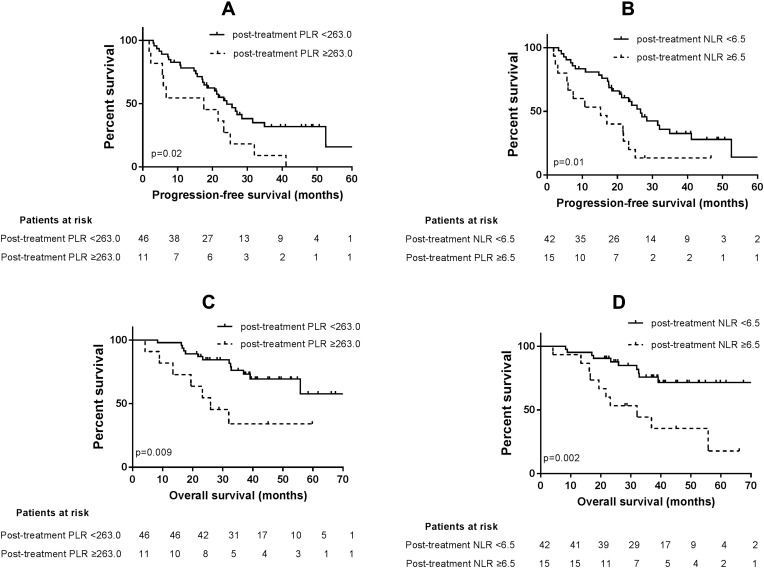
The median follow-up was 36.9 (range: 4.1-73.5) months. Median PFS was 21.4 (range: 1.8-66.9) months. The 1-year and 2-year PFS rates were 76.7% and 55.0%, respectively. The 1-year and 2-year OS rates were 95.0% and 78.3%, respectively. In multivariate analysis, post-treatment PLR ≥263.0 indicated both poor PFS (HR: 3.70; 95% CI: 1.07-12.76, =0.038) and OS (HR: 3.23; 95% CI: 1.01-9.11, =0.043) for sHCC patients treated with SBRT. In addition, the presence of hepatitis infection and a low level of red blood cell count were also proved to be significantly associated with patients' poor prognosis (<0.05 for each). Post-treatment increase in NLR ≥2.7-fold was shown to be a negative independent predictor of inferior OS (HR: 3.43; 95% CI: 1.14-10.38, =0.029).
High post-treatment PLR and change in NLR ≥2.7-fold were associated with poor prognosis in patients treated with SBRT and might be considered as reliable and independent prognostic biomarkers for patients with sHCC.
中性粒细胞与淋巴细胞比值(NLR)和血小板与淋巴细胞比值(PLR)是炎症指标,可能反映对肿瘤的免疫反应和预后。我们研究了立体定向体部放疗(SBRT)治疗的小肝细胞癌(sHCC)患者治疗前和治疗后NLR和PLR的预后价值以及这些比值的变化。
回顾性分析60例接受SBRT治疗的患者。NLR和PLR分别通过中性粒细胞计数和血小板计数除以淋巴细胞计数来计算。采用Kaplan-Meier法、对数秩检验和Cox多因素回归确定无进展生存期(PFS)和总生存期(OS)的独立因素。还计算了风险比(HRs)和95%置信区间(CIs)。
中位随访时间为36.9(范围:4.1 - 73.5)个月。中位PFS为21.4(范围:1.8 - 66.9)个月。1年和2年PFS率分别为76.7%和55.0%。1年和2年OS率分别为95.0%和78.3%。多因素分析显示,对于接受SBRT治疗的sHCC患者,治疗后PLR≥263.0表明PFS(HR:3.70;95%CI:1.07 - 12.76,P = 0.038)和OS(HR:3.23;95%CI:1.01 - 9.11,P = 0.043)均较差。此外,肝炎感染的存在和红细胞计数低也被证明与患者的不良预后显著相关(每项P<0.05)。治疗后NLR升高≥2.7倍被证明是OS较差的负性独立预测因素(HR:3.43;95%CI:1.14 - 10.38,P = 0.029)。
治疗后高PLR和NLR变化≥2.7倍与接受SBRT治疗的患者不良预后相关,可能被视为sHCC患者可靠的独立预后生物标志物。