Hsiang Chih-Weim, Huang Wen-Yen, Yang Jen-Fu, Shen Po-Chien, Dai Yang-Hong, Wang Ying-Fu, Lin Chun-Shu, Chang Wei-Chou, Lo Cheng-Hsiang
Department of Radiology, Tri-Service General Hospital, National Defense Medical Center, Taipei, Taiwan.
Department of Radiation Oncology, Tri-Service General Hospital, National Defense Medical Center, Taipei, Taiwan.
J Hepatocell Carcinoma. 2021 Oct 29;8:1299-1309. doi: 10.2147/JHC.S334933. eCollection 2021.
Immune response to antitumor therapies has been correlated with oncologic outcomes. This study aimed to determine whether dynamic changes in immune parameters could predict survival outcomes and assess their relationship with liver toxicity in hepatocellular carcinoma (HCC) patients treated with stereotactic body radiation therapy (SBRT).
Data on pre- and post-SBRT (within 3 months) peripheral blood cell counts, neutrophil-to-lymphocyte ratio (NLR), and platelet-to-lymphocyte ratio (PLR) were retrospectively collected. Kinetic changes in these immune parameters and delta-NLR (dNLR) and delta-PLR (dPLR) in response to SBRT were evaluated. Overall survival (OS) and progression-free survival (PFS) were compared based on baseline NLR/PLR and dNLR/dPLR. Additionally, the association of these dynamic measures with liver toxicity was determined.
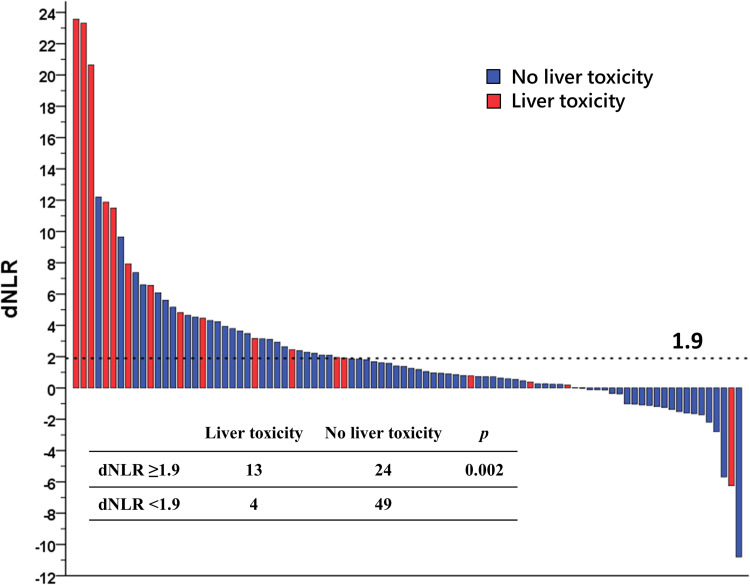
The study included 93 patients with a median 10.7-month follow-up. Significant increases in NLR (<0.001) and PLR (=0.003) were observed after SBRT. In the multivariable analysis, elevated pre-SBRT NLR (<0.001) and dNLR (=0.011) were predictive of worse OS. dNLR was not associated with PFS. Neither PLR nor dPLR was predictive of survival outcomes. Patients with Child-Turcotte-Pugh class B had higher dNLR and greater risk of liver toxicity than class A counterparts. Receiver operating characteristic curve analysis found that dNLR ≥1.9 was an optimal cut-off value for determining liver toxicity risk (35.1% vs 7.5%, =0.002).
Baseline NLR and dNLR can complementarily predict OS in HCC patients treated with SBRT. Elevated dNLR is associated with worse OS and development of liver toxicity, possibly through their relationship with baseline liver function. Dynamic changes in NLR should be monitored in HCC care.
抗肿瘤治疗的免疫反应与肿瘤学结局相关。本研究旨在确定免疫参数的动态变化是否可预测生存结局,并评估其与接受立体定向体部放射治疗(SBRT)的肝细胞癌(HCC)患者肝毒性的关系。
回顾性收集SBRT前及SBRT后(3个月内)外周血细胞计数、中性粒细胞与淋巴细胞比值(NLR)及血小板与淋巴细胞比值(PLR)的数据。评估这些免疫参数的动力学变化以及对SBRT反应的NLR变化值(dNLR)和PLR变化值(dPLR)。根据基线NLR/PLR和dNLR/dPLR比较总生存期(OS)和无进展生存期(PFS)。此外,确定这些动态指标与肝毒性的关联。
该研究纳入93例患者,中位随访时间为10.7个月。SBRT后观察到NLR(<0.001)和PLR(=0.003)显著升高。在多变量分析中,SBRT前NLR升高(<0.001)和dNLR(=0.011)可预测较差的OS。dNLR与PFS无关。PLR和dPLR均不能预测生存结局。Child-Turcotte-Pugh B级患者的dNLR较高,肝毒性风险高于A级患者。受试者工作特征曲线分析发现,dNLR≥1.9是确定肝毒性风险的最佳临界值(35.1%对7.5%,=0.002)。
基线NLR和dNLR可互补预测接受SBRT的HCC患者的OS。dNLR升高与较差的OS和肝毒性的发生相关,可能是通过它们与基线肝功能的关系。在HCC治疗中应监测NLR的动态变化。