Division of Cancer Epidemiology and Genetics, National Cancer Institute, Bethesda, MD, USA.
Nell Hodgson Woodruff School of Nursing, Emory University, Atlanta, GA, USA.
Cancer Causes Control. 2020 Apr;31(4):309-320. doi: 10.1007/s10552-020-01280-6. Epub 2020 Feb 25.
Disentangling the effects of endogenous estrogens and inflammation on obesity-related diseases requires a clearer understanding of how the two biological mechanisms relate to each other.
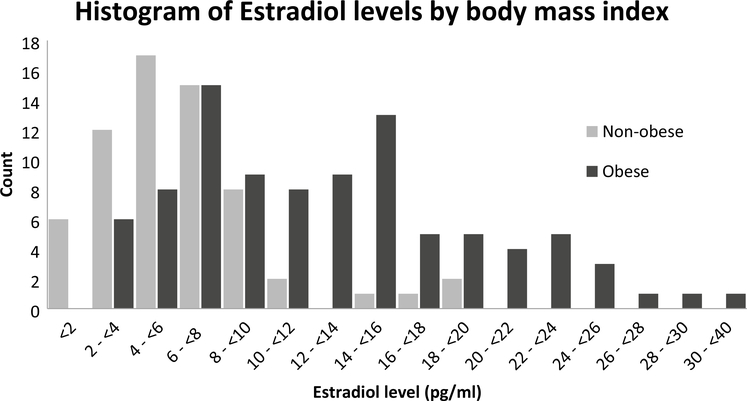
We studied 155 healthy postmenopausal women not taking menopausal hormone therapy enrolled in the Prostate Lung Colorectal and Ovarian (PLCO) screening cancer trial. From a baseline blood draw, we measured endogenous estradiol and 69 inflammation biomarkers: cytokines, chemokines, adipokines, angiogenic factors, growth factors, acute phase proteins, and soluble receptors. We evaluated the estradiol-inflammation relationship by assessing associations across different models (linear, ordinal logistic, and binary logistic) using a variety of estradiol classifications. We additionally investigated the estradiol-inflammation relationship stratified by baseline obesity status (BMI < 30 stratum and BMI > 30 stratum).
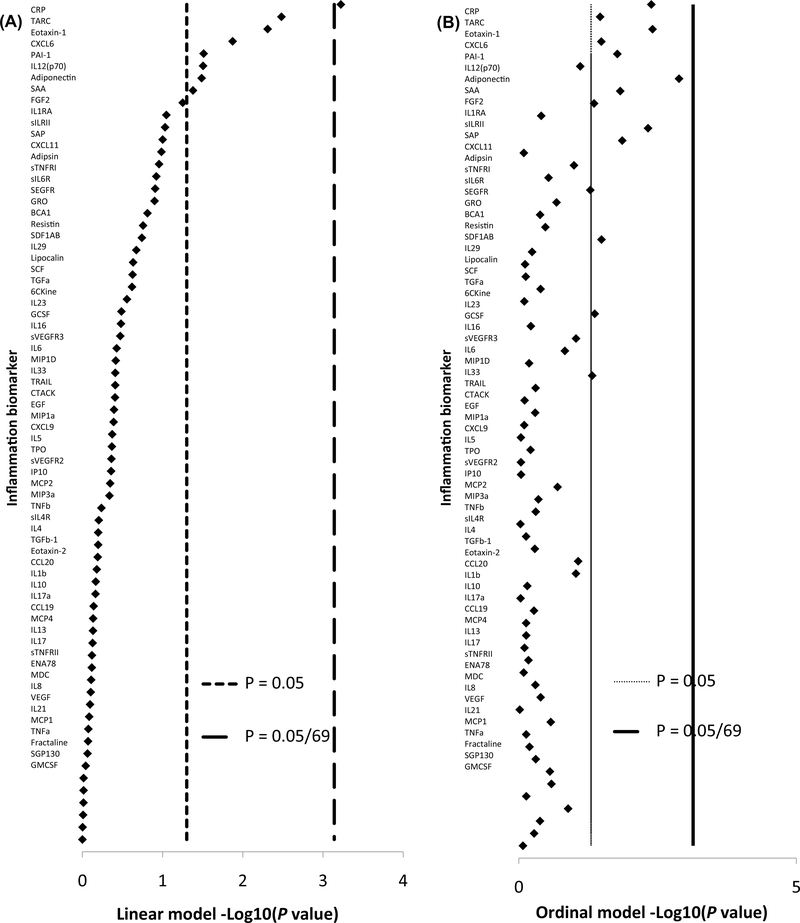
Associations of estradiol with 7 inflammation biomarkers met p < 0.05 statistical significance in linear and ordinal models: C-reactive protein (CRP), adiponectin, chemokine (C-X-C motif) ligand-6, thymus activation-regulated chemokine, eosinophil chemotactic protein, plasminogen activator inhibitor-1, and serum amyloid A. The positive association between estradiol and CRP was robust to model changes. Each standard deviation increase in endogenous estradiol doubled a woman's odds of having CRP levels higher than the study median (odds ratio 2.29; 95% confidence interval 1.28, 4.09). Estradiol was consistently inversely associated with adiponectin. Other estradiol-inflammation biomarker associations were not robust to model changes.
Endogenous estradiol appears to be associated with CRP and adiponectin; the evidence is limited for other inflammation biomarkers.
要厘清内源性雌激素和炎症对肥胖相关疾病的影响,就需要更清楚地了解这两种生物机制之间的相互关系。
我们研究了 155 名未接受更年期激素治疗的健康绝经后女性,这些女性参加了前列腺、肺、结肠和卵巢(PLCO)癌症筛查试验。我们从基线血样中测量了内源性雌二醇和 69 种炎症生物标志物:细胞因子、趋化因子、脂肪因子、血管生成因子、生长因子、急性期蛋白和可溶性受体。我们通过使用多种雌二醇分类方法,在不同模型(线性、有序逻辑和二元逻辑)中评估关联,评估了雌二醇-炎症之间的关系。我们还根据基线肥胖状况(BMI<30 分层和 BMI>30 分层)对雌二醇-炎症关系进行了分层分析。
在线性和有序模型中,雌二醇与 7 种炎症生物标志物的关联具有统计学意义(p<0.05):C 反应蛋白(CRP)、脂联素、趋化因子(C-X-C 基序)配体-6、胸腺激活调节趋化因子、嗜酸性粒细胞趋化蛋白、纤溶酶原激活物抑制剂-1 和血清淀粉样蛋白 A。雌二醇与 CRP 之间的正相关关系在模型改变后仍然存在。内源性雌二醇每增加一个标准差,女性 CRP 水平高于研究中位数的可能性就会增加一倍(优势比 2.29;95%置信区间 1.28,4.09)。雌二醇与脂联素呈负相关。其他雌二醇-炎症生物标志物的关联在模型改变后并不稳健。
内源性雌二醇似乎与 CRP 和脂联素有关;其他炎症生物标志物的证据有限。