Division of Infectious Diseases, Department of Medicine, Johns Hopkins University School of Medicine, Baltimore, MD, United States of America.
Vaccine and Gene Therapy Institute, Oregon Health and Science University, Portland, OR, United States of America.
PLoS One. 2020 Feb 26;15(2):e0229570. doi: 10.1371/journal.pone.0229570. eCollection 2020.
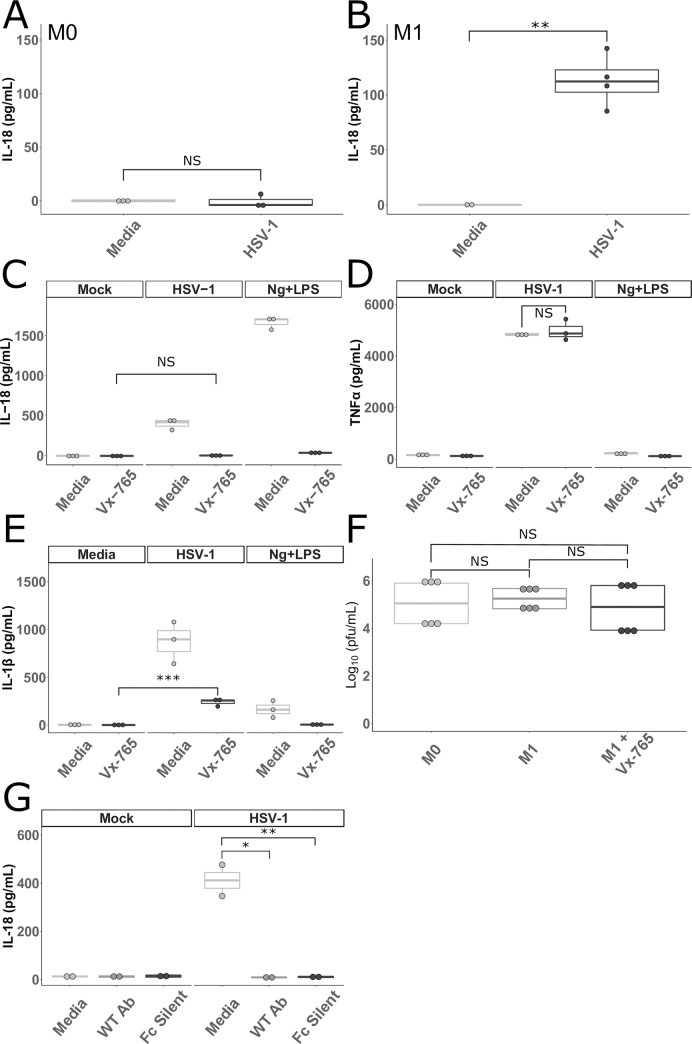
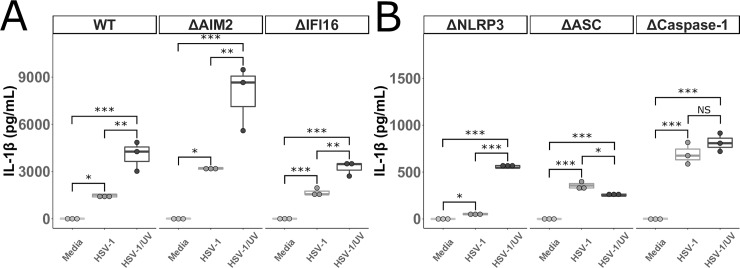
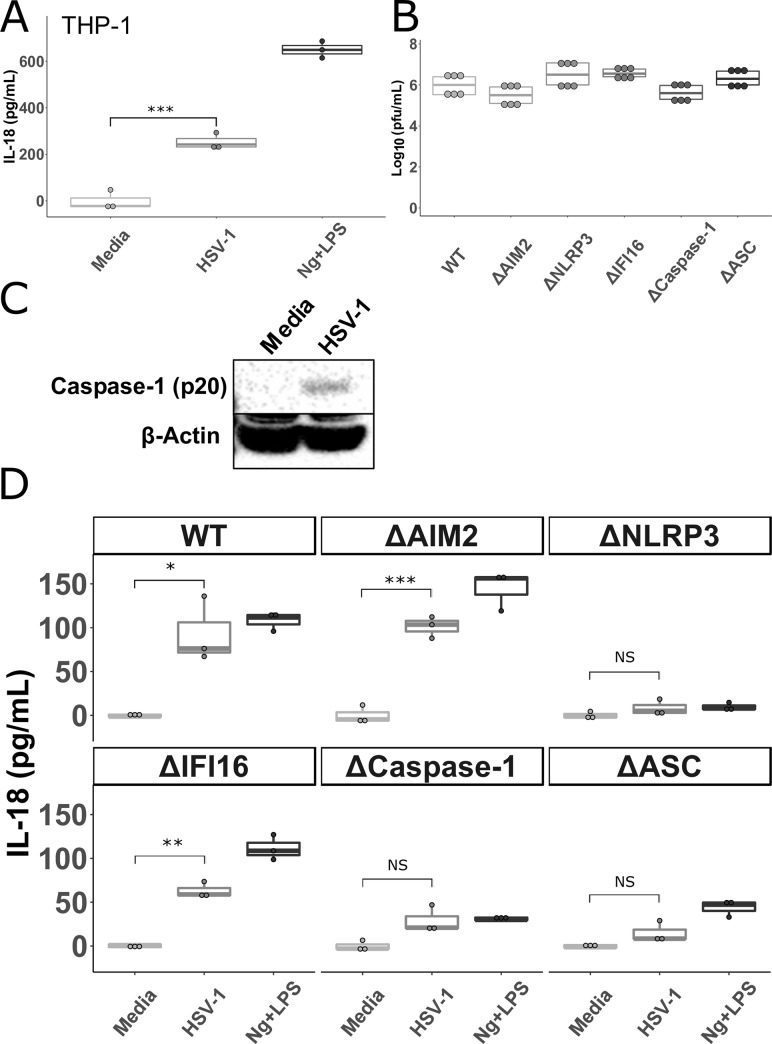
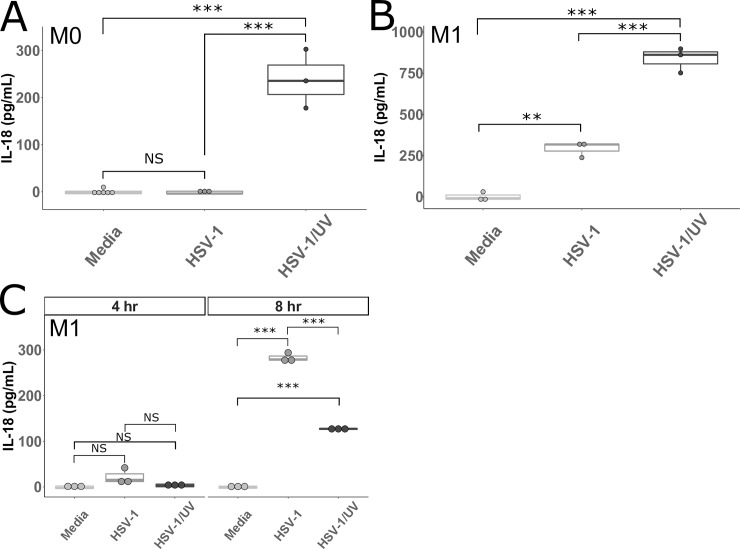
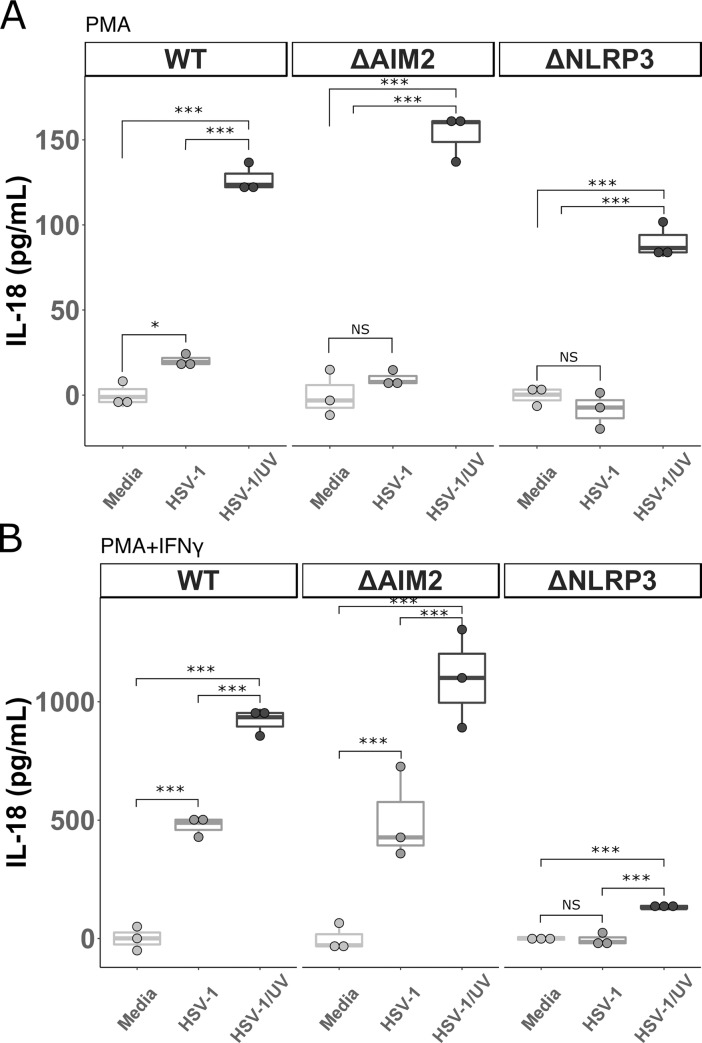
The proinflammatory cytokines interleukin (IL)-1β and IL-18 are products of activation of the inflammasome, an innate sensing system, and important in the pathogenesis of herpes simplex virus type 1 (HSV-1). The release of IL-18 and IL-1β from monocytes/macrophages is critical for protection from HSV-1 based on animal models of encephalitis and genital infection, yet if and how HSV-1 activates inflammasomes in human macrophages is unknown. To investigate this, we utilized both primary human monocyte derived macrophages and human monocytic cell lines (THP-1 cells) with various inflammasome components knocked-out. We found that HSV-1 activates inflammasome signaling in proinflammatory primary human macrophages, but not in resting macrophages. Additionally, HSV-1 inflammasome activation in THP-1 cells is dependent on nucleotide-binding domain and leucine-rich repeat-containing receptor 3 (NLRP3), apoptosis-associated speck-like molecule containing a caspase recruitment domain (ASC), and caspase-1, but not on absent in melanoma 2 (AIM2), or gamma interferon-inducible protein 16 (IFI16). In contrast, HSV-1 activates non-canonical inflammasome signaling in proinflammatory macrophages that results in IL-1β, but not IL-18, release that is independent of NLRP3, ASC, and caspase-1. Ultraviolet irradiation of HSV-1 enhanced inflammasome activation, demonstrating that viral replication suppresses inflammasome activation. These results confirm that HSV-1 is capable of activating the inflammasome in human macrophages through an NLRP3 dependent process and that the virus has evolved an NLRP3 specific mechanism to inhibit inflammasome activation in macrophages.
促炎细胞因子白细胞介素 (IL)-1β 和 IL-18 是炎症小体激活的产物,炎症小体是一种先天感应系统,在单纯疱疹病毒 1 型 (HSV-1) 的发病机制中起重要作用。基于脑炎和生殖器感染的动物模型,单核细胞/巨噬细胞中 IL-18 和 IL-1β 的释放对于抵抗 HSV-1 至关重要,但 HSV-1 如何以及是否在人类巨噬细胞中激活炎症小体尚不清楚。为了研究这一点,我们利用原代人单核细胞衍生的巨噬细胞和具有各种炎症小体成分缺失的人单核细胞系 (THP-1 细胞)。我们发现 HSV-1 在促炎原代人巨噬细胞中激活炎症小体信号,但在静止巨噬细胞中不激活。此外,THP-1 细胞中 HSV-1 炎症小体的激活依赖于核苷酸结合域和富含亮氨酸重复序列的受体 3 (NLRP3)、含有半胱氨酸蛋白酶募集结构域的凋亡相关斑点样蛋白 (ASC) 和半胱天冬酶-1,但不依赖于黑色素瘤 2 (AIM2) 或干扰素诱导蛋白 16 (IFI16)。相比之下,HSV-1 在促炎巨噬细胞中激活非经典炎症小体信号,导致 IL-1β 而非 IL-18 的释放,这与 NLRP3、ASC 和 caspase-1 无关。HSV-1 的紫外线照射增强了炎症小体的激活,表明病毒复制抑制了炎症小体的激活。这些结果证实 HSV-1 能够通过依赖 NLRP3 的过程激活人巨噬细胞中的炎症小体,并且病毒已经进化出一种 NLRP3 特异性机制来抑制巨噬细胞中的炎症小体激活。