Department of Paediatrics and Metabolic Center, University Hospitals Leuven, Leuven, Belgium.
Department of Development and Regeneration, KU Leuven, Leuven, Belgium.
Genet Med. 2020 Jun;22(6):1102-1107. doi: 10.1038/s41436-020-0767-8. Epub 2020 Feb 27.
We studied galactose supplementation in SLC35A2-congenital disorder of glycosylation (SLC35A2-CDG), caused by monoallelic pathogenic variants in SLC35A2 (Xp11.23), encoding the endoplasmic reticulum (ER) and Golgi UDP-galactose transporter. Patients present with epileptic encephalopathy, developmental disability, growth deficiency, and dysmorphism.
Ten patients with SLC35A2-CDG were supplemented with oral D-galactose for 18 weeks in escalating doses up to 1.5 g/kg/day. Outcome was assessed using the Nijmegen Pediatric CDG Rating Scale (NPCRS, ten patients) and by glycomics (eight patients).
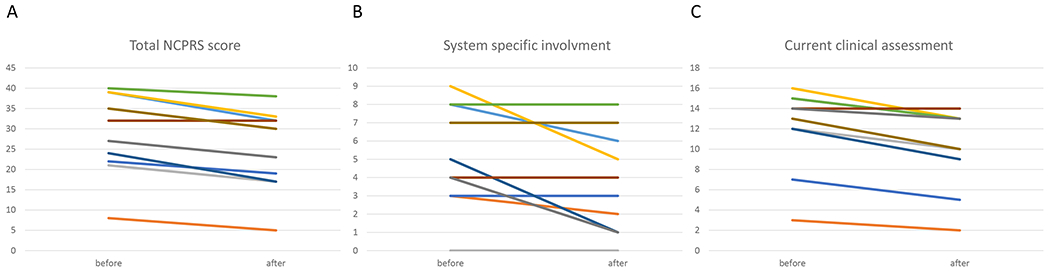
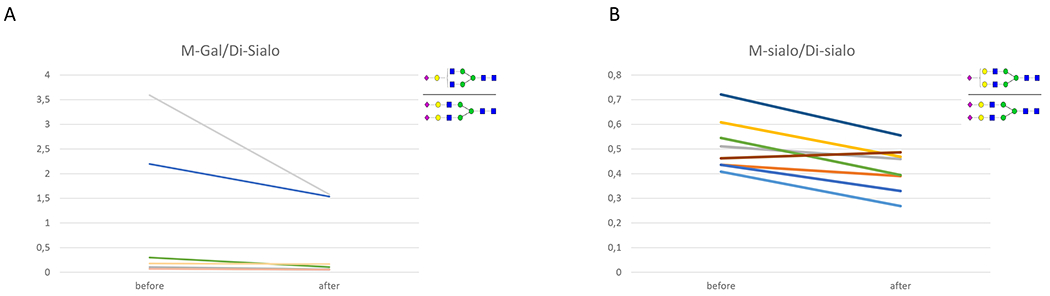
SLC35A2-CDG patients demonstrated improvements in overall Nijmegen Pediatric CDG Rating Scale (NPCRS) score (P = 0.008), the current clinical assessment (P = 0.007), and the system specific involvement (P = 0.042) domains. Improvements were primarily in growth and development with five patients resuming developmental progress, which included postural control, response to stimuli, and chewing and swallowing amelioration. Additionally, there were improvements in gastrointestinal symptoms and epilepsy. One patient in our study did not show any clinical improvement. Galactose supplementation improved patients' glycosylation with decreased ratios of incompletely formed to fully formed glycans (M-gal/disialo, P = 0.012 and monosialo/disialo, P = 0.017) and increased levels of a fully galactosylated N-glycan (P = 0.05).
Oral D-galactose supplementation results in clinical and biochemical improvement in SLC35A2-CDG. Galactose supplementation may partially overcome the Golgi UDP-galactose deficiency and improves galactosylation. Oral galactose is well tolerated and shows promise as dietary therapy.
我们研究了半乳糖补充治疗 SLC35A2-先天性糖基化障碍(SLC35A2-CDG)的效果,这种疾病由 SLC35A2 单等位基因突变引起(Xp11.23),该基因编码内质网(ER)和高尔基体 UDP-半乳糖转运蛋白。患者表现为癫痫性脑病、发育障碍、生长缺陷和畸形。
10 名 SLC35A2-CDG 患者接受口服 D-半乳糖治疗,18 周内剂量逐渐增加至 1.5g/kg/天。采用 Nijmegen 儿科 CDG 评分量表(NPCRS,10 例患者)和糖组学(8 例患者)评估疗效。
SLC35A2-CDG 患者的总体 Nijmegen 儿科 CDG 评分量表(NPCRS)评分(P=0.008)、当前临床评估(P=0.007)和系统特异性受累(P=0.042)均有改善。改善主要集中在生长和发育方面,5 例患者恢复了发育进展,包括姿势控制、对刺激的反应以及咀嚼和吞咽能力的改善。此外,胃肠道症状和癫痫也有改善。我们的研究中有 1 例患者没有显示任何临床改善。半乳糖补充治疗可改善患者的糖基化,减少不完全形成的聚糖与完全形成的聚糖的比值(M-半乳糖/二唾液酸,P=0.012 和单唾液酸/二唾液酸,P=0.017),并增加完全半乳糖化的 N-聚糖水平(P=0.05)。
口服 D-半乳糖补充治疗可改善 SLC35A2-CDG 患者的临床和生化指标。半乳糖补充治疗可能部分纠正高尔基体 UDP-半乳糖缺乏,并改善半乳糖化。口服半乳糖耐受性良好,有望成为饮食疗法。