Nancy E. and Peter C. Meinig School of Biomedical Engineering, Cornell University, Ithaca, NY, USA.
Fidia Farmaceutici S.p.A., Padua, Italy.
Osteoarthritis Cartilage. 2020 Apr;28(4):492-501. doi: 10.1016/j.joca.2020.02.029. Epub 2020 Feb 24.
Viscosupplementation has been used for decades to treat mild to moderate osteoarthritis, yet it is unknown if the lubricating function of different pathological synovial fluids (SF) vary, or if they respond differentially to viscosupplementation. The objectives of this study were to (i) evaluate the friction coefficients and induced shear strains in articular cartilage when lubricated with pathological SF, (ii) identify the effect of hyaluronic acid (HA) supplementation on friction coefficients and shear strains, and (iii) identify SF biomarkers that correlate with lubricating function.
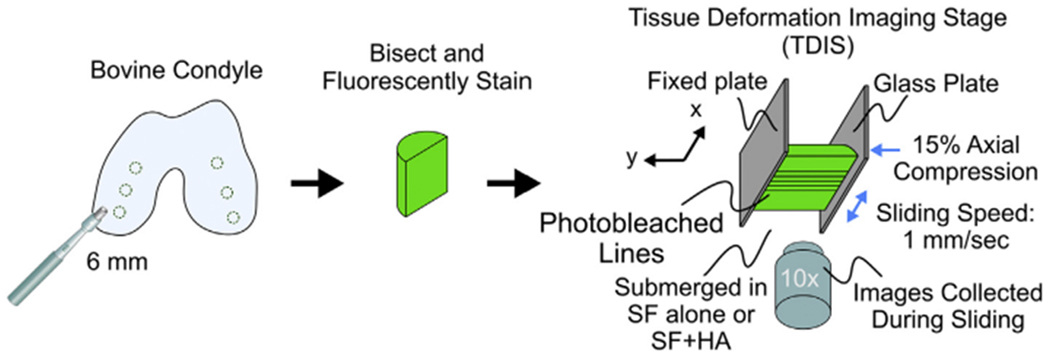
Human pathological SF was grouped by white blood cell count (inflammatory: >2000 cells/mm, n = 6; non-inflammatory: <2000 cells/mm, n = 6). Compositional analyses for lubricin and cytokines were performed. Friction coefficients and local tissue shear strain measurements were coupled using new, microscale rheological analyses by lubricating neonatal bovine cartilage explants with SF alone and in a 1:1 ratio with HA (Hymovis®).
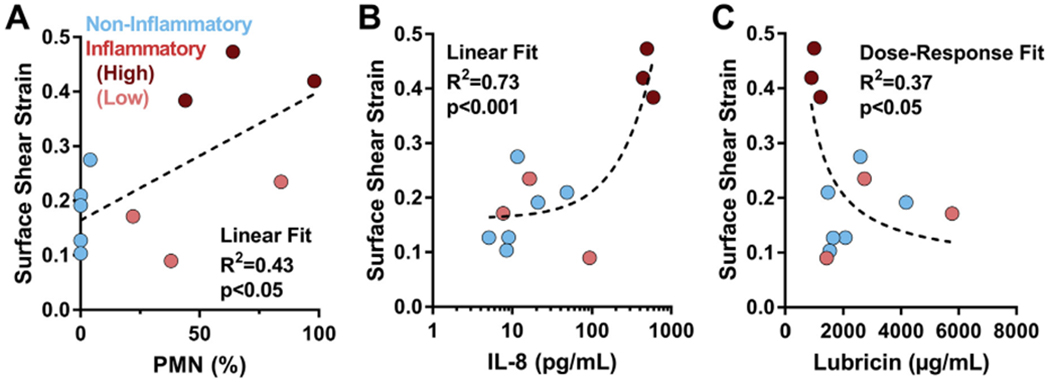
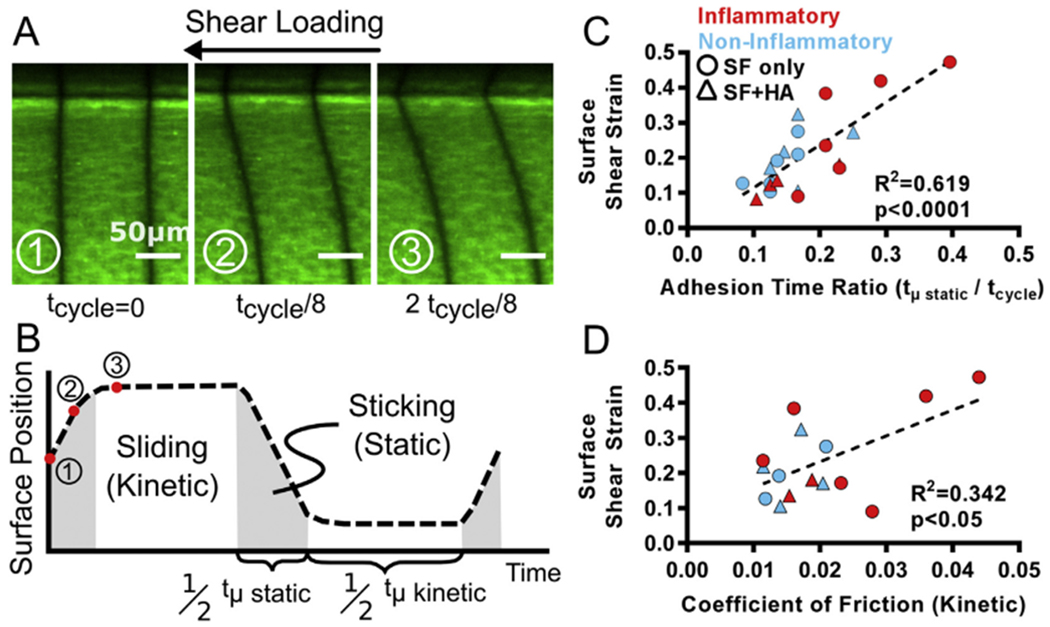
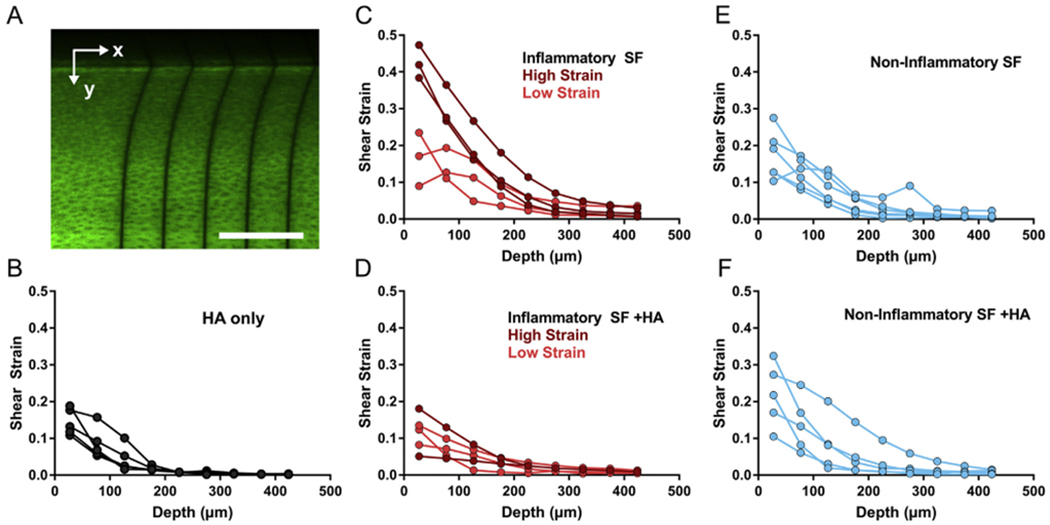
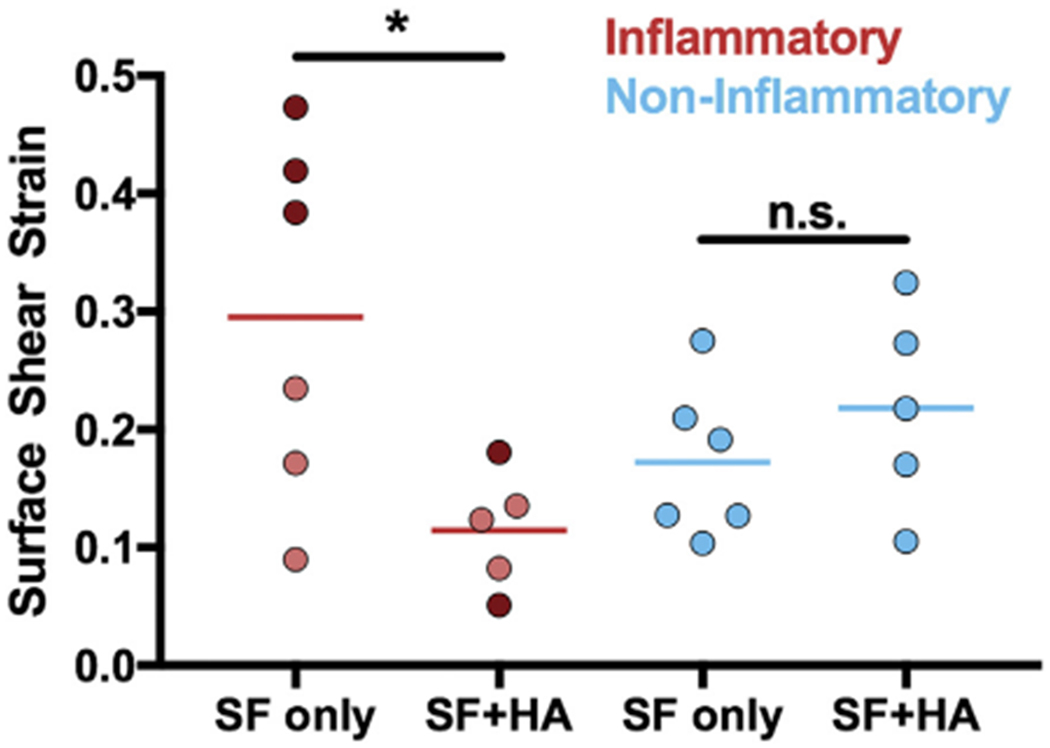
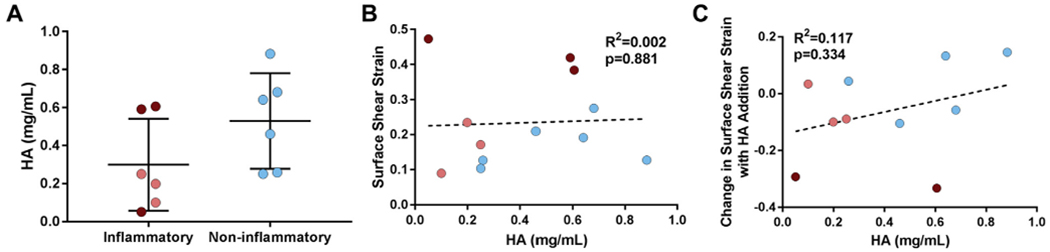
Friction coefficients were not significantly different between the inflammatory and non-inflammatory pathologies (p = 0.09), and were poorly correlated with peak tissue strains at the cartilage articular surface (R = 0.34). A subset of inflammatory SF samples induced higher tissue strains, and HA supplementation was most effective at lowering friction and tissue strains in this inflammatory subset. Across all pathologies there were clear relationships between polymorphonuclear neutrophil (PMN), IL-8, and lubricin concentrations with cartilage tissue strains.
These results suggest that pathological SF is characterized by distinct tribological endotypes where SF lubricating behaviors are differentially modified by viscosupplementation and are identifiable by biomarkers.
几十年来,黏弹性补充剂一直被用于治疗轻度至中度骨关节炎,但尚不清楚不同病理滑膜液(SF)的润滑功能是否不同,或者它们对黏弹性补充剂的反应是否不同。本研究的目的是:(i)评估关节软骨在病理 SF 润滑时的摩擦系数和诱导剪切应变,(ii)确定透明质酸(HA)补充对摩擦系数和剪切应变的影响,以及(iii)确定与润滑功能相关的 SF 生物标志物。
根据白细胞计数(炎症:>2000 个细胞/mm3,n=6;非炎症:<2000 个细胞/mm3,n=6)将人病理 SF 进行分组。进行了润滑素和细胞因子的组成分析。使用新的微尺度流变学分析方法,通过 SF 单独和与 HA(Hymovis®)以 1:1 比例润滑新生牛软骨外植体,对摩擦系数和局部组织剪切应变进行了耦合测量。
炎症和非炎症病理之间的摩擦系数没有显著差异(p=0.09),并且与软骨关节表面的峰值组织应变相关性较差(R=0.34)。一部分炎症 SF 样本诱导了更高的组织应变,并且 HA 补充在这种炎症亚群中最有效地降低摩擦和组织应变。在所有病理中,PMN、IL-8 和润滑素浓度与软骨组织应变之间都存在明确的关系。
这些结果表明,病理 SF 的特点是具有不同的摩擦学表型,其中 SF 的润滑行为通过黏弹性补充剂得到不同程度的修饰,并且可以通过生物标志物来识别。