imec-Vision Lab, Department of Physics, University of Antwerp, Antwerp, Belgium.
Department of Orthopaedics, Sint Maartenskliniek, Woerden, The Netherlands.
PLoS One. 2020 Feb 27;15(2):e0229685. doi: 10.1371/journal.pone.0229685. eCollection 2020.
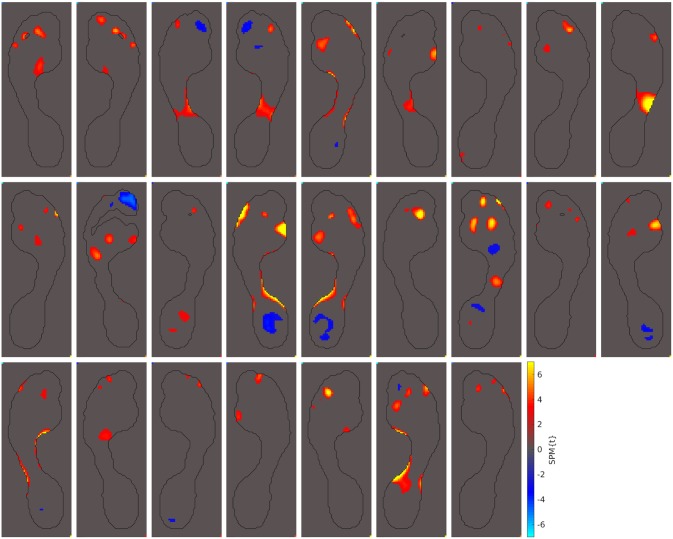
Quantitative analyses of plantar pressure images typically occur at the group level and under the assumption that individuals within each group display homogeneous pressure patterns. When this assumption does not hold, a personalized analysis technique is required. Yet, existing personalized plantar pressure analysis techniques work at the image level, leading to results that can be unintuitive and difficult to interpret. To address these limitations, we introduce PAPPI: the Personalized Analysis of Plantar Pressure Images. PAPPI is built around the statistical modelling of the relationship between plantar pressures in healthy controls and their demographic characteristics. This statistical model then serves as the healthy baseline to which an individual's real plantar pressures are compared using statistical parametric mapping. As a proof-of-concept, we evaluated PAPPI on a cohort of 50 hallux valgus patients. PAPPI showed that plantar pressures from hallux valgus patients did not have a single, homogeneous pattern, but instead, 5 abnormal pressure patterns were observed in sections of this population. When comparing these patterns to foot pain scores (i.e. Foot Function Index, Manchester-Oxford Foot Questionnaire) and radiographic hallux angle measurements, we observed that patients with increased pressure under metatarsal 1 reported less foot pain than other patients in the cohort, while patients with abnormal pressures in the heel showed more severe hallux valgus angles and more foot pain. Also, incidences of pes planus were higher in our hallux valgus cohort compared to the modelled healthy controls. PAPPI helped to clarify recent discrepancies in group-level plantar pressure studies and showed its unique ability to produce quantitative, interpretable, and personalized analyses for plantar pressure images.
足底压力图像的定量分析通常在群体水平上进行,并假设每个群体中的个体显示出同质的压力模式。当这种假设不成立时,就需要采用个性化的分析技术。然而,现有的个性化足底压力分析技术是在图像水平上进行的,导致结果可能不直观且难以解释。为了解决这些限制,我们引入了 PAPPI:足底压力图像的个性化分析。PAPPI 围绕着健康对照组足底压力与其人口统计学特征之间关系的统计建模构建。然后,该统计模型作为健康基线,使用统计参数映射将个体的实际足底压力与之进行比较。作为概念验证,我们在 50 名踇外翻患者的队列中评估了 PAPPI。PAPPI 表明,踇外翻患者的足底压力没有单一、同质的模式,而是在该人群的某些部位观察到 5 种异常压力模式。当将这些模式与足部疼痛评分(即足部功能指数、曼彻斯特-牛津足部问卷)和放射学踇外翻角度测量值进行比较时,我们观察到第一跖骨下压力增加的患者比队列中的其他患者报告的足部疼痛更少,而足跟处压力异常的患者则表现出更严重的踇外翻角度和更多的足部疼痛。此外,与建模的健康对照组相比,我们的踇外翻队列中扁平足的发生率更高。PAPPI 有助于澄清群体水平足底压力研究中的近期差异,并展示了其为足底压力图像生成定量、可解释和个性化分析的独特能力。