Prata A T, Folch A, Prata A J, Biondi R, Brenot H, Cimarelli C, Corradini S, Lapierre J, Costa A
Barcelona Supercomputing Center, Computer Applications in Science and Engineering, Barcelona, Spain.
AIRES Pty. Ltd., Mt Eliza, Victoria, Australia.
Sci Rep. 2020 Feb 27;10(1):3584. doi: 10.1038/s41598-020-60465-w.
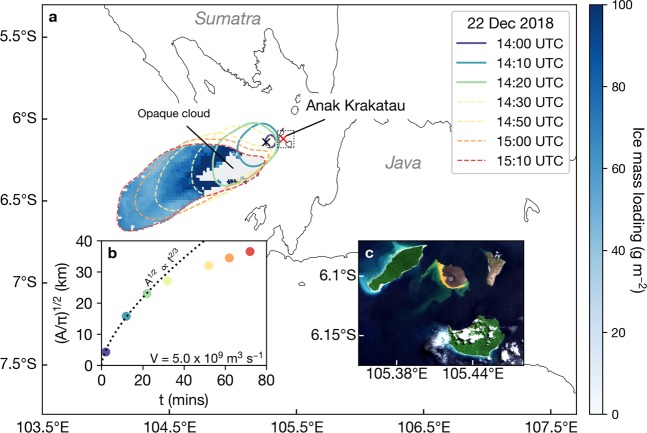
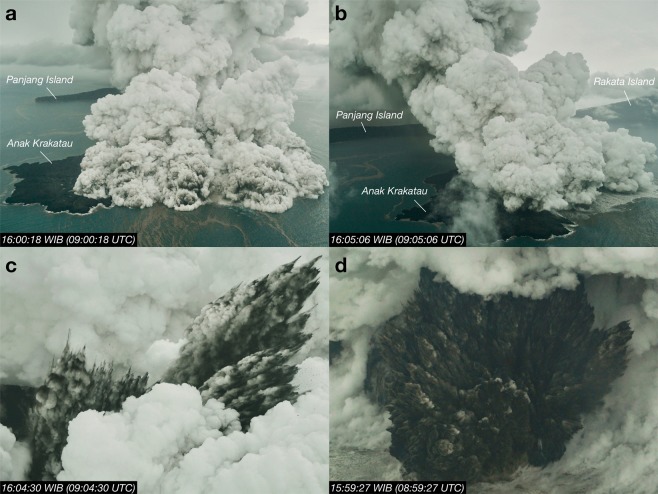
Volcanic activity occurring in tropical moist atmospheres can promote deep convection and trigger volcanic thunderstorms. These phenomena, however, are rarely observed to last continuously for more than a day and so insights into the dynamics, microphysics and electrification processes are limited. Here we present a multidisciplinary study on an extreme case, where volcanically-triggered deep convection lasted for six days. We show that this unprecedented event was caused and sustained by phreatomagmatic activity at Anak Krakatau volcano, Indonesia during 22-28 December 2018. Our modelling suggests an ice mass flow rate of 5 × 10 kg/s for the initial explosive eruption associated with a flank collapse. Following the flank collapse, a deep convective cloud column formed over the volcano and acted as a 'volcanic freezer' containing ~3 × 10 kg of ice on average with maxima reaching ~10 kg. Our satellite analyses reveal that the convective anvil cloud, reaching 16-18 km above sea level, was ice-rich and ash-poor. Cloud-top temperatures hovered around -80 °C and ice particles produced in the anvil were notably small (effective radii ~20 µm). Our analyses indicate that vigorous updrafts (>50 m/s) and prodigious ice production explain the impressive number of lightning flashes (100,000) recorded near the volcano from 22 to 28 December 2018. Our results, together with the unique dataset we have compiled, show that lightning flash rates were strongly correlated (R = 0.77) with satellite-derived plume heights for this event.
热带潮湿大气中发生的火山活动可促进强烈对流并引发火山雷暴。然而,这些现象很少被观测到持续超过一天,因此对其动力学、微物理学和起电过程的了解有限。在此,我们针对一个极端案例进行了多学科研究,该案例中由火山引发的强烈对流持续了六天。我们表明,这一前所未有的事件是由印度尼西亚喀拉喀托之子火山在2018年12月22日至28日期间的岩浆水汽喷发活动引起并维持的。我们的模型表明,与侧翼坍塌相关的初始爆发性喷发的冰质量流率约为5×10⁶千克/秒。侧翼坍塌后,火山上空形成了一个深厚的对流云柱,它就像一个“火山冷冻库”,平均含有约3×10⁶千克的冰,最大值达到约10⁶千克。我们的卫星分析显示,对流砧状云高达海平面以上16 - 18千米,富含冰而贫含灰分。云顶温度徘徊在 -80°C左右,砧状云中产生的冰粒子明显很小(有效半径约20微米)。我们的分析表明,强烈的上升气流(>50米/秒)和大量的冰生成解释了2018年12月22日至28日在火山附近记录到的惊人数量的闪电(约100,000次)。我们的结果以及我们汇编的独特数据集表明,对于该事件,闪电发生率与卫星反演的羽流高度密切相关(R = 0.77)。