Research Center of Basic Medical Sciences, School of Basic Medical Sciences, Hubei University of Science and Technology, Xianning, 437100, China.
Department of Pharmacology, Hubei University of Science and Technology, Xianning, 437100, China.
Acta Pharmacol Sin. 2020 Aug;41(8):1049-1057. doi: 10.1038/s41401-019-0348-z. Epub 2020 Feb 27.
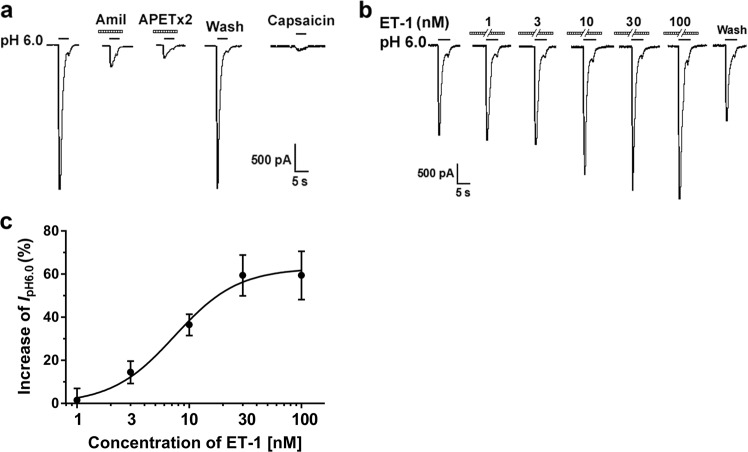
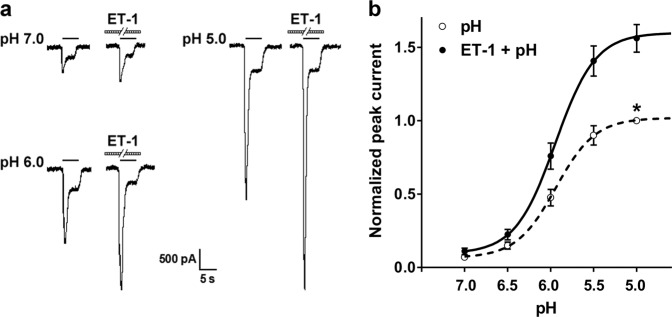
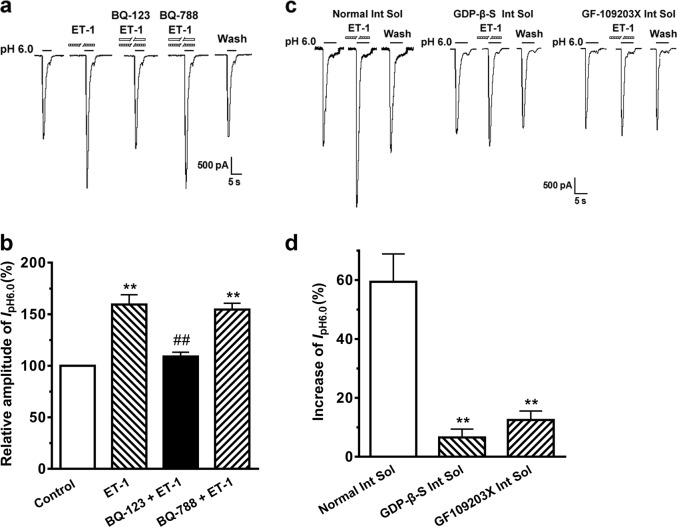
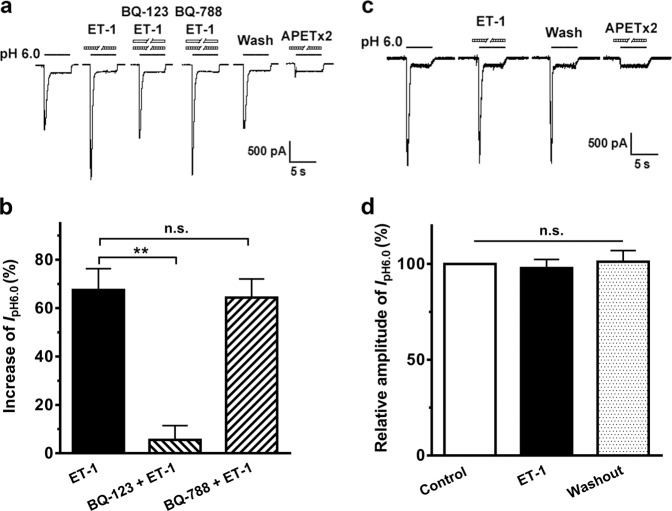
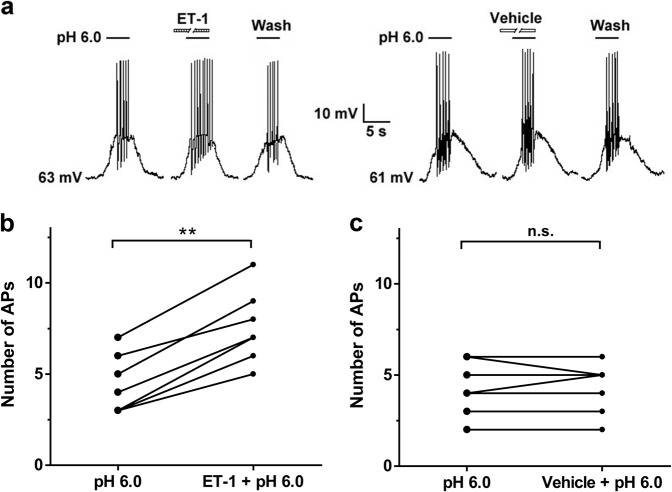
Endothelin-1 (ET-1), an endogenous vasoactive peptide, has been found to play an important role in peripheral pain signaling. Acid-sensing ion channels (ASICs) are key sensors for extracellular protons and contribute to pain caused by tissue acidosis. It remains unclear whether an interaction exists between ET-1 and ASICs in primary sensory neurons. In this study, we reported that ET-1 enhanced the activity of ASICs in rat dorsal root ganglia (DRG) neurons. In whole-cell voltage-clamp recording, ASIC currents were evoked by brief local application of pH 6.0 external solution in the presence of TRPV1 channel blocker AMG9810. Pre-application with ET-1 (1-100 nM) dose-dependently increased the proton-evoked ASIC currents with an EC value of 7.42 ± 0.21 nM. Pre-application with ET-1 (30 nM) shifted the concentration-response curve of proton upwards with a maximal current response increase of 61.11% ± 4.33%. We showed that ET-1 enhanced ASIC currents through endothelin-A receptor (ETR), but not endothelin-B receptor (ETR) in both DRG neurons and CHO cells co-expressing ASIC3 and ETR. ET-1 enhancement was inhibited by blockade of G-protein or protein kinase C signaling. In current-clamp recording, pre-application with ET-1 (30 nM) significantly increased acid-evoked firing in rat DRG neurons. Finally, we showed that pharmacological blockade of ASICs by amiloride or APETx2 significantly alleviated ET-1-induced flinching and mechanical hyperalgesia in rats. These results suggest that ET-1 sensitizes ASICs in primary sensory neurons via ETR and PKC signaling pathway, which may contribute to peripheral ET-1-induced nociceptive behavior in rats.
内皮素-1(ET-1)是一种内源性血管活性肽,已被发现在外周疼痛信号传递中发挥重要作用。酸敏离子通道(ASICs)是细胞外质子的关键传感器,有助于组织酸中毒引起的疼痛。目前尚不清楚 ET-1 和 ASICs 是否在初级感觉神经元中存在相互作用。在这项研究中,我们报告 ET-1 增强了大鼠背根神经节(DRG)神经元中 ASICs 的活性。在全细胞膜片钳记录中,在 TRPV1 通道阻断剂 AMG9810 的存在下,通过短暂局部应用 pH 6.0 的外部溶液来诱发 ASIC 电流。预应用 ET-1(1-100 nM)剂量依赖性地增加质子诱发的 ASIC 电流,EC 值为 7.42 ± 0.21 nM。预应用 ET-1(30 nM)使质子浓度反应曲线向上移位,最大电流反应增加 61.11%±4.33%。我们表明,ET-1 通过内皮素-A 受体(ETR)而不是内皮素-B 受体(ETR)增强 DRG 神经元和共表达 ASIC3 和 ETR 的 CHO 细胞中的 ASIC 电流。ET-1 增强作用被 G 蛋白或蛋白激酶 C 信号通路的阻断所抑制。在电流钳记录中,预应用 ET-1(30 nM)显著增加了大鼠 DRG 神经元的酸诱发放电。最后,我们表明,用阿米洛利或 APETx2 药理学阻断 ASICs 可显著减轻大鼠 ET-1 诱导的畏缩和机械性痛觉过敏。这些结果表明,ET-1 通过 ETR 和 PKC 信号通路使初级感觉神经元中的 ASICs 敏感化,这可能有助于大鼠外周 ET-1 诱导的伤害性行为。